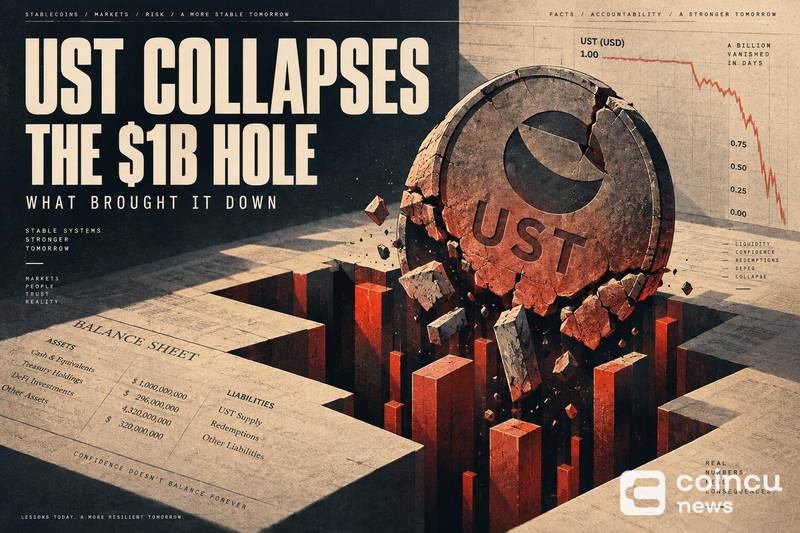
UST, the algorithmic stablecoin underpinning the Terra blockchain, collapsed in May 2022 after a liquidity gap that regulators and analysts later described as exceeding $1 billion in reserve
UST, the algorithmic stablecoin underpinning the Terra blockchain, collapsed in May 2022 after a liquidity gap that regulators and analysts later described as exceeding $1 billion in reserve shortfall, triggering a reflexive death spiral between UST and its sister token LUNA that wiped tens of billions of dollars in market value within days.
What the $1 Billion Shortfall Actually Measured
UST was not backed by cash or treasuries. Its peg to the dollar rested on an arbitrage mechanism: when UST traded below $1, users could burn UST to mint $1 worth of LUNA, theoretically restoring demand. The system held as long as LUNA retained sufficient market value to absorb redemptions, but the gap between outstanding UST supply and the liquid market cap of LUNA supporting it represented a latent solvency risk, not merely a liquidity mismatch. For related coverage, see Why Is Pepe (PEPE) Price Surging Today? Key Drivers Explained.
The $1 billion figure identified in post-mortem analysis refers to the scale at which coordinated selling pressure exhausted the protocol's stabilization capacity, per CoinDesk's reconstruction of the collapse sequence. Once redemption volume exceeded what the LUNA mint mechanism could absorb without diluting LUNA's price, a feedback loop activated: more UST sold, more LUNA was minted, LUNA's price fell, reducing its capacity to backstop further UST redemptions. For related coverage, see ZWTC 2026 Enters Squad Stage as Zoomex Opens Registration for Competition With Up to 2.5 Million USDT in Prizes.
How the Collapse Unfolded: The Feedback Loop
Large withdrawals from Anchor Protocol, which had been offering ~20% yields on UST deposits and holding the majority of UST's circulating supply, began draining liquidity in the days before the terminal depeg. As UST slipped from $1, the arbitrage mechanism that was supposed to correct the peg instead accelerated LUNA inflation, according to CoinDesk reporting on the mechanics. For related coverage, see Polymarket Lobbies Europe for MiFID Prediction Market Rules.
Within roughly 72 hours, LUNA's price collapsed from above $80 to fractions of a cent. UST, meanwhile, fell to as low as $0.10, far from its $1 target. The Luna Foundation Guard, which had accumulated Bitcoin reserves as an emergency backstop, deployed those reserves in an attempt to defend the peg; the intervention proved insufficient against the scale of outflows.
Contagion Channels Beyond Terra
The collapse transmitted stress to the broader crypto market through several identifiable channels. Funds and protocols holding UST or LUNA as treasury assets faced immediate mark-to-zero losses. Lending protocols that had accepted LUNA as collateral triggered liquidations as its price fell, while liquidity providers in UST trading pairs across decentralized exchanges absorbed asymmetric losses. Broader crypto markets sold off sharply in the days following the depeg, with the episode becoming one of the most cited examples of financing and collateral fragility in digital asset markets.
The SEC subsequently took enforcement action against Terraform Labs and its co-founder Do Kwon, as documented in an SEC press release, alleging that UST and LUNA were sold as unregistered securities and that investors were misled about the stability of the peg mechanism.
Risk Signals the Collapse Made Visible
Three structural vulnerabilities, each identifiable before the collapse, combined to make the failure catastrophic rather than recoverable. First, the stabilization mechanism was reflexive: the asset meant to defend UST's peg (LUNA) lost value precisely when defense demand was highest. Second, the Anchor Protocol yield was subsidized rather than organic, concentrating UST supply in a single venue and creating a single point of withdrawal risk. Third, reserve transparency was limited; the Bitcoin backstop's size relative to outstanding UST was not publicly verifiable in real time.
For evaluating any algorithmic or undercollateralized stablecoin, the UST episode establishes a practical checklist: the redemption mechanism should not rely on an asset whose value is endogenous to the stablecoin itself; yield should be traceable to real protocol revenue rather than subsidies; and reserve adequacy should be verifiable on-chain against total supply, not disclosed selectively. The episode also demonstrated how confidence-driven bank-run dynamics, well understood in traditional finance, apply with greater velocity in permissionless systems where institutional capital can exit without operational friction.
FAQ: UST Collapse and the $1 Billion Shortfall
What was UST?
UST (TerraUSD) was an algorithmic stablecoin on the Terra blockchain, designed to maintain a $1 peg through a mint-and-burn mechanism linked to LUNA, Terra's native token, rather than through direct dollar reserves.
What was the $1 billion hole?
The figure represents the scale of the reserve gap between the market value of LUNA available to absorb UST redemptions and the volume of UST that began exiting the system, per post-collapse analysis. It marked the threshold at which the stabilization mechanism could no longer restore the peg without hyperinflating LUNA supply.
Why did UST lose its stability?
The mint mechanism created a reflexive loop: selling UST required minting more LUNA, which diluted LUNA's price, which reduced its capacity to backstop further UST redemptions, which prompted more UST selling. The cycle accelerated faster than any intervention could interrupt, as detailed in CoinDesk's collapse analysis.
Did the collapse affect other crypto markets?
Yes. Contagion spread through liquidations of LUNA-backed loans, losses on UST liquidity positions, and a broader confidence shock. Several crypto lenders and funds that held UST or LUNA subsequently disclosed material losses in the weeks following the depeg.
What stablecoin-risk lessons remain?
Regulators, including the SEC per its 2024 enforcement action, have pointed to UST as evidence that algorithmic stablecoins require clearer disclosure of reserve mechanics and redemption limits. The episode remains the primary reference case for why peg design, collateral endogeneity, and yield sustainability must be assessed independently before treating any stablecoin peg as guaranteed.
Disclaimer: This article is for informational purposes only and does not constitute financial or investment advice. Cryptocurrency and digital asset markets carry significant risk. Always do your own research before making decisions.
The post UST Collapses: The $1 Billion Hole That Brought It Down was initially published on Coincu.