The U.S. Securities and Exchange Commission secured one of the largest enforcement outcomes in crypto history against Terraform Labs and its co-founder Do Kwon, pursuing billions in penalties
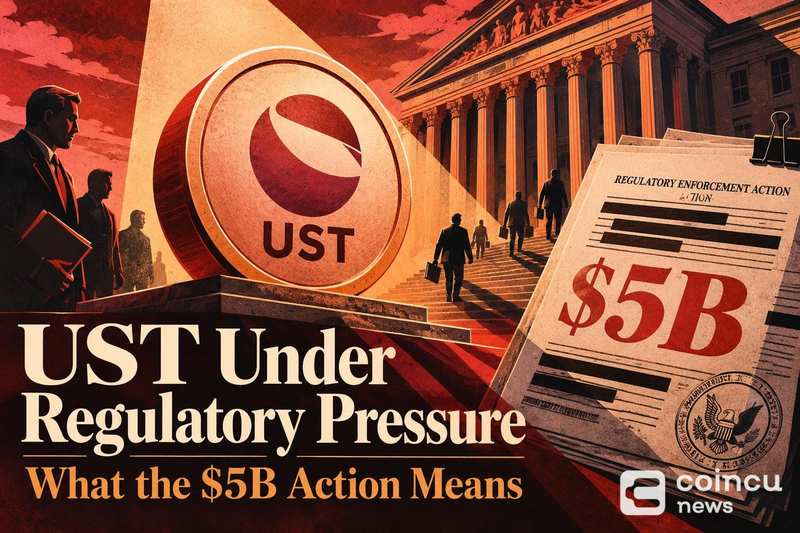
The U.S. Securities and Exchange Commission secured one of the largest enforcement outcomes in crypto history against Terraform Labs and its co-founder Do Kwon, pursuing billions in penalties tied to the algorithmic stablecoin UST and its paired token LUNA, a collapse that erased roughly $40 billion in market value in May 2022 and reoriented global regulatory attention toward stablecoin issuers. The action, detailed across SEC press releases in 2024, carries implications that extend well beyond the named parties.
The SEC filed charges against Terraform Labs PTE Ltd. and Do Hyeong Kwon alleging they orchestrated a multi-billion-dollar fraud through the unregistered offer and sale of crypto asset securities, including UST, LUNA, wLUNA, and MIR tokens, according to the SEC's enforcement announcement. The agency characterized UST not as a simple payment stablecoin but as a security, a legal determination that carries significant consequences for how algorithmic stablecoin issuers must structure their operations going forward. For related coverage, see UST Under Regulatory Pressure: What the $3.3B Action Means.
The SEC alleged that Terraform and Kwon misled investors about UST's stability mechanism and the adoption of the Chai payment application on the Terra blockchain, claiming that real-world usage underpinned UST's peg when, according to the agency, that was not the case. The regulator also alleged that Kwon secretly arranged a $1 billion bailout with a market maker to defend UST's peg during a 2021 depeg event, without disclosing that intervention to investors who were led to believe the algorithmic mechanism had restored stability on its own. For related coverage, see UST Under Regulatory Pressure: The $35.1M Action Explained.
A second SEC press release from 2024 addressed further aspects of the enforcement proceedings as the case moved through U.S. District Court in the Southern District of New York, one of the federal venues with the most active crypto enforcement dockets. For related coverage, see Bybit Secures Dubai Regulatory Approval: What It Means.
The combined disgorgement, prejudgment interest, and civil penalties sought in the Terraform action reached into the billions of dollars, with the case representing one of the most aggressive financial recovery efforts the SEC has mounted against a crypto project. The approximately $5 billion figure cited in regulatory reporting encompasses the full scope of alleged investor harm and ill-gotten gains that the SEC sought to claw back, not merely a single fine component. For related coverage, see Future Leaders Awards & Conference 2026 to Bring Global Business and Technology Leaders to Singapore on 2–3 November.
This outcome significantly exceeds earlier enforcement milestones against the same project, signaling that the SEC's litigation strategy in crypto has matured toward seeking penalties commensurate with the full market impact of alleged fraud rather than symbolic fines. The trajectory also invites comparison with large-scale regulatory outcomes affecting other major crypto platforms, where headline penalty figures have progressively grown as regulators calibrate enforcement to investor harm rather than nominal violation categories.
Terraform Labs filed for Chapter 11 bankruptcy protection in January 2024, months before the civil trial concluded, complicating the actual recovery of funds for harmed investors. The bankruptcy filing does not extinguish the SEC's civil claims but affects the practical distribution of any eventual recovery, a distinction that holders of LUNA Classic (LUNC) and other Terra ecosystem tokens will need to track through the bankruptcy court proceedings running parallel to the SEC case.
Why the SEC Classified UST as a Security
The SEC's legal theory rested on the Howey test, the four-part investment contract framework derived from a 1946 Supreme Court case. The agency argued that buyers of UST, LUNA, and MIR tokens were investing money in a common enterprise with an expectation of profits derived from the efforts of Terraform and Kwon, satisfying all four prongs of Howey. This classification is contested by much of the crypto industry, which has argued that algorithmic stablecoins and proof-of-stake tokens function more like commodities or currencies than investment contracts.
The court's acceptance of the SEC's securities framing in the Terraform case established a precedent that other algorithmic stablecoin projects are now actively working to navigate. Unlike collateralized stablecoins such as USDC or USDT, which hold dollar-denominated reserves, UST maintained its peg through an algorithmic mint-and-burn mechanism tied to LUNA, a design that the SEC characterized as inherently reliant on the managerial and promotional efforts of the founding team. That characterization, if applied broadly, would place most yield-bearing or algorithmically governed stablecoins under securities law.
Do Kwon's Legal Status and the Extradition Dimension
Do Kwon was arrested in Montenegro in March 2023 while allegedly traveling on fraudulent documents. His extradition became a prolonged legal dispute between the United States and South Korea, both of which filed competing extradition requests, as Montenegro's courts worked through which jurisdiction had priority. The extradition proceedings ran concurrently with the SEC civil case and separate criminal charges filed by the U.S. Department of Justice, which accused Kwon of wire fraud, commodities fraud, securities fraud, and money laundering conspiracy.
The parallel DOJ criminal track means that even a full civil resolution with the SEC would leave Kwon facing potential federal prison time in the United States, a dimension that distinguishes the Terraform case from typical regulatory settlements where a fine and industry bar represent the ceiling of personal consequences.
For holders of LUNA Classic (LUNC) and the relaunched LUNA 2.0 token, the SEC action creates continued legal overhang rather than a clean resolution, since the bankruptcy estate and civil penalties will compete with token holders for any residual Terraform assets. The SEC's classification of original LUNA as a security also raises questions about whether secondary market trading of LUNC on exchanges operating in the United States remains legally permissible, a question no major exchange has publicly addressed in light of the court's findings.
The broader stablecoin market absorbed the Terra collapse's first shock in May 2022, when UST lost its peg and LUNA's price fell from roughly $80 to fractions of a cent within days. The 2024 enforcement outcome adds a second-order regulatory shock: the confirmation that a stablecoin can be designated a security after the fact, based on how it was marketed and managed, regardless of its nominal function as a medium of exchange. Projects including Frax, USDD, and other partially algorithmic stablecoins have restructured their collateral models since 2022, partly in anticipation of exactly this regulatory trajectory.
The prior $3.3 billion action against UST had already flagged the scale at which regulators were willing to pursue the Terra ecosystem; the final $5 billion enforcement outcome validated that those earlier figures represented a floor, not a ceiling, for the SEC's recovery ambitions in high-profile crypto fraud cases.
The Terraform outcome intersects with the U.S. stablecoin legislative debate that accelerated through 2024 and into 2025, as Congress worked toward a federal stablecoin framework. Regulators and legislators in both chambers cited the UST collapse repeatedly as the primary evidence of why algorithmic stablecoins require either a full reserve requirement or an outright prohibition for retail issuance, a position the SEC's civil win materially reinforced.
International regulators drew parallel lessons. The European Union's Markets in Crypto-Assets regulation, which took full effect in 2024, explicitly restricts algorithmic stablecoins from being marketed as stable-value instruments without full reserve backing, a provision directly informed by the Terra collapse even though it was drafted before the SEC's enforcement action concluded. For projects seeking to operate across both U.S. and EU jurisdictions, the combined regulatory posture leaves essentially no compliant path for launching an unbacked algorithmic stablecoin at scale.
Exchanges that listed UST, LUNA, and MIR tokens without registering as securities broker-dealers also face residual exposure, since the court's findings establish that those tokens were securities during the period when most exchange listings occurred. The SEC has not announced additional exchange-focused enforcement tied to Terraform listings as of the time of this reporting, but the legal foundation for such actions now exists in the court record.
Key Dates and Procedural Milestones to Watch
The Terraform bankruptcy proceedings in the U.S. Bankruptcy Court for the District of Delaware represent the next concrete milestone for anyone with a financial stake in the estate, including potential victims seeking restitution. The bankruptcy plan confirmation and creditor distribution schedule will determine whether the SEC's civil penalty translates into any actual recovery for retail investors who lost funds in the May 2022 collapse.
Do Kwon's extradition outcome remains the most legally consequential near-term event, since his presence or absence in a U.S. courtroom will determine whether the DOJ criminal case proceeds to trial or resolves through a plea agreement. A U.S. criminal conviction would carry its own restitution order separate from the SEC civil penalty, potentially layering additional recovery mechanisms for harmed investors.
For stablecoin issuers and DeFi protocols watching the regulatory calendar, the U.S. federal stablecoin bill's progress through Congress represents the legislative response that the Terraform enforcement action was designed to accelerate. Passage of a reserve-backed stablecoin framework would effectively codify the SEC's position that unbacked algorithmic stablecoins cannot legally operate in U.S. markets, converting a litigation outcome into permanent statutory prohibition. Institutional participants across custody, lending, and structured product desks are treating that legislative timeline, rather than any further Terraform-specific proceedings, as the primary regulatory risk factor for stablecoin-adjacent positions through 2025 and 2026.
FAQ: UST and the $5 Billion Regulatory Action
What is the $5 billion action involving UST? The figure represents the combined disgorgement, prejudgment interest, and civil penalties the SEC pursued against Terraform Labs and Do Kwon in connection with the alleged fraudulent offer and sale of UST, LUNA, wLUNA, and MIR tokens, per the SEC's enforcement proceedings.
Who is named in the action? Terraform Labs PTE Ltd., a Singapore-incorporated entity, and Do Hyeong Kwon, its co-founder and former CEO, are the primary named defendants in the SEC civil case. The DOJ filed parallel criminal charges against Kwon separately.
Is the $5 billion figure a penalty, settlement, or damages claim? The figure encompasses multiple components of the SEC's recovery demand, including disgorgement of alleged ill-gotten gains and civil penalties. Terraform's Chapter 11 bankruptcy filing complicates the practical recovery of the full amount, meaning the headline figure represents what was sought and adjudicated rather than what has been distributed to harmed investors.
What could happen next? The most consequential near-term catalysts are the Terraform bankruptcy court's creditor distribution schedule, Do Kwon's extradition resolution, and U.S. Congressional action on stablecoin legislation. Each of these events will further define the legal and regulatory boundaries for algorithmic stablecoin projects operating in or serving U.S. markets, and institutional desks are treating the legislative timeline as the primary forward-looking variable.
Disclaimer: This article is for informational purposes only and does not constitute financial or investment advice. Cryptocurrency and digital asset markets carry significant risk. Always do your own research before making decisions.
The post UST Under Regulatory Pressure: What the $5B Action Means was initially published on Coincu.