How Very Network Brings Web3 Into Everyday Chat Very few people will ever check a blockchain wallet on its own. But almost everyone already has a messaging app open. That gap is what the Very
How Very Network Brings Web3 Into Everyday Chat
Very few people will ever check a blockchain wallet on its own. But almost everyone already has a messaging app open.
That gap is what the Very Network Ecosystem is built around. Instead of asking people to learn crypto first, it puts a wallet, identity verification, and token rewards inside a chat app they'd use anyway.
The project has grown into several connected pieces since development began in December 2023. Verychain is the underlying blockchain. VeryChat is the messaging app most users actually interact with. VeryPay handles payments. VeryAds is an advertising system built to help fund ongoing rewards. All four run on VERY, the network's native token.
This article covers what each piece does, how they connect, and what's confirmed versus still in progress.
What Is the Very Network Ecosystem?
Very Network describes its mission, in its own whitepaper, as making cryptocurrency more convenient and reliable enough for everyday use. That's a common goal in crypto. What's less common is the approach: instead of building a wallet app and hoping people adopt it, the team built a chat app first and buried the wallet inside it.
The ecosystem now spans four connected products. Verychain handles the blockchain layer. VeryChat is the consumer app where most activity happens. VeryPay is the payments feature built for spending VERY in the real world. VeryAds is the advertising platform that lets brands pay in VERY, which is meant to recycle real spending back into the token economy rather than relying only on new buyers.
Verychain: The Blockchain Powering the Ecosystem
Verychain is the project's own Layer 1 blockchain, referred to in official materials as Very Mainnet. It's fully EVM compatible, meaning developers who already know Ethereum's tooling, Solidity, MetaMask, Hardhat, can build on it without learning a new system from scratch.
Network security runs through a proof-of-node model. Validators run nodes, either on cloud servers like AWS or on a personal computer, and each node is tied to a Node NFT. The project sold 8,000 Node NFTs in total, though it says half of that supply, 4,000 nodes, was distributed to the community through invites, level-ups, and giveaways rather than direct sale.
Node holders earn from three sources: a share of transaction fees, a fixed ecosystem reward pool, and a cut of VeryChat's advertising revenue. According to the project's node reward policy, validators collectively receive 10% of VERY spent on both main and channel advertising, split proportionally by how many Node NFTs each person holds.
Verychat: The Core Application of Very Network
VeryChat is where almost everything in this ecosystem actually happens. The name blends "Verify," "Chat," and "Wallet," which sums up the pitch: messaging, identity checks, and a self-custody wallet in one place.
Users earn VERY through a mining mechanic the app calls planting and harvesting. Plant a "Very seed," wait 12 hours, then harvest the "fruit" it produces. Inviting friends increases mining power, and reaching higher levels inside the app can also unlock Node NFTs.
According to a project update posted on Medium in April 2026, VeryChat had crossed one million downloads. That's a meaningful adoption number for an app still built around an unlisted token, though it's a project-reported figure rather than an independently audited one.
There's a catch worth knowing before mining anything. Moving mined VERY out of the app and into a usable wallet requires completing KYC, identity verification, first. The project runs this in periodic rounds tied to wallet migration rather than opening it to everyone at once, and it has previously targeted users holding 1,000 or more VERY for initial snapshots.
VeryPay: Bringing VERY Into Payments
VeryPay is the ecosystem's answer to actually spending the token, not just earning it. The project's roadmap lists a QR-code offline payment feature under VeryPay, letting users pay merchants directly with VERY or supported stablecoins by scanning a code.
A related product, VeryWallet, is already live according to the project's own announcements. It lets users send VERY and USDT to each other using just a Verychat ID, and the project has said it offers a limited number of free USDT transfers per day on BNB Chain.
VeryPay's offline QR payment feature, by contrast, sits later on the published roadmap. It's a stated plan, not something independently confirmed to live at full scale, so treat the payments side of the ecosystem as partially built rather than finished.
VeryAds: The Advertising Layer of the Ecosystem
VeryAds is arguably the most important piece for anyone trying to judge whether VERY has real demand beyond mining and speculation.
The idea is straightforward. Brands pay for ad placements inside VeryChat using VERY. The project has pointed to its first fully VERY-paid ad campaign as an early proof point for this model. Some of that advertiser spending gets burned, permanently removed from supply, and some flows back into the ecosystem reward fund that pays node holders and channel owners.
Channel owners inside VeryChat reportedly receive 50% of the VERY spent on ads shown in their channel, giving active community builders a direct incentive tied to engagement rather than just token holding.
This is the part of the ecosystem worth watching closest. A reward system funded partly by mining and partly by advertiser demand is only sustainable if that advertiser demand actually scales. Right now, VeryAds is still in its early campaign stage, according to public reporting, so this remains a thesis being tested rather than a proven revenue engine.
VERY Token: Utility, Supply and Distribution
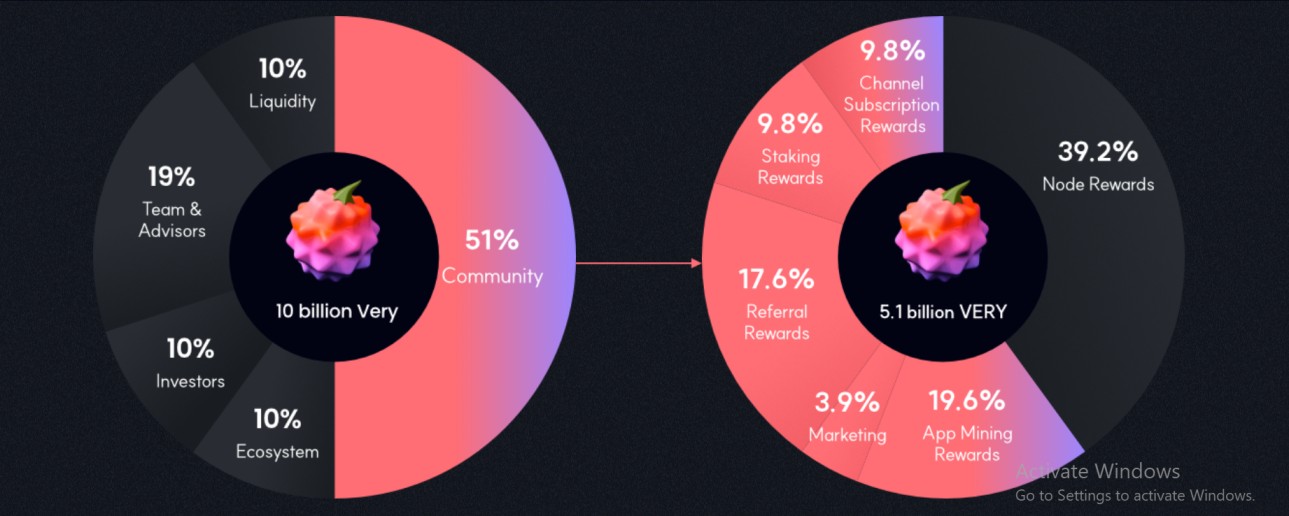
VERY has a fixed total supply of 10 billion tokens, according to the project's published tokenomics. Here's how that supply breaks down:
Allocation
Share
Amount
Purpose
Layer Node Rewards
20%
2,000,000,000
Paid to validators securing Very Mainnet
Verychat Fruit Rewards
10%
1,000,000,000
Funds in-app mining and retention
Verychat Referral Rewards
9%
900,000,000
Grows the user base through invites
Channel Subscription Rewards
5%
500,000,000
Activates and rewards VeryChat channels
Staking Rewards
5%
500,000,000
Supports liquidity providers like VerySwap
Marketing Rewards
2%
200,000,000
Funds promotion of the network and app
Finance and Ecosystem
10%
1,000,000,000
Supports dApps, partly replenished by ad spend
Investors
10%
1,000,000,000
Reserved for VC and strategic partners
Liquidity Provision
10%
1,000,000,000
Manages exchange spreads at listing
Team and Advisory
19%
1,900,000,000
Retains team and advisors long-term
Source: Official White Paper
Roughly 51% of supply sits in community-facing categories: mining, referrals, staking, channels, and node validation. That's a larger community share than many mobile-mining projects offer, though it's worth remembering that a big allocation doesn't guarantee a healthy token if the underlying user growth or advertiser demand doesn't hold up.
How the Very Network Ecosystem Works Together
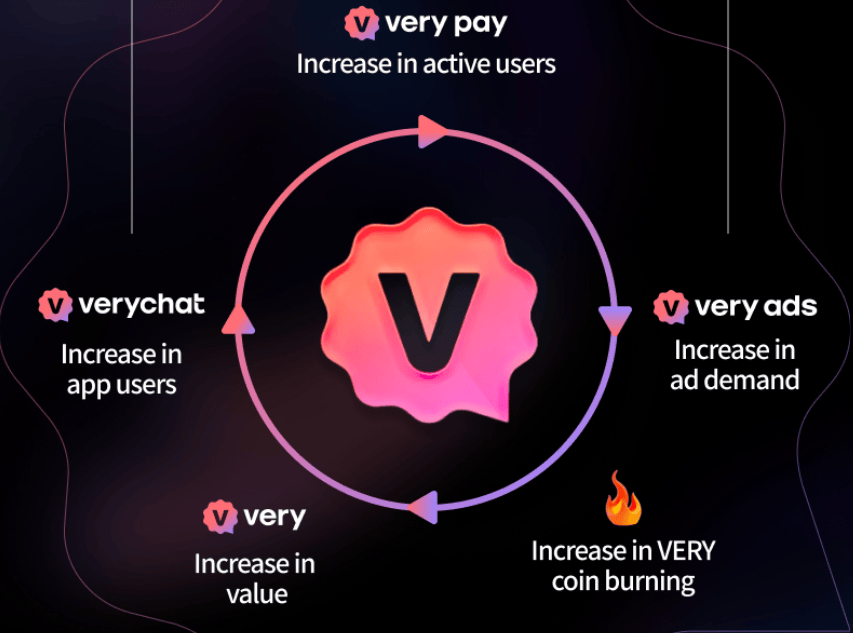
Each piece feeds the next. VeryChat generates daily engagement through mining and messaging. That engagement builds the user base VeryAds sells access to. VeryAds revenue partly burns supply and partly refunds the community reward pool. Verychain settles and secures everything underneath, with node operators earning a cut of that same ad revenue.
VeryPay is the piece meant to close the loop, giving VERY an actual spending use case rather than a mine-and-hold cycle. Until VeryPay's offline payment feature is confirmed live at scale, that closing piece remains partially theoretical.
Very Network Ecosystem Development and Roadmap
The project's published roadmap lists several near-term items: a wider rollout of the VeryAds B2B platform in Korea alongside a global Web3 version, a desktop release of VeryChat, improvements to the in-app wallet, free global stablecoin transfer fees, and a VERY burn tied to node distribution.
Further out, the roadmap lists VeryPay's QR-code offline payment launch, an NFT profile verification feature, exclusive access tiers for NFT or token holders, and an NFT collection called VERYPUNKS. The roadmap itself notes that later items are subject to "flexible updates based on market conditions," language worth taking at face value rather than as a fixed schedule.
What Makes the Very Network Ecosystem Different?
The stronger signal here is distribution strategy. Most token projects launch first and search for users second. Very Network built a consumer app that already claims over a million downloads before the token has any confirmed exchange listing, which is a different order of operations than most presale-stage projects follow.
The advertising-funded reward loop is also a genuine point of difference. Rather than relying purely on new token buyers to sustain mining rewards, the model ties a portion of long-term sustainability to whether brands actually pay to advertise inside VeryChat.
Challenges Facing the Very Network Ecosystem
The biggest unknown remains exchange access. Without a confirmed listing, VERY has no verifiable open-market price, and community-run "unofficial" trading channels carry real scam risk.
Impersonation is a separate, practical concern. Search results for VeryChat and VERY tokens surface unofficial sites and apps offering token sales or airdrops that don't appear to be affiliated with Very Labs' official channels. Anyone engaging with this ecosystem should stick to verylabs.io and wp.verylabs.io directly rather than third-party links found through search or social media.
Beyond that, the reward economy depends on continued user growth and rising VeryAds adoption. A 10-billion fixed supply with over half allocated to community rewards only holds value if enough of that supply gets absorbed by real usage rather than sold immediately once liquidity exists.
What Is the Future of the Very Network Ecosystem?
The data suggests a project that has prioritized product and user growth ahead of a token launch, which is unusual, but not necessarily a stronger or weaker strategy on its own. The main concern is timing: a large mined and referred community waiting on KYC migration and an eventual listing creates pent-up supply that could move quickly once trading opens.
Whether VeryAds can generate enough recurring advertiser demand to meaningfully offset that supply is the single number worth tracking most closely over the next few quarters.
Conclusion
The Very Network ecosystem ties together a blockchain, a chat app, a payments layer, and an advertising system around one token, with VeryChat as the main entry point. Verychain, the Node NFT structure, and VeryWallet are live, and VeryAds has started running real advertiser-paid campaigns.
What's still uncertain is whether VeryPay's full rollout lands as planned, how fast VeryAds adoption grows, and whether VERY ever secures a confirmed exchange listing. Readers should check the official whitepaper and verylabs.io directly before treating any of this as settled
Disclaimer:
This article is for informational purposes only and does not constitute financial or investment advice. Cryptocurrency markets are volatile and carry risk of loss, and readers should independently verify all project claims before taking any action.