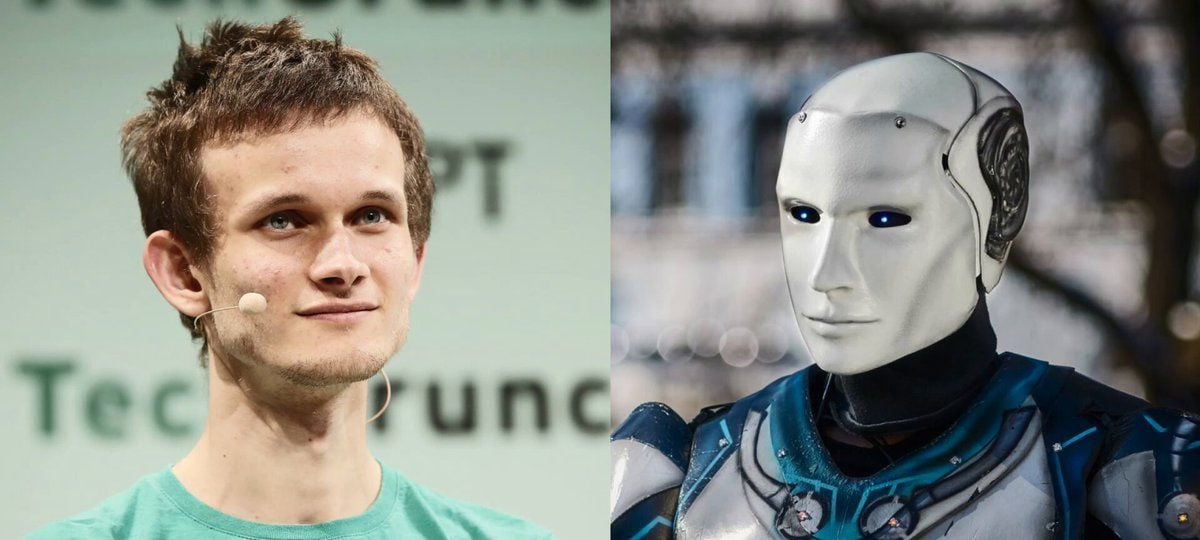
Ethereum (@ethereum) co-founder Vitalik Buterin (@VitalikButerin) has warned that artificial intelligence could expose serious weaknesses in widely used cryptographic systems within the next
Ethereum (@ethereum) co-founder Vitalik Buterin (@VitalikButerin) has warned that artificial intelligence could expose serious weaknesses in widely used cryptographic systems within the next two years, putting pressure on the crypto industry to rethink its security foundations sooner than many expected.
A Threat Beyond Quantum Computing
Most crypto security debates have focused on quantum computers that may arrive someday. Buterin pointed at a threat that might show up sooner: AI that is very good at math.Buterin warned that AI advancements in mathematics could undermine elliptic curve cryptography and lattice-based systems like ML-DSA and fully homomorphic encryption (FHE) within two years. He specifically said there is a "good chance" that the practical security of lattice-based cryptography could face "serious hits" within that window due to AI-driven mathematical advances.
Lattice cryptography is a mathematical approach increasingly favored by researchers and standards bodies as a replacement for traditional encryption methods. It is widely viewed as resistant to attacks from quantum computers, making it a leading candidate for post-quantum cryptographic standards. Governments and technology firms have been migrating toward lattice-based schemes precisely because conventional encryption, including RSA and elliptic-curve systems, is expected to become vulnerable once quantum computing matures. Buterin's warning puts that assumed safe harbor in doubt.
Ethereum researcher Justin Drake made a similar point on the same day, emphasizing that recent breakthroughs in AI-driven mathematics could produce vulnerabilities in ECDSA signatures much sooner than previously anticipated and calling for faster preparation.
Ethereum's Response and Practical Advice for Users
Ethereum's Lean roadmap is already transitioning toward hash-based cryptography, avoiding lattice-based signatures and zero-knowledge structures.The roadmap has adopted WOTS or SPHINCS+ for signatures and excludes any lattice-based components.Buterin emphasized that hash function-based schemes provide greater resilience and should be prioritized.
For everyday users, Buterin's guidance is measured. He recommends prioritizing the storage of funds in addresses that have not yet initiated any transactions, where convenience allows, but advises against hastily migrating assets, as the migration process itself carries risks of fund loss.He also advised privacy protocols to avoid on-chain encryption and recommended that multisig wallets verify signatures off-chain.
Buterin framed his concern as a probability, not a certainty, and the two-year window is a forecast. Any concrete AI-assisted result against lattice schemes or ECDSA would turn this from a warning into an emergency.
SourcesCrypto Briefing: Vitalik Buterin says there's a 'good chance' AI could break lattice cryptography within two yearsCoinfomania: Buterin Raises Alarm on AI Threat to Cryptography's FutureFX Street: Cryptocurrencies face new security risk as Ethereum researcher warns of potential ECDSA break