Your wallet has stopped showing a coin, and the app has put a date on the screen. The good news first: your balance is not gone. It sits on the blockchain, and the blockchain keeps running. W
Your wallet has stopped showing a coin, and the app has put a date on the screen. The good news first: your balance is not gone. It sits on the blockchain, and the blockchain keeps running. What you lose is the convenient way in through that one app, and that can be replaced as long as you still have your recovery phrase.
The next case falls on September 24, 2026: Phantom is ending support for the Sui network. It is the fifth shutdown of this kind in four weeks. This article explains what actually happens at a technical level, which two routes you have before any such deadline, where the move most often goes wrong in practice, and what German tax law has to say about it.
What happens to your coins when a wallet drops a network?
Technically, nothing at all happens to your balance. A self-custody wallet stores no coins. What it holds are the private keys you use to sign transactions on a blockchain, and its interface shows you what the chain assigns to your address. When a provider drops a network, it switches off the display and the signing function for that network. The chain itself, your address and your holdings stay exactly as they were.
Phantom puts it plainly on its own help page for the Sui case: "Your assets are not lost. They remain on the Sui blockchain and can be accessed using a compatible wallet with the same credentials."
In practice, plenty still changes for you. After the deadline you can no longer send, swap or work with applications on that chain from inside the old app. Anyone who does nothing until then is not facing a loss but a chore: setting up access again, with a phrase they may not have touched in months.
Three things decide how unpleasant that will be: whether your recovery phrase is complete and legible, whether you know what kind of assets you hold on the affected chain, and whether you act before the deadline or after it.
Self-custody explained: your wallet is a keyring, not a vault
Self-custody means the private keys to your crypto assets sit with you alone and no provider holds them on your behalf. The recovery phrase, usually twelve or twenty-four words, is the human-readable form of the seed from which all your private keys are calculated. The address is the public half of that key pair, the identifier under which your holdings are recorded on the chain.
From that structure follows the sentence this whole article rests on: the app is replaceable, the phrase is not. Any wallet software that supports the same chain and the same derivation scheme will compute the same keys from your phrase, and therefore the same address. That is why the provider cannot take your access away as long as you hold the words.
The distinction from an exchange matters. There it works the other way round: with a custodial account the provider holds the keys, your balance is a claim against that provider, and if it delists an asset, no phrase will help you. All that counts then is the withdrawal window the provider sets. Confuse the two cases and you either panic without cause or underestimate a real deadline. For an overview of which applications support which chains at all, see our comparison of crypto software wallets.
Phantom and Sui: what happens to your balance on September 24, 2026
By its own announcement, Phantom will end support for the Sui network on September 24, 2026. From that day, SUI and other assets on that chain can no longer be viewed, sent, swapped or used in applications inside the app. We covered the move in detail when it was announced in August, back when the now expired Monad deadline was still in play: Phantom Wallet drops Sui and Monad.
One detail is missing from the announcement and belongs in your planning: Phantom names no time of day. The help page gives the date and nothing else. Anyone banking on the last day is relying on a window the provider commits to nowhere. Plan the move with several days to spare, not hours.
As the destination wallet Phantom names Slush, the application recommended by the Sui Foundation. The wording of the announcement is on Phantom's help page. The details on the swap routes in the next section come from there as well.
Route 1: swap inside the old wallet before the deadline falls
The first route leaves the chain altogether. You swap your assets while still inside the old app into something it will keep supporting. At Phantom that includes SOL, ETH and USDC at the usual fees, according to the provider. For the move from native SUI into a version wrapped on Solana, Phantom has waived its own fee until the deadline; network and trading fees still apply.
This route is convenient and comes with two catches worth knowing. First, a wrapped version leaves you with a claim rather than a native balance, and that claim depends on the bridge behind it and on its backing. Second, a swap counts as a disposal for tax purposes, even when it feels like nothing more than rearranging. What that triggers in concrete terms is in the tax section below.
Route 1 makes sense above all when your holdings are small, when you have nothing further planned on the affected chain and when the hassle of a second wallet puts you off. For larger holdings, for staked positions and for collectibles, there is barely a way past route 2.
Every shutdown comes with a deadline. What closes afterwards is the route through the old app, not the access to your balance.
Route 2: import the recovery phrase into a compatible wallet
The second route keeps your assets where they are and swaps out the tool alone. You install a wallet that supports the affected chain and restore the same recovery phrase there. Address and balance appear on their own afterwards, because both are calculated from the phrase.
In practice this order has proved itself:
- First check that your phrase is complete, in the right order and legible. Do that before you install anything.
- Download the new wallet only through the provider's official route, never through an ad link or a search result.
- Restore the phrase in the new app. Enter it only in the app itself, never on a website and never in a form somebody sends you.
- Check that balance and address match what the old wallet was showing.
- Send a small test amount before you move larger sums, and keep some of the coin that pays the fee on that chain ready for it.
Keeping the phrase in two applications at once, incidentally, adds no risk on the chain itself; it simply puts a second copy into circulation. Depending on what you hold, that is an argument for combining the move directly with a switch to a hardware wallet, where the key never leaves the device.
The derivation path decides: why one phrase produces two different addresses
This is the source of most of the scares during a wallet switch. Your phrase is first turned into a seed, and from that seed wallets derive their keys along a fixed pattern. The derivation path is the set of directions that determines which key comes out of that seed for which chain and which sub-account.
One component of that path is a number per chain, recorded in the public SLIP-0044 registry. There Bitcoin carries 0, Dogecoin 3, Ether 60, Solana 501, Aptos 637 and Sui 784. The same phrase therefore necessarily produces a different address for Sui than for Solana, and that is not a fault but the normal case.
From this follows the most important rule for the moment it matters: if your new wallet shows an empty balance after the import, the coins are almost never gone; the path or the sub-account is wrong. Before you panic, check in order whether the app has actually opened the right chain, whether it offers several accounts from the same phrase, and whether it lets you set the derivation path by hand. Many applications show only the first account by default, even though your balance sits on the second or third.
You can verify this independently of any app: your address and its balance are in the block explorer of the chain in question. If the amount you expect is there under your old address, the case is settled, and all that is missing is the right path in the new software.
Staked SUI: why the position keeps running and when you can reach your capital
Phantom's help page does not answer this question. It speaks of "Sui assets" throughout, and staked holdings appear nowhere separately. The answer is in Sui's own documentation instead, and it is reassuring.
Staking on Sui means your tokens are locked into an object of their own on the chain, assigned to a validator. The Sui documentation calls this a self-custodial stake object: it sits on the blockchain and continues to belong to your address, entirely regardless of which app displays it. When you unstake, that object is dissolved and returns your principal and accrued rewards to you as SUI.
One limitation belongs in your timing. According to the same documentation, rewards accrue only for epochs in which your stake was active for the full epoch. Exit in the middle of an epoch and you give up that epoch's yield. This is no reason to rush, but it is a reason to place the exit deliberately rather than on the final evening.
For the Phantom case that means: staked SUI does not vanish on September 24, it merely stops being visible in Phantom. Once the phrase is imported into a Sui-capable wallet, the position reappears and you unstake from there. Anyone planning the swap under route 1 before the deadline, though, has to exit first: staked holdings cannot be swapped while they are locked.
NFTs and edge cases: what the help pages leave open
Collectibles follow the same mechanics as tokens, because they too are objects on the chain and hang off your address. Once the phrase is imported into a suitable wallet, they reappear. What does not apply to them is route 1: a collectible cannot simply be swapped into USDC, and a sale needs a buyer on a marketplace of that chain.
Two further cases sit close to this. With very small or thinly traded tokens the swap can fail on missing trading volume, leaving only the move. And with balances committed inside an application, as collateral, in a liquidity pool or in a contract with a lock-up, you first have to unwind that position, through an interface that will no longer be reachable from the old wallet after the deadline.
Where a provider writes nothing about your particular case, that is a sign of open questions, not a quiet assurance. When in doubt, ask support before the deadline and keep a record of the answer.
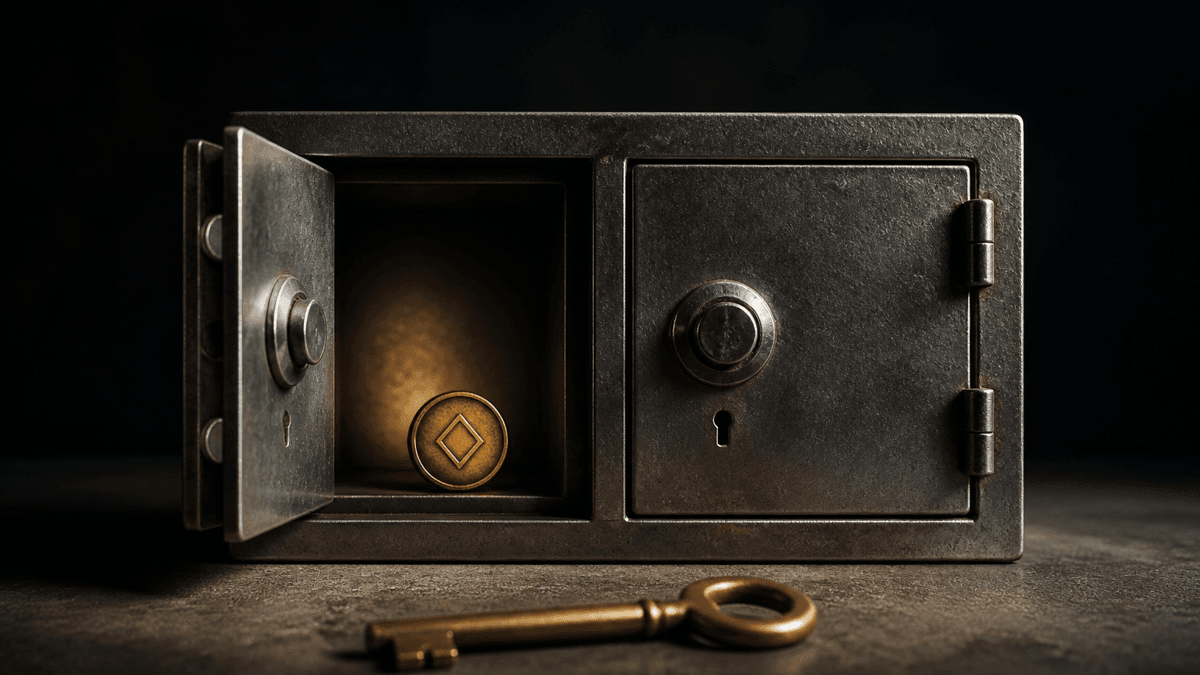
The same key, two doors: whether your balance appears after the import depends on the derivation path of the new wallet.
Five shutdowns in four weeks: the pattern behind the wallet drops
The Phantom case is not an isolated one, and that is exactly what makes it predictable for you. Between August 24 and September 17, 2026 alone we have followed five events of the same kind: Phantom is ending Sui, Trust Wallet is removing 25 networks on September 15, Cosmostation shut down its wallet operation in early September, Cypher required withdrawals by September 6, and MyDoge is switching off Doginals and DRC-20 on September 17. All five dates come from our own reporting in that period.
The reasons are alike. Every additional chain a provider supports costs it effort on a permanent basis: its own node connection, its own signing procedures, its own failure modes in support. When usage of that chain does not carry the effort, it eventually drops out. For you as a user, a sober expectation follows: the fact that an app displays a chain today is no commitment for next year.
Anyone using several chains should therefore build two habits. First, actually read the announcements from your own provider instead of swiping them away as marketing. Second, have tried at least once how your own phrase is restored in a second application, with a small amount, in calm conditions, long before the first real deadline.
When the wallet app itself disappears: the harder case
A dropped chain is the mild version. It gets harder when the provider shuts down operations entirely, as Cypher and Cosmostation did. Route 1 then falls away, because there is no interface left in which you could still swap, and the notice period is often shorter.
Two points are regularly underestimated here. For one, convenience services that ran quietly in the background often disappear with the app: the connection to a node, the display of prices, sometimes the recovery function through a provider account. For another, there are applications that keep keys exclusively on the device and issue no phrase in the classic sense. There you have to export actively before the shutdown, or your access hangs on a device that will break at some point.
The check that spares you all this takes ten minutes: for every app you use, do you know where your phrase is and whether it belongs to an open standard? If the answer for one application is no, that is your next task, regardless of any deadline.
Wallet drop or blockchain shutdown: the difference decides what happens to your coins
The two cases sound the same in everyday use and are fundamentally different. In a wallet drop the chain carries on as normal, only one app stops displaying it. Your phrase solves the problem completely.
In a blockchain shutdown the network itself ceases operation. Once the validators stop producing blocks, the best key is no use to you, because there is no chain left on which you could sign. All that counts then is whether you used the designated swap or the bridge to another chain before the date. Harmony and Lisk were the most recent cases of exactly that.
So the first question to ask is always: does the announcement concern my app or my network? If a provider's name is in the notice, it is the mild case. If the name of the chain is there, you have a real deadline.
Tax in Germany: why the move is tax-free and the swap is not
For investors in Germany the two routes diverge completely for tax purposes, and that should feed into your decision.
The move under route 2 transfers nothing. Your coins stay on the same address, there is no acquirer and no proceeds, so there is no private disposal transaction within the meaning of section 23 of the German Income Tax Act (EStG). All you change is the software you use to reach the same holdings.
The swap under route 1, by contrast, is a disposal. Section 23(1) sentence 1 no. 2 EStG covers transactions "in other assets where the period between acquisition and disposal is no more than one year". If your purchase is therefore less than a year old, any gain arising from it is taxable in principle. An exemption threshold applies: under section 23(3) sentence 5 EStG gains remain tax-free "if the total gain realised from private disposal transactions in the calendar year was less than 1,000 euros". Because this is a threshold and not an allowance, the entire gain becomes taxable at 1,000 euros or more, not merely the part above it.
Two further points belong on your radar. First, a swap into a wrapped version of the same coin also has to be treated as a disposal of the original asset. Second, staking rewards are handled separately and not like a plain price gain. Because both can only be calculated cleanly with complete acquisition records, there is barely a way around proper bookkeeping; suitable applications are in our comparison of crypto tax tools. For a binding assessment of your own case, a tax adviser is the right address.
The most common mistakes when switching wallets
- Entering the phrase on a website. No reputable wallet asks for the words outside its own app. Any page that does is after your holdings.
- Forgetting the fee coin. On the new chain you need a small balance of the coin that pays for transactions there. Without it you can see your balance but cannot move it.
- Reading an empty screen as a loss. In the vast majority of cases only the right sub-account or the right derivation path is missing.
- Overlooking staked or committed positions. Such positions often do not appear in the balance display like ordinary holdings and need a step of their own.
- Waiting until the last day. Where the provider names no time of day, the last day is not a figure you can plan around.
- Throwing away the old phrase after the move. As long as the same phrase stays in use, it remains the access to everything.
Wallet drops a network: what to take away
- Check today, not on the deadline, that your recovery phrase is complete and legible. The phrase is the one part of your setup that cannot be replaced. If your holdings justify secure storage, the move is a good occasion to switch to a device from our hardware wallet comparison.
- Decide deliberately between swapping and moving. The swap closes your position and can trigger tax, the move keeps it and costs only some setup time. Which application supports your chains is shown by our software wallet comparison.
- Record your acquisition data before you move anything. Purchase date, quantity and price decide later on holding period and exemption threshold. Tools for that are in the comparison of crypto tax tools.
(As of September 16, 2026. This article is not investment advice. Prices and fee structures change; check the terms with the provider before you buy.)