Weakly generated wallet recovery phrases have been linked to at least $5.69 million in crypto losses, according to a new security analysis of how some wallets create the secret words that pro
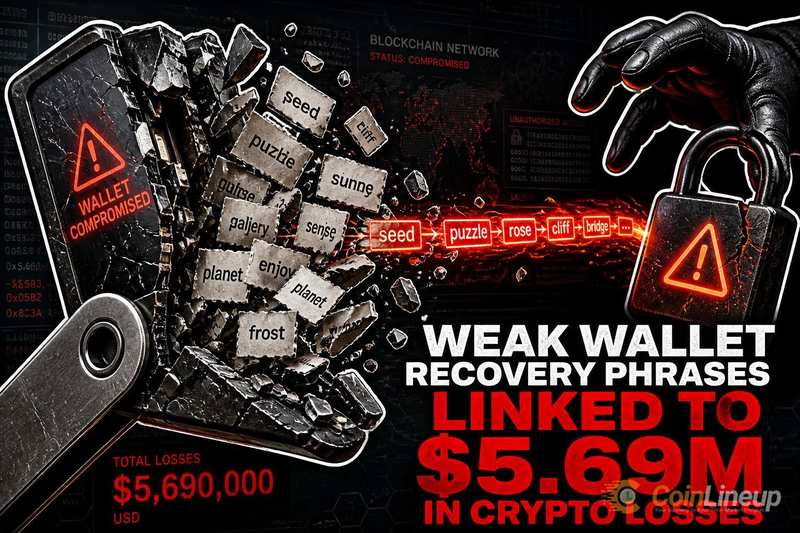
Weakly generated wallet recovery phrases have been linked to at least $5.69 million in crypto losses, according to a new security analysis of how some wallets create the secret words that protect user funds. A recovery phrase is the list of words that lets you restore a crypto wallet, and when those words are too predictable, thieves can guess them and drain the account.
KEY TAKEAWAYS
- Weakly generated recovery phrases were tied to at least $5.69 million in stolen crypto.
- The losses trace to how the phrases were created, not to phishing, bad trades, or an exchange hack.
- Predictable phrase generation shrinks the number of guesses an attacker needs, exposing self-custody wallets.
How weak recovery phrases were connected to the reported losses
Security researchers at Coinspect traced roughly $5.69 million in crypto losses to wallet recovery phrases that were generated in a weak, predictable way. For related coverage, see Cleveland Fed: Bitcoin's 12-Month Gains Attract New Crypto Investors.
The finding is a security analysis, not a story about market swings. That matters because these funds were lost even while prices moved for unrelated reasons, unlike broad sell-offs such as when Bitcoin fell below $79,000. For related coverage, see Next Crypto to Explode? Ethereum and AVAX Set the Pace as IceBull's Stage 1 Buy Window Opens.
The losses were linked specifically to how the phrases were created. Reporting on the research noted the affected users lost money because their wallet seeds were too predictable, not because of ordinary trading behavior.
Why weak phrase generation creates a direct attack path
A secure recovery phrase should be random, like drawing words blindly from a huge bag. Weak generation is the opposite: the words follow a pattern that a computer can reproduce.
Predictability shrinks the "search space," meaning the number of combinations an attacker must try. When phrases come from a flawed random number generator, that space collapses from astronomically large to something a thief can brute-force.
Investigators tied part of the problem to weak randomness in the widely used crypto-js library, whose flawed generation could undermine the security of self-custodied wallets.
This is a wallet security failure, not just a user mistake. The danger is that funds can be exposed with no phishing link clicked and no exchange breached, simply because the phrase itself was guessable, as detailed in coverage of the weak-randomness flaw.
What this means for wallet users and the broader crypto industry
For everyday holders, the lesson is that self-custody is only as safe as the tool that generated your phrase. If you hold a little crypto in a wallet you control, the software's setup step matters as much as your password.
Users depend entirely on wallet software to produce secure recovery material during setup. When that process is flawed, even careful people can lose funds, which chips away at confidence in wallet safety.
For developers, the incident is a push to audit how wallets create phrases and to hold to stronger security standards. It also lands amid wider scrutiny of the industry, from shifting SEC rules on token sales to new ventures like the World Liberty crypto bank.
The practical takeaway: this was a preventable weakness with real financial cost. If you use a self-custody wallet, favor well-reviewed, audited software, and treat how your recovery phrase was generated as a core part of keeping your crypto safe.
Disclaimer: This article is for informational purposes only and does not constitute financial or investment advice. Cryptocurrency and digital asset markets carry significant risk. Always do your own research before making decisions.
Read original article on coinlineup.com