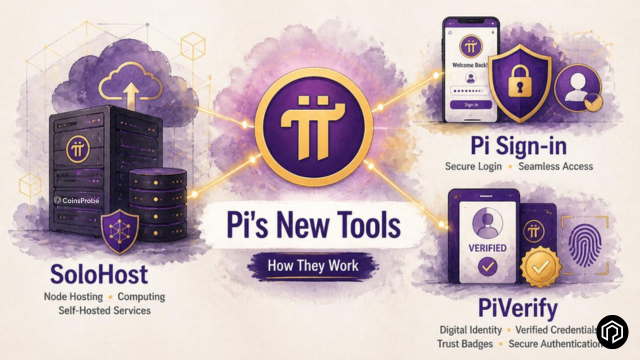
Key Highlights Pi Network launched SoloHost, Pi Sign-in, and PiVerify on Pi2Day 2026, expanding utility in AI, computing, and digital identity. SoloHost enables users to run self-hosted apps
Key Highlights
- Pi Network launched SoloHost, Pi Sign-in, and PiVerify on Pi2Day 2026, expanding utility in AI, computing, and digital identity.
- SoloHost enables users to run self-hosted apps and local AI agents directly on their computers.
- Pi Sign-in allows users to access third-party apps using their Pi accounts.
- PiVerify lets businesses use Pi's KYC system, creating real-world utility for the Pi token.
If you opened the Pi mining app today and saw three unfamiliar new names — SoloHost, Pi Sign-in, and PiVerify — here is exactly what each one does, how it actually works, and why Pi Network chose to launch all three together on Pi2Day 2026.
As we covered in our Pi2Day 2026 release announcement — these three tools share a single underlying strategic goal: making Pi’s existing infrastructure genuinely useful to external developers and businesses, not just to Pioneers inside the Pi ecosystem.
1. SoloHost (Beta) — Self-Hosted Apps and Local AI on Pi Desktop
What is SoloHost?
SoloHost is an open, permissionless framework built directly into Pi Desktop. In simple terms — it allows third-party developers to create and publish apps that Pioneers can then run locally on their own computers, rather than through a centralised server somewhere else on the internet.
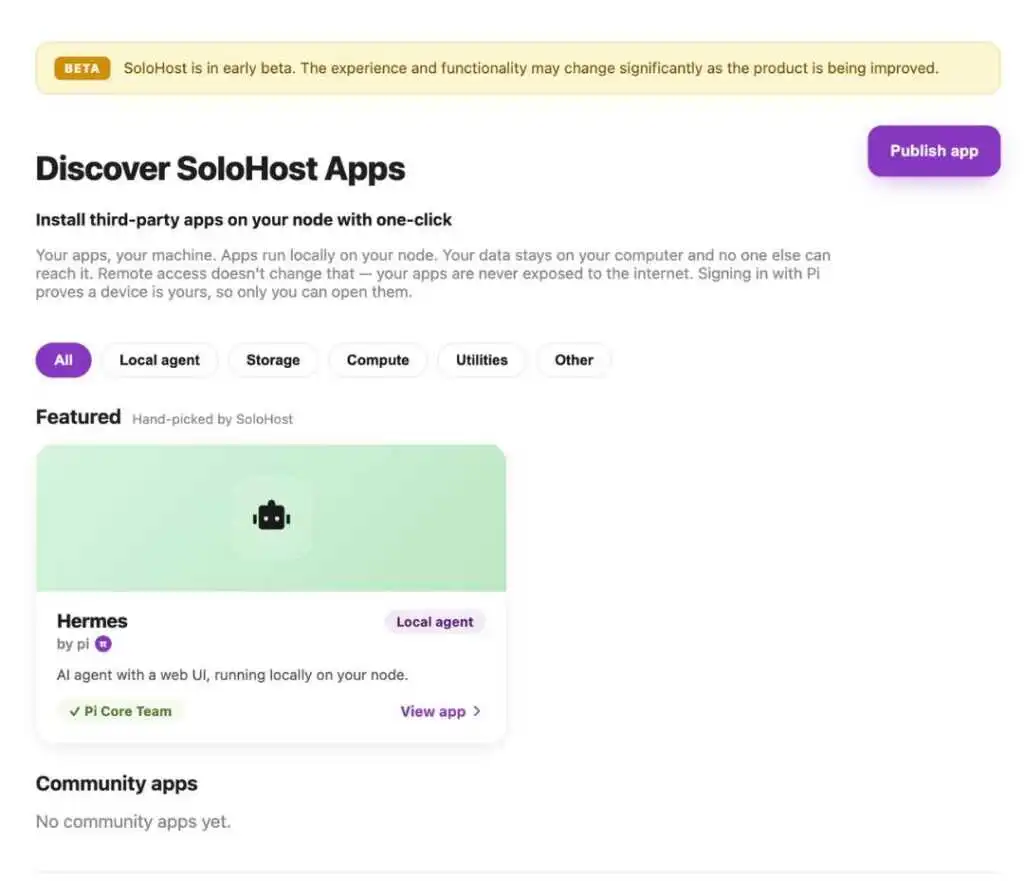 Pi Network’s SoloHost Beta/Source: minepi
How it works, step by step:
Step 1 — Developers build and list their apps through a streamlined publisher flow designed to make the submission process straightforward.
Step 2 — Users browse and discover these apps directly within Pi Desktop.
Step 3 — Once discovered, users install and run the app directly on their own device — meaning the software executes locally rather than on a remote cloud server.
Step 4 — Apps can also be accessed or controlled remotely from mobile via the Pi Browser — letting users manage a desktop-based tool from their phone.
Key use cases:
Local AI agents — This is the headline use case. AI tools run privately on your own computer, and critically, your data never leaves your device. The example application Pi has highlighted is Hermes — an open-source local AI agent designed to handle tasks and answer queries, all without sending any of your information to an external server.
Distributed computing (coming soon) — SoloHost’s roadmap extends beyond individual local apps toward something larger: leveraging the combined power of Pi’s 420,000+ Nodes for bigger computing workloads. Under this model, Node operators can opt in to contribute their unused computing resources, and in return, they could potentially earn Pi from third-party clients who need that compute power.
Why this matters — the benefits:
Enhanced privacy and data control — Because processing happens locally rather than in the cloud, users retain direct control over their own data at all times.
Turns existing Nodes into practical resources — Pi’s substantial Node network — built originally for blockchain consensus — gains an additional, genuinely useful function as a distributed compute resource.
Lowers the technical barrier to self-hosting — Running your own software locally typically requires meaningful technical know-how. SoloHost is designed to make this process significantly more accessible to non-technical Pioneers.
Current status: SoloHost is in early beta right now, with a gradual rollout planned and ongoing improvements expected as the framework matures.
2. Pi Sign-in — Use Your Pi Account on Third-Party Sites
What is Pi Sign-in?
Pi Sign-in lets Pioneers log into supported external websites and applications using their existing Pi account — working in essentially the same way as familiar options like “Sign in with Google” or “Sign in with Apple.”
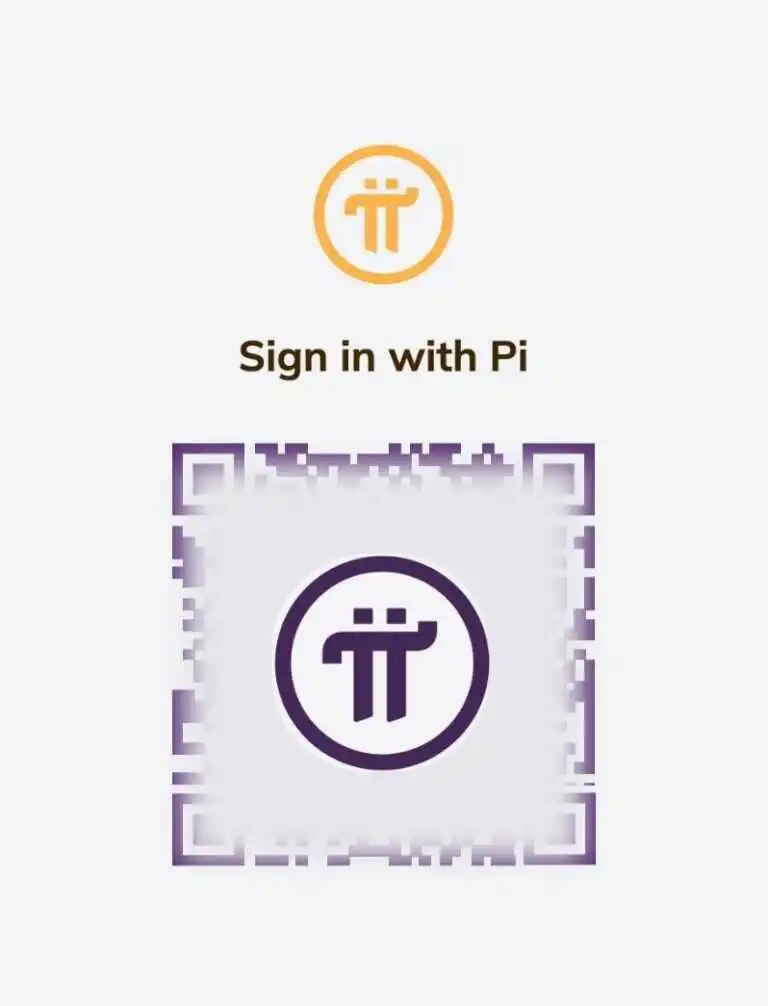 Pi Sign-in/Source: minepi
How it works, step by step:
Step 1 — On a website or app that supports Pi Sign-in, the user selects the “Sign in with Pi” option, just as they might select Google or Apple on other sites.
Step 2 — Authentication then happens securely — commonly via a QR code scan or directly through the Pi Browser — confirming the user’s identity without requiring them to create or remember a separate username and password for that specific site.
Step 3 — Throughout this process, users control exactly what information is shared with the third-party site, rather than the site automatically receiving full access to a user’s entire Pi profile.
Key benefits:
Simplifies access across the internet — No need to create yet another new account with another new password for every individual website. Your existing Pi identity travels with you.
Better cross-device connectivity — Pi Sign-in specifically enables scenarios like controlling a desktop AI agent (such as Hermes, running via SoloHost) directly from your phone — connecting Pi’s various products together into one more cohesive experience.
Gives external services access to Pi’s user base — Any website or app that integrates Pi Sign-in instantly gains the ability to authenticate against Pi’s large, already-engaged population of users — a meaningful value-add for developers building on top of Pi’s identity layer.
The bigger picture: This feature significantly expands Pi’s practical presence beyond its own ecosystem — and it is specifically designed to make integration straightforward for outside developers who want to plug into Pi’s identity system without building their own from scratch.
3. PiVerify — Pi’s Identity Verification for External Businesses
What is PiVerify?
PiVerify takes Pi’s already-proven, real-human KYC (Know Your Customer) verification system and makes it available as a service to third-party businesses and platforms that are not part of the Pi ecosystem at all.
 PiVerify/Source: minepi
How it works, step by step:
Step 1 — A business integrates PiVerify directly into its own platform — through whatever technical integration method PiVerify supports.
Step 2 — That business can then verify its own users by checking them against Pi’s existing database of verified Pioneers — confirming whether a given person is a real, previously-verified human rather than a bot or duplicate account.
Step 3 — For each individual verification performed, the client business pays in Pi.
Key benefits:
Reduces fake accounts, bots, and fraud — Businesses gain a reliable way to filter out non-human or duplicate accounts on their own platforms.
Supports regulatory compliance — Many businesses face legal requirements to verify customer identity. PiVerify gives them a ready-made tool to help meet those obligations.
Increases direct demand for Pi — This is the detail with the clearest economic significance: every verification performed generates real, functional Pi spending from businesses that have nothing to do with mining or speculation — they simply need a working identity verification tool and are paying for it in Pi.
Built on a genuinely large existing base — PiVerify’s underlying credibility comes from Pi’s pool of over 18 million verified users worldwide — a dataset that took years of real KYC processing to build.
The bigger picture: PiVerify effectively converts Pi’s identity infrastructure into a revenue-generating utility — while simultaneously helping the external platforms that use it build greater trust with their own user bases.
The Overall Strategy Behind the Releases
Pi Network’s approach across all three releases follows one consistent logic: first offer genuinely valuable services to the outside world — local compute via SoloHost, easy sign-in via Pi Sign-in, reliable identity verification via PiVerify — and then let that real-world utility naturally encourage those external users and businesses to join and contribute to the broader Pi ecosystem.
This strategy is particularly well-timed given current technology trends. Privacy-focused local AI, decentralised compute, and trusted digital identity are all capabilities currently in high and growing demand across the broader tech landscape — and Pi is positioning all three of today’s releases directly at the intersection of those trends.
How to Get Involved
Open the Pi mining app to read the full official Pi2Day 2026 announcement directly from the source.
Participate in the Pi2Day Ecosystem Quest — a structured way to test all three new features hands-on and earn a commemorative badge for participating in Pi2Day 2026.
Bottom Line
SoloHost, Pi Sign-in, and PiVerify represent meaningful, practical progress toward real-world utility for Pi Network — moving the project further from its mining-app origins and toward genuine infrastructure that external developers and businesses can actually use and pay for.
This builds on a year of similar utility-focused moves — from the Vibe Coder Campaign recruiting developers, to the Launchpad’s SLICE testnet token, to the Ecosystem Directory Staking update that helped real apps gain real users.
As these features mature, they could meaningfully strengthen Pi’s position in Web3 and AI — and feed directly into the bigger question many Pioneers are watching: whether $PI can recover above $1 again.
Disclaimer: The views and analysis presented in this article are for informational purposes only and reflect the author’s perspective, not financial advice. Technical patterns and indicators discussed are subject to market volatility and may or may not yield the anticipated results. Investors are advised to exercise caution, conduct independent research, and make decisions aligned with their individual risk tolerance.