What Is Bitcoin Difficulty Adjustment? A Simple Guide Bitcoin difficulty adjustment is the rule that keeps new blocks arriving about every 10 minutes. The network keeps an eye on how fast blo
What Is Bitcoin Difficulty Adjustment? A Simple Guide
Bitcoin difficulty adjustment is the rule that keeps new blocks arriving about every 10 minutes. The network keeps an eye on how fast blocks are coming in.
When they are too quick or too slow, it makes the mining puzzle harder or easier. So miners can come and go as they please, and blocks still show up at a steady pace.
The most recent reset came on November 14, 2026. Difficulty fell about 9.13%, according to Mempool data. This guide explains how the system works and why it matters to miners. Anyone mining through a group can also read ourBitcoin mining pool guide.
What Is Bitcoin Difficulty Adjustment?
Every Bitcoin block header carries a target. A miner must find a block hash that is lower than or equal to that target. When the target gets lower, fewer hashes can pass, so miners have a tougher puzzle to solve.
Difficulty is the ratio between a reference target and the current target. Theformula for difficulty equals difficulty 1 target divided by the current target. Difficulty 1 uses the nBits value 0x1d00ffff, per the Bitcoin developer reference.
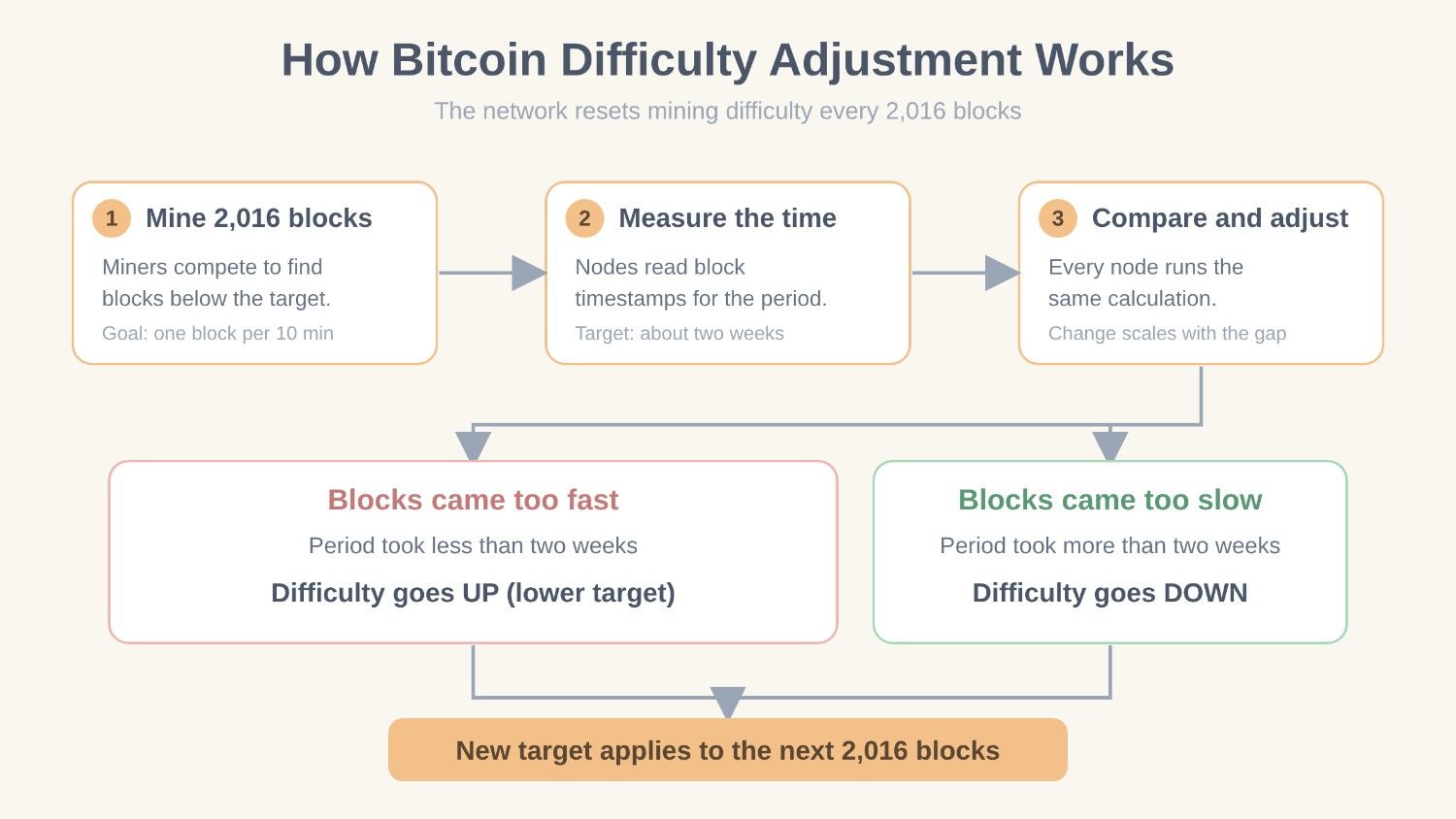
The adjustment happens every 2,016 blocks. At one block per 10 minutes, that period should last two weeks. The change is proportional to how far the last period ran over or under that time.
Mission and Vision
The goal is a predictable block schedule without a central clock or operator. The whitepaper describes the idea in one line. Proof-of-work difficulty is set by a moving average that targets an average number of blocks per hour.
The same sentence adds the rule for fast blocks. If they arrive too fast, difficulty rises. The network manages its own pace.
Why Bitcoin Difficulty Adjustment Was Created
Mining power never stays constant. New machines switch on. Old ones shut down. Prices, power costs, and regulation all shift hashrate.
Without a reset, more hashrate would mean faster blocks. A lower hashrate would mean slower ones. Payments and rewards would arrive on an uneven schedule.
The reset solves this by tying difficulty to measured results. The network doesn't guess how much hashrate exists. It reads the timestamps and reacts.
How Bitcoin Difficulty Adjustment Works
The process repeats every 2,016 blocks:
Nodes measure how long the last 2,016 blocks took.
They compare that time with two weeks.
They scale the target up or down in proportion to the gap.
The new target applies to the next 2,016 blocks.
Slow periods lower difficulty. Fast periods raise it. No vote or announcement is involved. Every full node runs the same calculation and gets the same answer.
Core Architecture
Three pieces carry the system:
Block timestamps: each header records a time, which lets nodes measure a period.
nBits field: a 32-bit value that stores the target in compact form.
Retarget interval: the fixed 2,016-block window that triggers a new target.
The developer reference says nBits is an encoded version of the target threshold. A block hash must be less than or equal to it. Because the field has only 32 bits, the 256-bit target is stored in a compact format.
Key Features
Self-regulating: the system needs no outside input.
Predictable: the target pace is one block per 10 minutes.
Global: every node applies the same rule to the same data.
Delayed: changes come in steps every 2,016 blocks, not block by block.
That delay explains why blocks can run slow or fast for days. Hashrate can change before the next reset arrives.
Technology Behind the Adjustment
The design rests on proof-of-work and on timestamps. Consensus rules require each timestamp to be later than the median of the previous 11 blocks. Miners can still choose timestamps within those limits.
That flexibility is what the time warp attack targets. A miner with a majority hashrate could shift timestamps so a period looks longer than it was. Difficulty would then fall. Bitcoin Optech describes a soft fork proposal to close this gap. It would require a new period's first block to carry a time no earlier than ten minutes before the previous period's last block.
Optech also lists Bitcoin Core changes tied to this issue. One prevents block templates that exploit the bug. A 2026 change follows BIP54's time warp mitigation. The sources reviewed don't say whether BIP54 has been activated on the mainnet.
Token Utility and Tokenomics
Difficulty adjustment isn't a token and has no allocation table. It's a protocol rule that applies to Bitcoin itself. It still shapes miner economics, since difficulty sets how much work each reward needs.
Roadmap and Timeline
2008: the whitepaper describes the moving-average difficulty idea.
Every 2,016 blocks: the network checks its pace and resets the difficulty.
November 14, 2026:difficulty dropped about 9.13%, to roughly 134.82 trillion at block height 975,744, according to Mempool data.
Next retarget: the following adjustment is due after another 2,016 blocks. Check theMempool.space mining dashboard for the confirmed figure.
Ecosystem Impact
Difficulty links directly to the mining sector. Miners track it alongside power costs, since higher difficulty means more work per reward. Pool users feel it through changing payout rates.
Mining income can also be taxable, and rules differ by country. See thiscrypto tax guide for India for one example.
Advantages
Block timing stays stable as hashrate changes.
No central party controls the pace.
Difficulty can fall after miners leave, so remaining miners can keep the chain moving.
Every node can verify each change on its own.
Challenges and Risks
The system reacts with a lag. A sharp drop in hashrate can slow blocks for days before the next reset.
Timestamp manipulation is a known concern. Bitcoin Optech lists risks from the time warp attack. They include faster claiming of the remaining block subsidy, effects on timelock contracts, and easier eclipse attacks. These risks need a majority of hashrate to exploit.
Miners face business risk too. When difficulty goes up, profit can shrink if revenue doesn't rise along with it.
When difficulty comes down, the pressure eases, but that usually means other miners switched off their machines. Keeping payouts safe matters as well, so miners should send their rewards tosecure crypto wallets.
Future Outlook: Time Warp Fixes and Shifting Hashrate
Developers continue to discuss the time warp fix. Bitcoin Optech lists Bitcoin Core work related to BIP54 in 2026. Activation of any soft fork would need broad agreement, and no timeline is confirmed in the sources reviewed.
Each future retarget will still follow the same 2,016-block rule. Changes in hashrate, energy costs, and mining hardware will keep moving the numbers.
Expert Sources: A Thermostat, Not a Price Signal
The mechanism works like a thermostat. It measures the room, then nudges the heat. It doesn't forecast anything.
One retarget says little on its own. A cut can follow miners switching machines off. A rise can follow new machines coming online. Each case needs hashrate, power cost, and block-time data for context. Readers can learnhow mining pools work to see how those shifts reach miners.
The documented limits are the lag and the timestamp issue. Both are known, and developers are actively working on the second.
Final Thoughts: How a 2,016-Block Reset Keeps Mining Steady
Bitcoin difficulty adjustment is a quiet part of the protocol. It lets the network absorb big swings in mining power while keeping blocks close to 10 minutes apart.
For readers, the takeaway is simple. Difficulty follows hashrate with a delay of up to two weeks. Check live data from sources like Mempool before relying on any single figure.
Disclaimer: This article is for educational and informational purposes only and should not be considered financial or investment advice. Always conduct your own research before making investment decisions.
