Bitcoin mining is the process that adds new blocks to the Bitcoin blockchain and issues new bitcoin. Specialised machines known as ASIC miners try trillions of random numbers per second until
Bitcoin mining is the process that adds new blocks to the Bitcoin blockchain and issues new bitcoin. Specialised machines known as ASIC miners try trillions of random numbers per second until a block produces a hash below the target set by the network. Whoever succeeds first collects a block reward of 3.125 BTC, the amount in force since the halving of April 20, 2024, plus the transaction fees in that block. Whether mining pays off in Germany comes down almost entirely to the price of electricity: a current Antminer S21 XP only covers its power bill below roughly 10.4 cents per kilowatt hour (as of October 22, 2026).
The sections below explain proof of work without formulas, run the numbers for two current machines on German household and business electricity rates, and put halving, pools, locations, tax and cloud mining into context.
Bitcoin mining: the key facts at a glance
- Block reward: 3.125 BTC per block since the halving on April 20, 2024, plus an average of 0.0166 BTC in fees (last 1,008 blocks up to October 22, 2026).
- Rhythm: A block is meant to arrive every ten minutes. Every 2,016 blocks the network adjusts the difficulty; the latest change, on October 16, 2026, was an increase of 5.9 percent.
- Computing power: The network runs at roughly 1,050 exahashes per second and the difficulty stands at 140.6 trillion (as of October 22, 2026).
- Revenue: An Antminer S21 XP with 270 TH/s earns about €9.10 a day before costs and uses 87.5 kilowatt hours to do so.
- Electricity price: At the average German household rate of 37.0 cents per kilowatt hour (BDEW, August 2026), the same day costs about €32.40 in power.
- Tax: For private individuals in Germany, mining income under Section 22 No. 3 of the Income Tax Act stays tax-free as long as all such income together remains below €256 a year (Federal Ministry of Finance letter of March 6, 2025, para. 45).
How does Bitcoin mining work? Proof of work explained simply
Every bitcoin transfer first lands in the waiting area of the network's nodes, the mempool. A miner picks transactions from it, preferring those with the highest fees per byte, and assembles a candidate block. Its header is 80 bytes long and contains, among other things, the hash of the previous block, a checksum covering all transactions and a 32-bit field called the nonce.
This block header is run twice through the SHA-256 hash function. The result is a 256-bit number that cannot be predicted: change a single character and a completely different hash emerges. A block is only valid if its hash is smaller than a target set by the network. A miner therefore cannot calculate the solution, only search for it: change the nonce, hash, compare, many trillions of times per second. If the roughly 4.3 billion possible nonce values are not enough, the miner changes other fields in the block and starts again.
When a miner finds a valid hash, it broadcasts the block to the network. The other nodes check it with a single calculation and append it to their copy of the blockchain. That asymmetry is the essence of proof of work: the work is expensive, the verification cheap. Anyone trying to forge an earlier transaction would have to redo the work of all later blocks faster than the rest of the network combined.
To keep the average at one block every ten minutes, the protocol adjusts the target every 2,016 blocks, or roughly every two weeks. When more machines join, the difficulty rises; when miners switch off, it falls. On October 16, 2026 it went up by 5.9 percent. Since then blocks have arrived every 9 minutes and 24 seconds on average, and for the next adjustment at block 973,728 mempool.space estimates a further increase of 6.6 percent. What the jump means for operators' margins is covered in our analysis of difficulty and miner margins.
The Bitcoin network in figures (as of October 22, 2026, source: mempool.space)
Metric
Value
Block height
972,546
Difficulty
140.6 trillion
Estimated network hashrate
about 1,050 EH/s
Block reward (newly issued bitcoin)
3.125 BTC
Fees per block, average of the last 1,008 blocks
0.0166 BTC
Next difficulty adjustment
Block 973,728, estimated +6.6%
Bitcoin issued so far
about 20.10 million of 21 million
Halving and 21 million: why the mining reward keeps shrinking
The protocol caps the number of bitcoin at just under 21 million. The halving enforces that cap: every 210,000 blocks, roughly every four years, the reward a miner receives for a new block is cut in half. Up to block 972,546, about 20.10 million BTC have been issued by calculation, a little more than 95.7 percent of the maximum supply. The remaining 900,000 or so BTC are spread over more than a century, with the last fraction expected to be mined around the year 2140.
The halvings at a glance (block times according to mempool.space)
Halving
Block
Date
Reward afterwards
1st
210,000
November 28, 2012
25 BTC
2nd
420,000
July 9, 2016
12.5 BTC
3rd
630,000
May 11, 2020
6.25 BTC
4th
840,000
April 20, 2024
3.125 BTC
5th
1,050,000
expected April 2028
1.5625 BTC
Each halving wipes out most of a miner's bitcoin income overnight. Fees barely make up for it at present: over the last 1,008 blocks, roughly one week, they accounted for only 0.53 percent of revenue. There are still 77,454 blocks to go until the next halving; our halving countdown tracks the gap continuously.
Is Bitcoin mining profitable in Germany? The numbers for two current ASICs
Graphics cards and ordinary processors stopped being viable for mining bitcoin years ago. The network is now run almost entirely by ASICs, chips that compute nothing but SHA-256. The table below compares two air-cooled Bitmain models using the figures from the manufacturer's data sheets: the Antminer S21 XP with 270 TH/s at 3,645 watts and the Antminer S21 Pro with 234 TH/s at 3,510 watts.
Revenue depends on three variables: difficulty, reward per block and the bitcoin price. At a difficulty of 140.6 trillion, one terahash per second earns an average of 0.00000045 BTC a day. At a price of €75,011 according to CoinMarketCap, that equals a hashprice of €33.72 or $37.87 per petahash per day (as of October 22, 2026). The electricity prices used are the average German household rate of 37.0 cents per kilowatt hour and the rate for small and medium-sized industrial customers of 17.2 cents, both taken from the BDEW electricity price analysis of August 2026. The second figure applies to consumption of 160,000 kilowatt hours or more a year, in other words to a commercial operation running several machines.
Bitcoin mining in Germany: revenue and electricity cost per machine (as of October 22, 2026)
Metric
Antminer S21 XP
Antminer S21 Pro
Hashrate according to data sheet
270 TH/s
234 TH/s
Power draw and efficiency
3,645 W, 13.5 J/TH
3,510 W, 15.0 J/TH
Electricity use per day
87.5 kWh
84.2 kWh
Revenue per day
0.000121 BTC = €9.10
0.000105 BTC = €7.89
Revenue per month (30 days)
€273
€237
Power at household rate (37.0 cents) per day and month
€32.37 and €971
€31.17 and €935
Result at household rate per month
−€698
−€698
Power at business rate (17.2 cents) per day and month
€15.05 and €451
€14.49 and €435
Result at business rate per month
−€178
−€198
Break-even electricity price
10.4 cents/kWh
9.4 cents/kWh
The result is clear. On German household electricity, each machine loses around €700 a month, and even at the business rate the loss is €178 to €198. The purchase price of the hardware, pool fees, cooling and noise insulation are not yet included. Revenue only covers the power bill below 10.4 cents per kilowatt hour for the S21 XP and 9.4 cents for the S21 Pro. If the difficulty rises by the estimated 6.6 percent at the end of October, the S21 XP's break-even point drops to 9.8 cents.
Turned the other way round: for an S21 XP to earn back its electricity at the business rate, bitcoin would have to cost about €124,000 at an unchanged difficulty, or about €267,000 on household power. That is not a price forecast but the arithmetic behind the question of whether mining pays; how analysts see the price is collected in our Bitcoin price prediction. At today's level, an S21 XP would also need almost 23 years to accumulate one whole bitcoin.
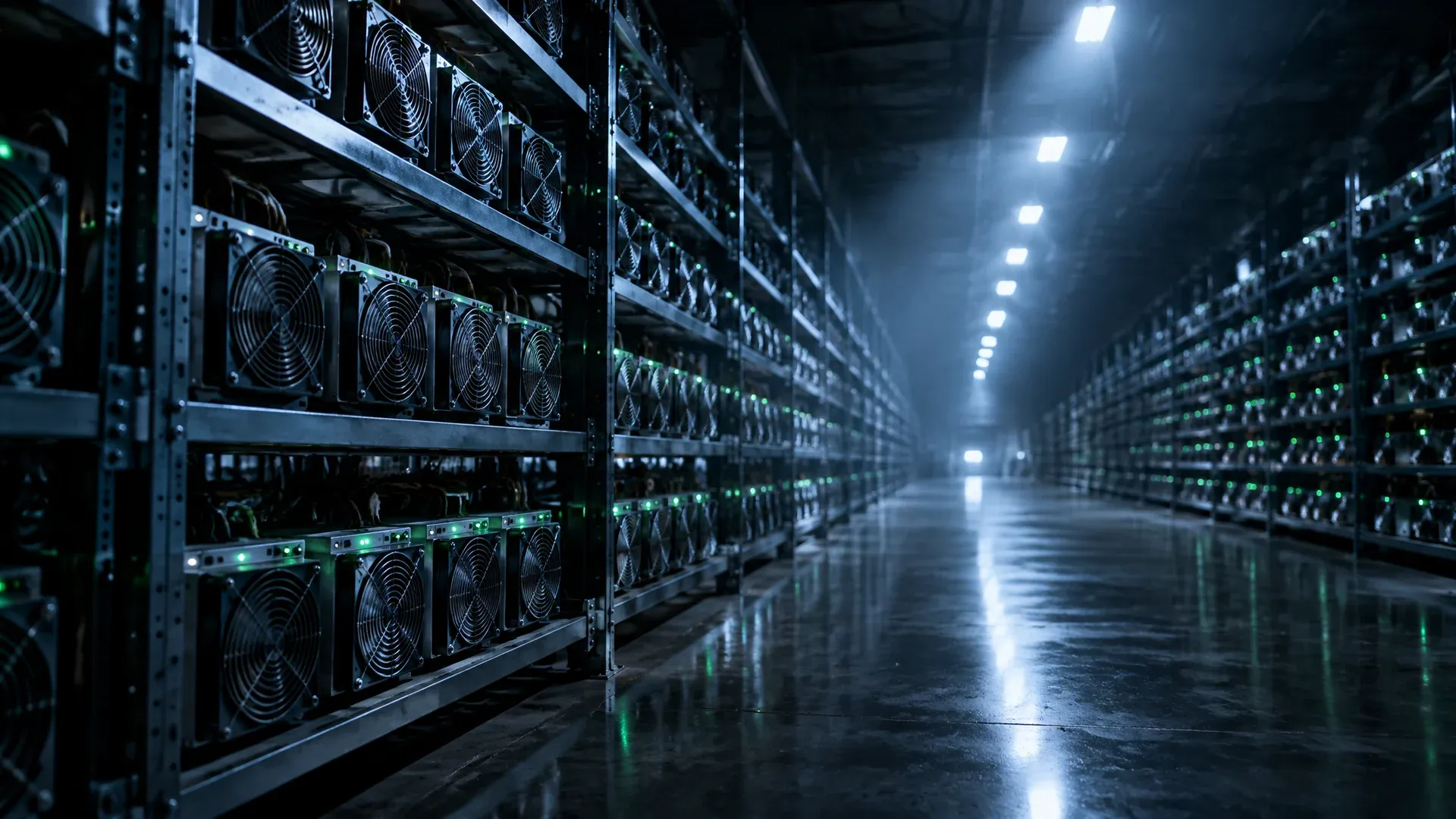
Thousands of ASICs run side by side in large mining halls; electricity and cooling are the biggest cost items. Illustrative image, AI-generated.
Our view: In Germany, bitcoin mining only makes sense with electricity that costs next to nothing, such as surplus power from your own solar installation that would otherwise only earn the feed-in tariff, or when the waste heat warms a building that needs heating anyway. If you simply want to own bitcoin, buying it on an exchange is cheaper than running a machine that loses money every month.
Mining pools: why miners combine their computing power
On its own, an S21 XP would statistically find a block only once every 71 years at today's level. That is why almost all miners join pools. The pool splits up the search, each participant submits partial solutions known as shares and is paid according to its share of the computing power, usually daily. Instead of a rare large payout, miners receive a steady income from which the pool deducts a fee.
Pools are highly concentrated. In the month up to October 22, 2026, almost two thirds of the 4,492 blocks found went to three pools, according to mempool.space. A pool decides which transactions go into its blocks, but the machines belong to many individual operators who can switch pools at any time.
The largest mining pools by blocks found in the month to October 22, 2026
Pool
Blocks
Share
Foundry USA
1,160
25.8%
AntPool
945
21.0%
F2Pool
739
16.5%
ViaBTC
423
9.4%
SpiderPool
297
6.6%
MARA Pool
229
5.1%
Energy and locations: where the miners are today
Bitcoin mining turns electricity into security, and on a large scale. Even if every machine on the network were as efficient as the S21 XP, roughly 1,050 exahashes per second would require a continuous load of about 14 gigawatts, or around 125 terawatt hours a year. Older machines push actual consumption higher still. Miners therefore move to wherever power is cheap and plentiful: hydropower, wind, gas that would otherwise be flared, and regions with surplus grid capacity.
The most important mining country is the United States. In a survey by the Cambridge Centre for Alternative Finance published in April 2025, covering 49 mining companies that together accounted for 48 percent of the network's hashrate, 75.4 percent of reported activity was in the US. The institute itself notes that US firms took part particularly actively, so their share is probably overstated. According to the same survey, 52.4 percent of the electricity used by the miners questioned came from sustainable sources. With electricity prices far above the break-even point, Germany is an unattractive location for large facilities.
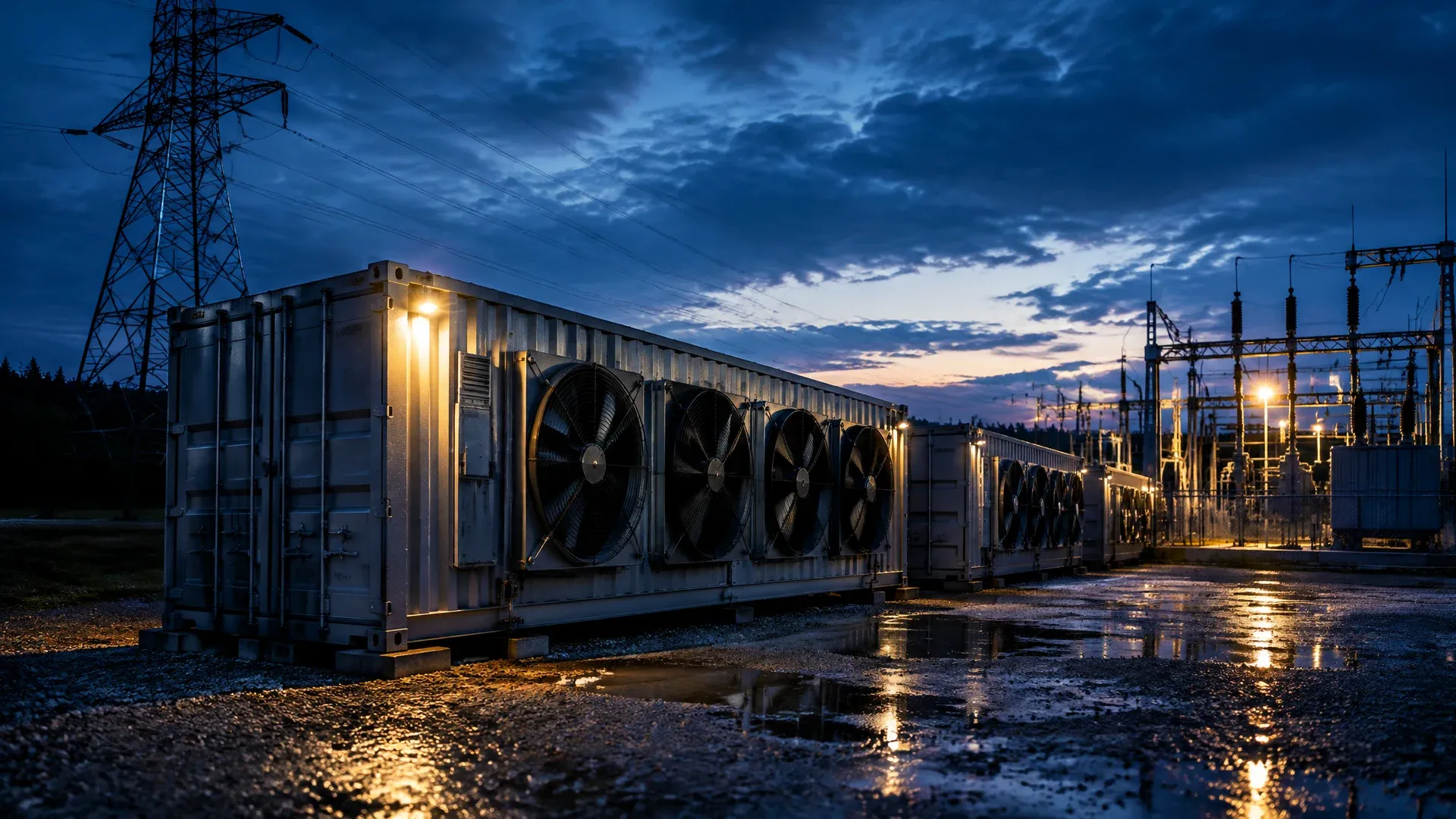
Miners settle where electricity is cheap and plentiful, often right next to substations and power plants. Illustrative image, AI-generated.
Tax on mining income in Germany
How the German tax office treats mined bitcoin is set out in the Federal Ministry of Finance letter on crypto assets of March 6, 2025, which replaced the version of May 10, 2022. The key points for miners:
- Acquisition: Mining counts as an acquisition. Income includes both the block reward and the transaction fees (paras. 33 and 34).
- Private or commercial: Whether mining is a business is determined by Section 15 (2) of the Income Tax Act. It is sustained if it is designed to be repeated and can generate a profit over time (paras. 35 to 37). In a business, the coins form part of business assets, to which the holding period does not apply.
- Private mining: If it is not a business, the income counts as other income under Section 22 No. 3 of the Income Tax Act and stays tax-free as long as all income of this kind together remains below €256 per calendar year (para. 45). The market price at the time of receipt applies, and hardware (through depreciation) and electricity can be deducted as expenses (paras. 46 and 47).
- Sale: The one-year period for private sales under Section 23 of the Income Tax Act starts when the coins are received. Gains within that period remain tax-free if all private sale gains in the year together stay below €1,000 (para. 53).
When the tax office assumes a business, and what that means for bookkeeping and profit calculation, is explained in our article Crypto mining and tax: when the tax office treats your mining as a business. Whether the one-year holding period for privately held crypto assets will survive is a political question that remains open; our overview of the crypto holding period reform tracks where things stand. The free CryptoTicker tax calculator works out the tax due when you sell mined coins. This section does not replace professional tax advice.
Cloud mining: the typical traps of rented mining
With cloud mining, you buy or rent computing power in someone else's server farm instead of running machines yourself; that is also how the Finance Ministry letter describes it (para. 11). It sounds convenient, but it is a field with many losses and more than a few frauds. Three checks help with any offer:
- Hold the promised return against the hashprice: As of October 22, 2026, 100 TH/s earn about €3.37 a day before costs. If an offer promises more for the same capacity, or a fixed daily interest rate, the money cannot be coming from mining.
- Work through the running fees: Many contracts deduct electricity and maintenance fees from revenue every day. Check what happens if the fees exceed revenue after a difficulty increase; if the contract then ends without a refund, you carry the entire risk.
- Check the payouts: A reputable service pays out transparently to your own wallet. A provider that demands new deposits before paying out, or that advertises mainly with bonuses for recruiting customers, is a warning sign.
HashFlare shows how large the damage can be. Its two founders pleaded guilty before a US federal court in February 2025; between 2015 and 2019 they had sold mining contracts worth more than $577 million without owning most of the computing power promised, according to the US Department of Justice.
Bitcoin mining in 2026: electricity costs decide, not the machine
Bitcoin mining is the backbone of the network: around 1,050 exahashes per second secure the blockchain, and each new block earns its finder 3.125 BTC plus fees. For private individuals in Germany it nonetheless remains a loss-making business as long as a kilowatt hour costs more than about 10 cents, and the next halving in April 2028 will cut revenue in half again. If you want to own bitcoin, buying it directly is cheaper; our comparison of crypto exchanges sets providers and fees side by side. If you already hold coins, whether bought or mined yourself, the safest long-term option is to keep them offline; suitable devices are listed in our hardware wallet comparison.
(As of October 22, 2026. This article is not investment advice. Prices, electricity rates and the difficulty change constantly; check the figures before you put money into mining hardware or a mining contract.)