Why Is Robinhood Chain’s Newest Token Drawing Attention? PONS is the token linked to Pons, a no-code launchpad on Robinhood Chain where anyone can create and trade meme coins. So what is PONS
Why Is Robinhood Chain’s Newest Token Drawing Attention?
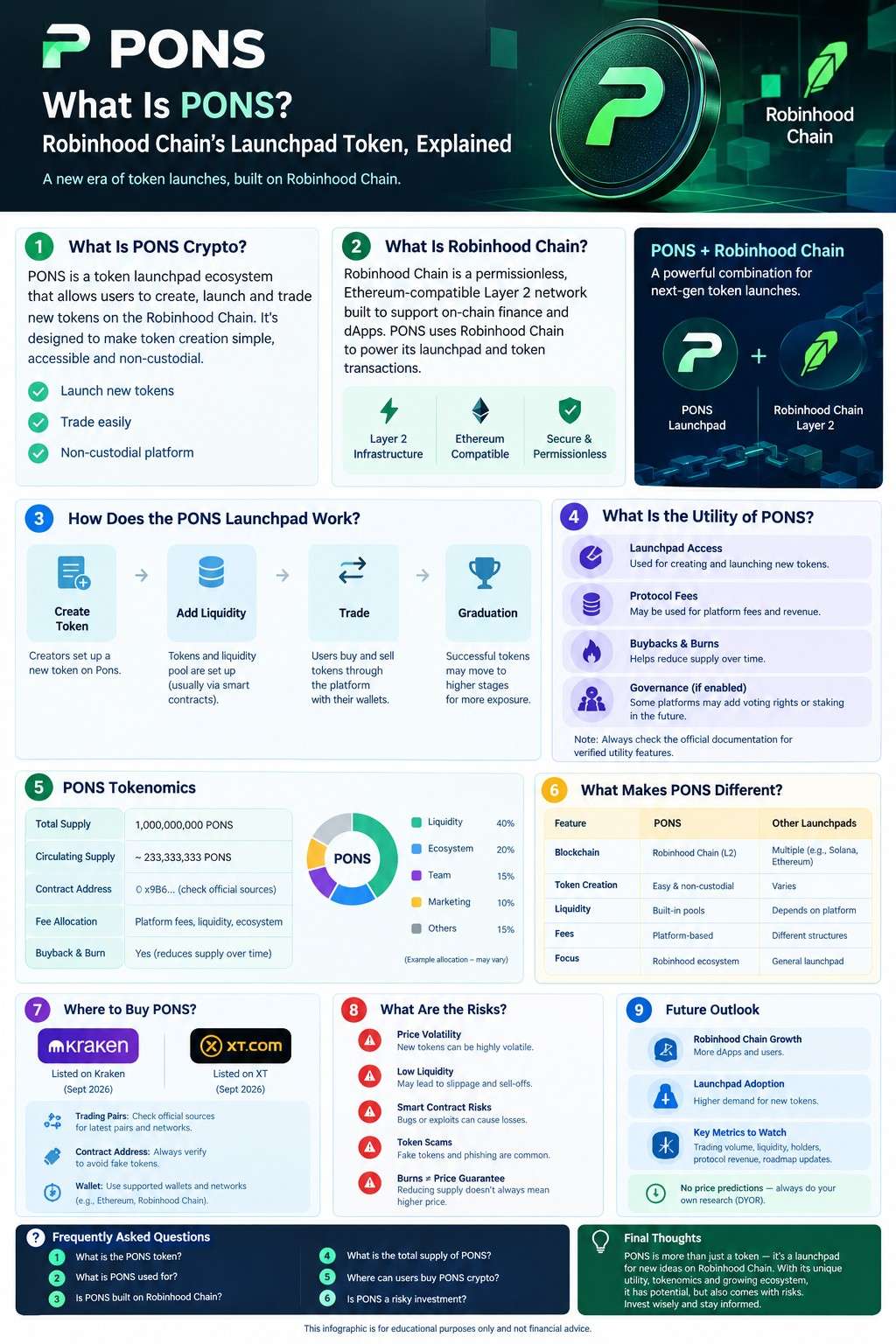
PONS is the token linked to Pons, a no-code launchpad on Robinhood Chain where anyone can create and trade meme coins. So what is PONS, in short? It’s a fixed-supply token, and part of the launchpad’s fees is used to buy it back and burn it. Many people started searching for it after Robinhood Chain went live on July 1, 2026.
PONS crypto news has mostly covered burn totals, fee income, and the risks of a fast meme-coin market. This guide explains how it all works in plain words. Figures are from project documents and market data checked on October 29, 2026, and they can change.
Key Facts
- Pons is the launchpad. PONS is the separate token tied to its fees.
- Max supply is 1 billion tokens, with no minting, team share, or investor vesting in the published design.
- The launchpad takes a 1% trading fee. About 80% of the protocol’s share goes to buybacks and burns.
- Burns removed an estimated 29% to 33% of supply by late October 2026.
- It has no official link with Robinhood Markets. Always verify details yourself.
What Is PONS, and How Does the Launchpad Work?
The platform runs on Robinhood Chain, a Layer-2 network built on Ethereum with Arbitrum technology. Robinhood Markets launched the chain, but it didn’t build the Pons launchpad.
Users keep control of their own funds. They sign every transaction from a personal wallet, and the platform never holds money for them. Creating a token needs no coding. A name, a ticker, an image, and a launch fee of about 0.0005 ETH plus network gas is enough.
Most launched tokens have a fixed supply of 1 billion. New launches start on a bonding curve, so the price goes up as more people buy. A tax on early buyers fades fast. Once reserves reach about 4.2 ETH, the token usually moves into a permanently locked Uniswap V4 pool.
Key Token Data at a Glance
Detail
Information
Ticker
PONS
Network
Robinhood Chain
Maximum supply
1 billion tokens
Reported circulating supply (Oct 29, 2026)
About 708.8 million
Contract address
0x39dBED3a2bd333467115dE45665cC57F813C4571
Category
Robinhood ecosystem launchpad token
Circulating supply means the tokens now in the market. It changes whenever new burns happen. Check the contract address on the blockchain explorer before you trust any listing.
How Do the PONS Robinhood Chain Tokenomics Work?
Tokenomics is how a token’s supply, distribution, and fees are set up. Supply is capped at 1 billion. The published design has no minting function, no team allocation, and no investor vesting schedule. Vesting is a schedule that releases locked tokens over time, so it doesn’t apply here. Early distribution happened through the open market and the liquidity pool.
How Do Fees, Buybacks, and Burns Work?
The launchpad charges a 1% trading fee on launched tokens. In current launches, 70% goes to the token creator and 30% to the protocol. Older launches often paid 90% to creators and 10% to the protocol.
About 80% of the protocol’s share pays for automated buybacks. The bought tokens go to a burn address, which removes them from circulation for good. The other 20% covers running costs and the team.
Buybacks often use TWAP, short for time-weighted average price. It spreads purchases over short cycles, such as every 15 minutes, so one big buy doesn’t move the price.
Creators can also turn on buybacks from their own fee share. Those tokens are usually locked and vested for about five years instead of being burned.
Feature
Protocol buyback
Creator-funded buyback
Funded by
Protocol’s 30% fee share
Creator’s own fee share
What happens to tokens
Burned
Locked and vested
Typical timeline
Permanent
About five years
How Much Has Been Burned?
By mid to late October 2026, burns had removed an estimated 29% to 33% of the original supply. That’s roughly 290 million to 328 million tokens. The exact number differs by source and timing, so confirm it on the explorer using the burn address.
The token trades on Uniswap and has appeared on a few other listings. Price and liquidity can differ from one venue to another.
Is PONS the Leading Launchpad on Robinhood Chain?
Market data backs up part of that claim. Since opening in mid-July 2026, just after the chain’s mainnet, the platform has led Robinhood Chain in launches, trading volume, and active addresses. CoinGabbar reported a record of about $5.95 million in daily fees at one point.
Still, leading a speculative niche doesn’t last by default. The token’s value depends on launchpad activity staying strong.
The launchpad also supports ETH, stablecoins, and approved tokenized stocks as quote assets. A quote asset is the currency used to price a new token.
PONS itself has one clear job: it captures value from launchpad fees through buybacks and burns. It doesn’t offer governance or staking.
Why Does AI Make Crypto Scams Harder to Detect?
Permissionless launchpads accept any creator without approval, so fraud gets an easy opening. A token can go live in minutes, and AI makes it cheap to fake trust around it.
AI tools can produce polished websites, fake team profiles, cloned social accounts, and convincing endorsement videos within hours. A project with no real product can look established at first glance.
Impersonation is another problem. Any claim that a launched token is an official Robinhood product is false. No official link between Robinhood Markets and the Pons launchpad or its token has been announced, so check Robinhood’s own channels and the project’s documentation.
A few simple checks still work:
- Verify the contract address on the blockchain explorer.
- Confirm liquidity locks, which stop creators from pulling funds out of the pool.
- Treat unsolicited links and celebrity endorsements as warning signs.
What Are the Main Risks Before Following PONS Token News?
The market is highly speculative and meme-driven, and most launched tokens fail or lose value. Some contract versions may also lack an audit, so check the current documentation.
Supply reduction depends on fees. If trading volume drops, buybacks shrink, burns slow down, and the main value driver weakens.
Liquidity can also dry up fast once early excitement fades, which makes it harder to exit during sharp falls.
A burn doesn’t guarantee a higher price, and a price rise doesn’t prove long-term strength.
Expert Take: What Should Readers Watch?
The structure is the strongest signal: a fixed supply, no team or investor unlocks, and a clear loop from fees to burns. PONS works more like a fee-linked asset than a usual governance token.
The main concern is the reliance on one activity, meme-coin trading, which can cool off quickly. Another open question is whether the 80% buyback share stays fixed. The project calls it current policy, not a permanent on-chain rule, so fee splits and buyback rules could change.
Readers should check burn totals on the blockchain explorer and read the current documentation. Compare market cap and fully diluted valuation (FDV), which prices the full 1 billion supply. Price alone says little.
Glossary
- Bonding curve: a pricing formula where the token price rises as more people buy.
- TWAP: time-weighted average price, a method that spreads buys over short cycles.
- FDV: fully diluted valuation, the price multiplied by the full 1 billion supply.
- Quote asset: the currency used to price a new token, such as ETH or a stablecoin.
- Vesting: a schedule that releases locked tokens over time.
What Is PONS? Final Thoughts
So, what is PONS after all the mechanics? It’s a fixed-supply token tied to launchpad fees through buybacks and burns on Robinhood Chain. Its appeal and its risk come from the same place: trading activity.
Fee levels and buyback rules can change, so check burn data, contract details, and the latest documentation before relying on any number here.
Disclaimer
This article is for informational purposes only and does not constitute financial, investment, or legal advice. Crypto assets are highly volatile, and meme-coin launchpads carry a high risk of total loss. Readers should research independently and consult a licensed advisor before making any financial decision.