Why Is ZelleUSD Getting Attention Right Now On November 16, 2026, Zelle announced at the Solana Breakpoint event that its dollar-backed stablecoin, ZLUSD, will run on Solana for international
Why Is ZelleUSD Getting Attention Right Now
On November 16, 2026, Zelle announced at the Solana Breakpoint event that its dollar-backed stablecoin, ZLUSD, will run on Solana for international peer-to-peer payments.
Zelle is the bank-owned network run by Early Warning Services. The network says it processed more than $1.2 trillion in US payments during 2025. So what is ZelleUSD, and what has actually launched? This article separates confirmed facts from stated plans, starting withstablecoin explained basics.
What is ZelleUSD? ZelleUSD (ZLUSD) is a US dollar-pegged stablecoin issued by Anchorage Digital Bank for Zelle. Early Warning Services announced it in June 2026. It has a documented Solana deployment, but planned international payment use isn't the same as confirmed consumer availability.
What Is ZelleUSD, and Who Issues It?
Early Warning Services announced the token on June 11, 2026. The same announcement named India as the first international destination for US consumers sending money throughZelle digital payments.
A stablecoin is a digital token designed to hold a steady value of one dollar. Anchorage Digital Bank, a federally chartered US bank, is the issuer. Its monthly reserve reports describe one-to-one redemption.
Redemption terms, reserve backing, and independent attestation are three separate questions. Each needs its own check.
Is ZelleUSD Already Issued on Solana?
In practice, what is ZelleUSD today? A token that exists, with small reserves. Anchorage's reserve report dated September 30, 2026 documents native ZLUSD tokens on Solana.
But issuance isn't a consumer launch. Zelle hasn't announced a confirmed customer date for its international service. Public availability remains unconfirmed.
What Is the ZLUSD Contract Address?
The September report identifies the smart contract as 7NNkMtGACBbwJdMRYD2KchTKm2xBwnsb4bT7YSfRUWZ4. Readers should match it against issuer documentation before touching any token. Imitations can copy names.
How Much Do Reserves Back?
The report records 85,151 redeemable tokens against $185,185 in reserve assets. That includes $92,668 in cash and $92,517 in money market funds.
These are reporting-date figures, not live balances. The scale fits an early pilot, not mass use.
Anchorage publishes monthly attestations, and an independent accountant examined the September report under AICPA attestation standards. An attestation checks reported figures. It doesn't guarantee safety.
How Does ZelleUSD Work on the Solana Blockchain?
Solana is a public blockchain known for quick confirmation and low fees. Zelle executives said a partner had to deliver payments at a massive scale internationally. Coverage of theZelle Solana stablecoin plan repeats that reasoning.
At Breakpoint, executives demonstrated a confidential transfer on a test network. A $1.25 million ZelleUSD transfer kept its amount encrypted. That figure shows a demo, not transaction volume, andZelleUSD on Solana hasn't shown real-money use on the mainnet, the live network.
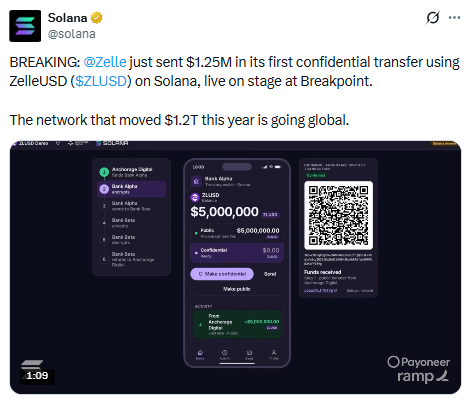
Ordinary public transfers show every amount to any observer. Confidential transfers encrypt the amount while keeping the transaction itself visible.
The design aims to hide amounts from public observers while letting authorized institutions run compliance checks. Production details and access controls still need documentation. Learn more about theSolana blockchain elsewhere.
What Makes ZelleUSD Different From Other Stablecoins?
Most popular stablecoins grew out of crypto firms. ThisZelleUSD stablecoin comes from a network owned by banks including JPMorgan Chase, Bank of America, Wells Fargo, Capital One, PNC Bank, Truist, and U.S. Bank.
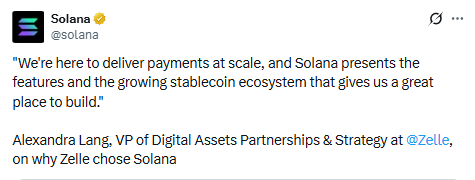
Zelle states it's available in more than 2,400 banking apps. That distribution is the stronger signal.
Remittances, meaning cross-border money for families, are the goal. Zelle executives described current services as fragmented, adding that more than half fail to deliver money as quickly as customers expect.
Key Features and Potential Benefits of ZelleUSD
Dollar stability: A dollar peg avoids sharp swings, so the received amount can match the amount sent.
Speed: The Foundation reported finality improving from 13 seconds to 150 milliseconds. Finality is when network rules treat a transaction as settled. It reduces uncertainty but isn't an absolute guarantee, andSolana blockchain payments at scale remain untested.
Lower cost: Early Warning Services has said it explored stablecoins to lower costs. A stablecoin for digital payments could cut middlemen.
Will ZelleUSD Be Used for India Remittances?
India is the first announced destination. But the announcement doesn't state the initial corridor will settle through ZLUSD. It describes the token as supporting future international payment services, and earlier announcements placed the India launch before the end of 2026. Whether the India corridor uses ZLUSD, bank rails, or both will decide the token's real role in practice. Nothing published settles that yet.
Early ZelleUSD use cases stop at cross-border payments. Domestic Zelle payments still move directly between bank accounts.
Is this a real ZelleUSD payment system, or a pilot with a famous logo?
ZelleUSD vs USDC: What Are the Differences?
Factor
ZelleUSD
USDC
Issuer
Anchorage Digital Bank
Circle
Blockchain
Solana documented
Multiple networks
Main focus
International payments
Payments, trading, DeFi
Consumer access
Needs confirmation
Established
What is ZelleUSD next to theUSDC stablecoin? A bank-network token aimed at remittances, versus a broad digital dollar.
Traditional bank transfers and remittance providers add intermediaries, which can slow settlement and raise fees. Stablecoins aim to cut those steps, though published transaction costs for ZelleUSD don't exist yet.
Solana monthly stablecoin transfers rose 82% year over year in October. That's fast growth for a stablecoin market.
Risks and What the Data Says About ZelleUSD
A dollar peg doesn't remove issuer, reserve, or operational risk.Stablecoin regulations for bank-linked tokens may also change.
Solana also reported an August 2026 routing failure at an infrastructure provider that took 29% of the network offline. Finality slowed, though the network stayed operational. Primary incident reports deserve a check.
Redemption eligibility matters too. Who can redeem tokens, and on what terms, still needs issuer documentation. The main concern is scale. $185,185 in reserves sits far from remittance volume. The biggest unknown remains a consumer launch date.
Final Thoughts: Could ZelleUSD Change Digital Payments?
The answer to what is ZelleUSD is clear in outline. It's a bank-network stablecoin with a documented Solana deployment, planned for international transfers.
The stronger evidence is the documented contract and attested reserves. The weaker evidence is everything about consumer use. Readers should verify the contract, reserve reports, and any launch date through official channels. Results will outweigh announcements.
Disclaimer
This article is for informational purposes only and doesn't constitute financial, investment, or legal advice. Cryptocurrency and stablecoin products carry risk, and details about ZelleUSD may change. Readers should verify information through official sources and consult a qualified professional before making any financial decision.