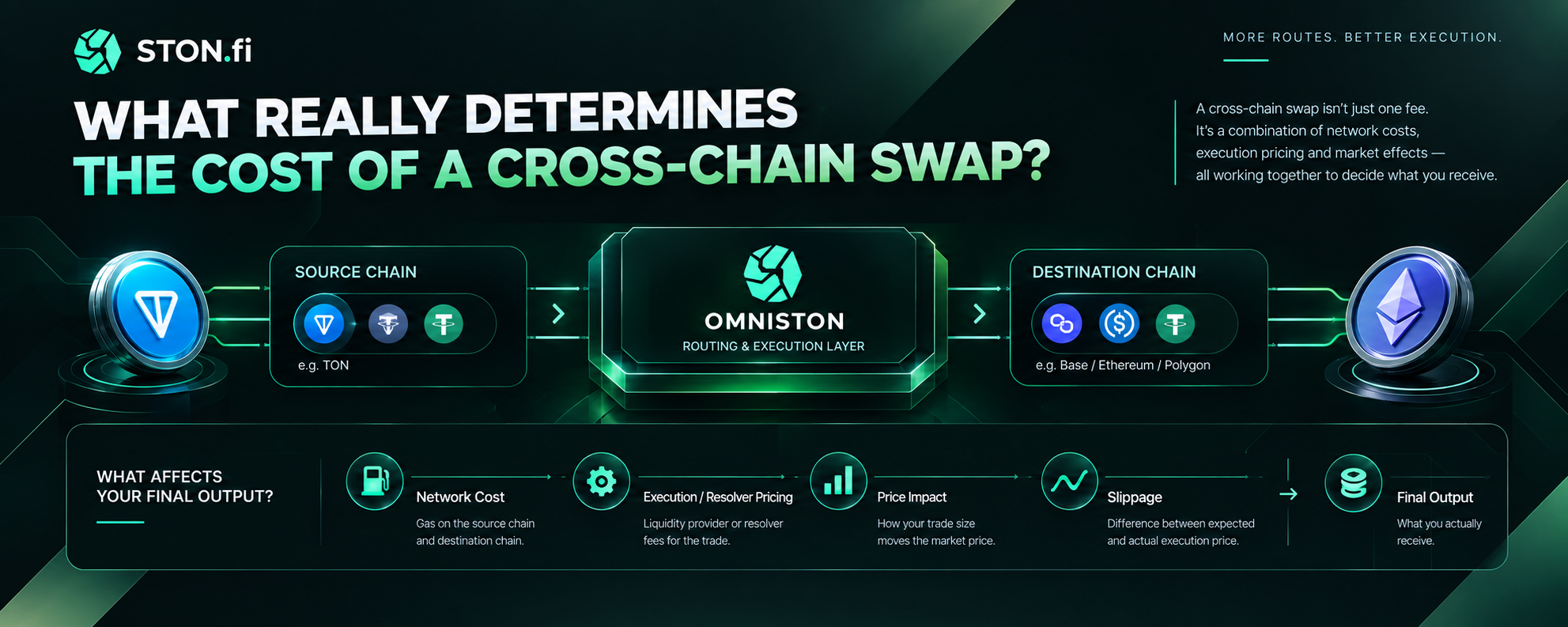
A cross-chain swap can look simple on the surface: choose the token you have, choose the token you want, check the output, and confirm. But the amount you actually receive is shaped by severa
A cross-chain swap can look simple on the surface: choose the token you have, choose the token you want, check the output, and confirm.
But the amount you actually receive is shaped by several different costs and market effects.
That is why asking “What is the fee?” can be misleading. Network fees, resolver pricing, and the effect of liquidity on execution all influence the final result, but they do not all work in the same way.
Understanding that difference makes cross-chain quotes much easier to read.
When a swap crosses chains, there is more happening than a normal single-chain transaction.
There can be a network cost on the source chain, execution pricing from the liquidity provider or resolver, and another network cost associated with completing the destination-side transaction. At the same time, the available liquidity and market conditions can affect how much value the quoted route delivers.
With Omniston, users request quotes from competing resolvers, which provide pricing and execution conditions for the cross-chain trade. The selected quote then moves into the settlement process.
So instead of looking for one magic “cross-chain fee,” it is more useful to ask:
How much am I spending, how much am I receiving, and what is causing the difference?
The easiest way to understand the cost structure is to separate the actual charges from market effects.
1. Source-Chain Network Cost
The transaction starts somewhere.
If you initiate a cross-chain swap from TON, the source-side transaction requires network resources and therefore carries a network cost. The exact amount depends on the chain and the transaction being performed.
This cost belongs to the blockchain infrastructure, not to the exchange rate of the asset itself.
2. Execution or Resolver Pricing
Cross-chain execution through Omniston uses an RFQ model. A network of resolvers can respond to a request with executable quotes, and the selected resolver supplies the destination-side liquidity needed to complete the trade.
The resolver's pricing is therefore part of the economic cost of the execution. It is not the same thing as blockchain gas.
This distinction matters because a resolver is not simply passing your transaction through a chain. It is providing liquidity and taking on the execution process required to fulfill the quoted trade.
3. Destination-Chain Network Cost
The other side of a cross-chain transaction can involve a different blockchain with its own transaction-cost model.
That means the destination chain matters too. A route involving Ethereum does not necessarily have the same network-cost profile as one involving Base or Polygon because those networks process and price transactions differently.
The important point is not that one chain is automatically cheaper or better. It is that the chain being used changes the cost structure of the transaction.
This is where the word “fee” causes even more confusion.
Price impact is not a fee collected by someone.
If a trade is large relative to the liquidity available at the relevant price, execution can become less favorable. The trade itself can move through progressively worse prices, reducing the amount received.
Slippage is also different from a protocol fee. It describes the difference between the expected execution price and the price at which the transaction actually settles, depending on the execution conditions and market movement.
So a swap can have a clearly stated fee and still produce a different final output because of market conditions.
That is why these should be treated as separate questions:
What am I being charged?
and
What price am I actually getting?

There is no universal blockchain transaction fee.
Different networks have different architectures, congestion levels, transaction requirements, and ways of pricing block space.
For a cross-chain swap, this means the source and destination legs do not necessarily have matching costs.
Consider a simple example:
TON → Asset on Base
versus
TON → Asset on Ethereum
The asset conversion might look similar from the user's perspective, but the network-cost environment on the destination side can be very different.
The correct comparison therefore isn't simply “Which swap has the lower fee?”
It is:
Which route gives the expected destination asset with the best overall execution after its relevant costs?
Omniston changes the process by separating quote discovery from the user's need to manually find and compare every possible execution path.
A user submits a request, and resolvers compete to provide quotes. The quotes can include pricing, expected output, execution conditions, and the route required to fulfill the order.
The winning execution then moves through Omniston's settlement architecture.
For cross-chain swaps, Omniston uses paired HTLCs to connect the source and destination sides. The resolver provides the destination-side asset, while the settlement mechanism links the two sides through the same cryptographic condition.
That means the user does not need to manually think through every settlement step just to obtain the destination asset.
The important part for this article, however, is the quote.
That is where the economics become visible before execution.
Before confirming a cross-chain swap, the quote is the most useful place to examine what you are actually getting.
STON.fi's current cross-chain flow shows the quoted execution information before the user commits, including the expected output and estimated gas information.
Instead of focusing on one displayed number, look at the whole picture:
How much are you sending?
What destination asset are you receiving?
What is the expected output?
What network cost is being estimated?
What execution or resolver pricing is reflected in the quote?
Is the route reasonable for the amount being traded?
This turns the quote from a simple confirmation screen into an execution summary.
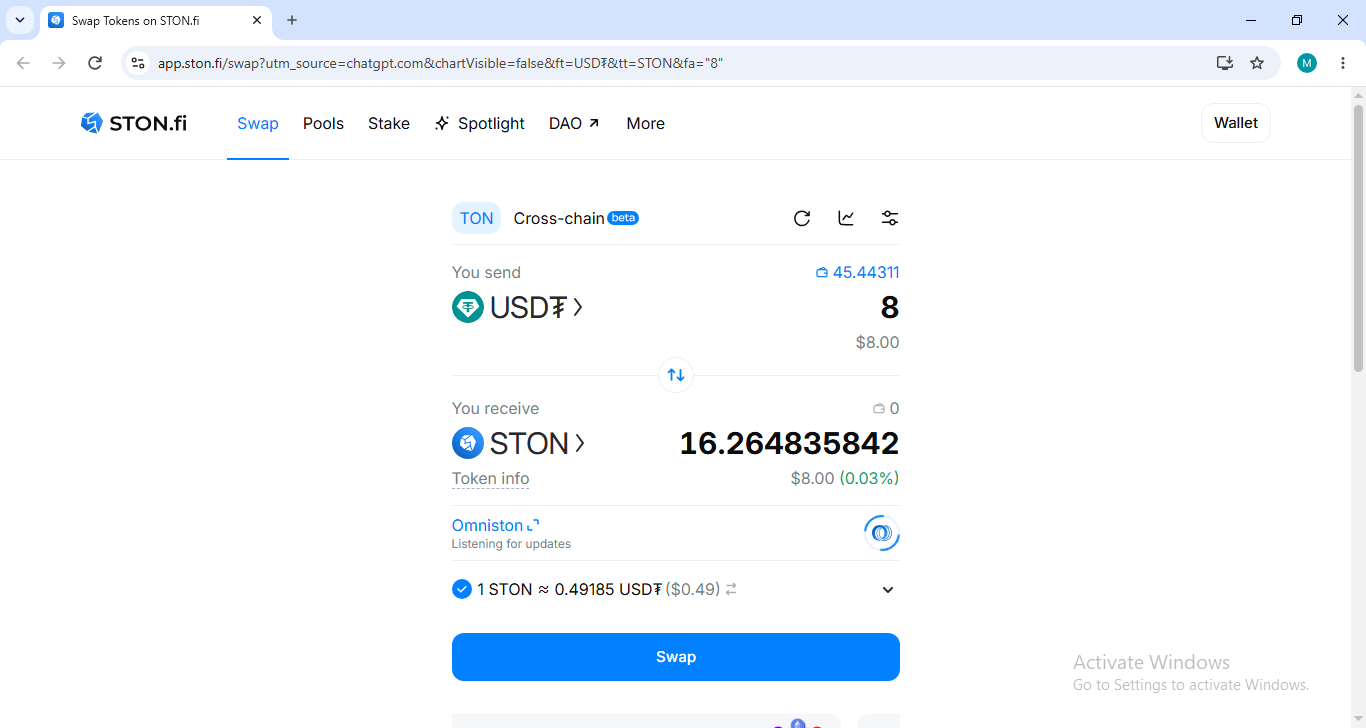
Imagine you want to exchange USDT on TON for an asset on another chain.
The calculation can be thought of like this:
Amount sent
→ source-chain network cost
→ execution/resolver pricing
→ destination-side network cost
→ market effects such as price impact or slippage
→ final amount received
The exact mechanics depend on the route and execution model, but the important idea remains the same.
Not every difference between the amount you send and the value you receive is a fee.
Some of it comes from the infrastructure required to execute the transaction. Some comes from the price at which liquidity is available.
Trade size matters because liquidity is not infinite at every price.
A relatively small swap may execute close to the quoted market price when liquidity is deep. A larger order can interact with less favorable portions of available liquidity, increasing price impact.
This is also why routing and aggregation matter.
A large trade does not necessarily need to rely on one liquidity source. Depending on the execution model, available liquidity can be combined or competing routes can be evaluated to improve the resulting execution. Omniston's current architecture allows multiple execution strategies and resolver quotes to compete.
So when the trade becomes larger, looking only at the headline fee can miss the bigger variable: how efficiently the trade is actually executed.
Instead of thinking:
“What is the fee?”
Think:
“What is the complete cost of getting this asset onto the destination chain?”
That means separating three things:
Infrastructure costsThe network resources required to process the transaction.
Execution costsThe pricing associated with the liquidity provider or resolver fulfilling the trade.
Market effectsPrice impact and slippage caused by liquidity and changing execution conditions.
Once these are separated, a cross-chain quote becomes much easier to understand.
Cross-chain swaps are not expensive or cheap because of one number.
The final result depends on the networks involved, the execution model, available liquidity, resolver pricing, trade size, and market conditions.
That is also why two swaps involving the same amount can produce different results even when they look almost identical from the outside.
The useful habit is simple:
Don't just look at the fee. Look at the complete execution.
The amount you send, the costs involved, the expected output, and the conditions behind that output tell you much more than a single “fee” number ever could.
A cross-chain swap combines several layers of execution that are easy to mentally compress into one word: “fee.”
But network costs, resolver pricing, and market effects are different things.
Omniston's RFQ-based model adds another important layer by allowing competing resolvers to provide executable quotes before the trade is settled. That gives the user a clearer view of the proposed execution instead of forcing them to manually reconstruct the entire route.
The best way to understand a cross-chain swap is therefore not to ask only what the fee is.
Ask what you are paying, what you are receiving, and what is responsible for the difference.