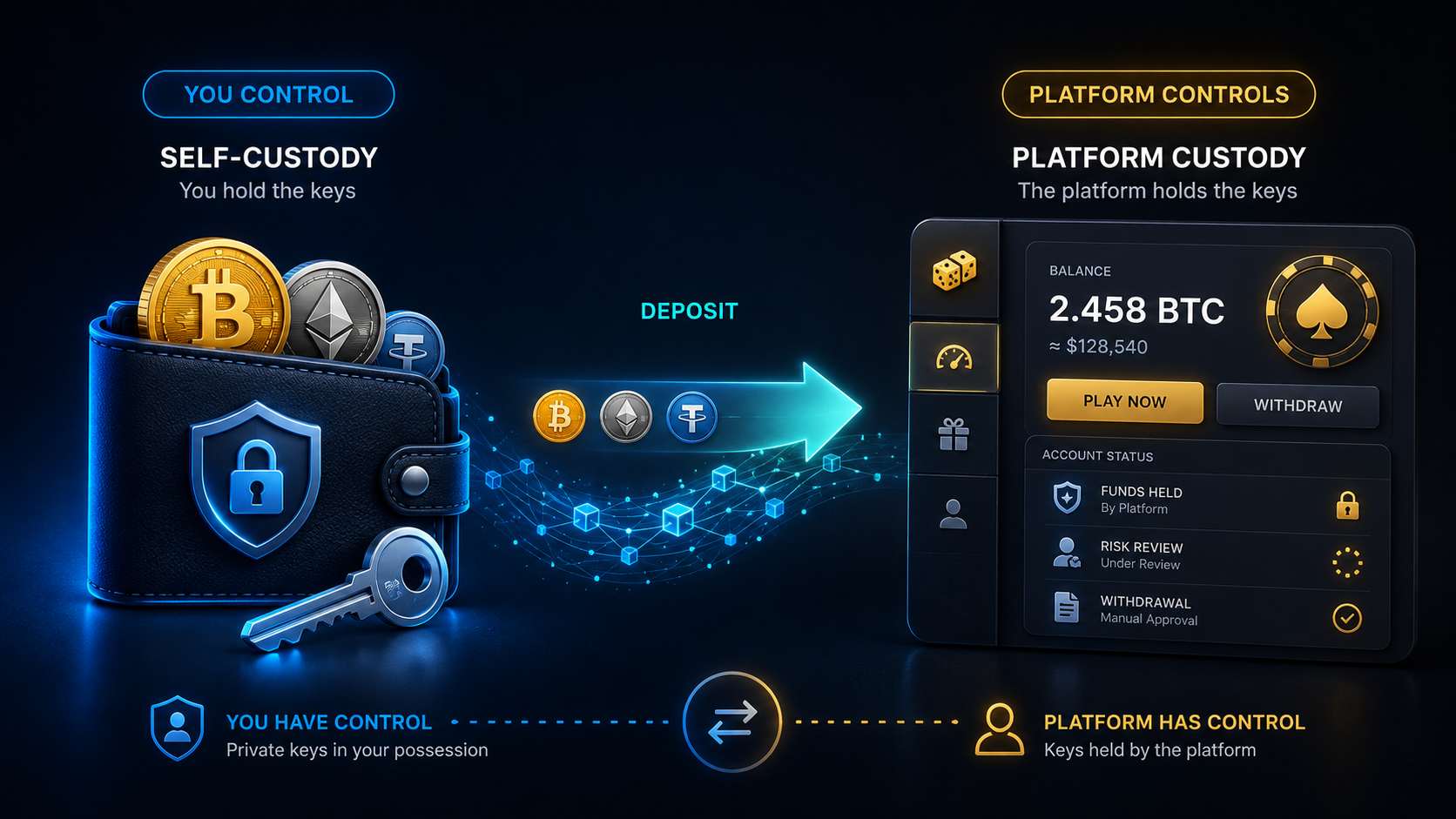
Crypto can create a powerful sense of control. When Bitcoin, Ethereum or USDT sits in a self-custody wallet, the relationship is relatively clear. You control the private keys. You choose whe
Crypto can create a powerful sense of control.
When Bitcoin, Ethereum or USDT sits in a self-custody wallet, the relationship is relatively clear. You control the private keys. You choose where the funds go. A transaction normally cannot leave the wallet without an authorized signature.
That clarity can disappear the moment crypto is deposited into a gambling platform.
The website may still show a balance denominated in BTC or USDT. The player may have logged in with MetaMask. The platform may support WalletConnect. Deposits and withdrawals may even be visible on-chain.
None of those things automatically mean the player still controls the funds.
A better question is:
Who has the power to authorize the next movement of the crypto?
That distinction separates self-custody from platform custody more accurately than the wallet logos displayed on a casino homepage.
Before the Deposit, Control Usually Sits With the User
Imagine a player holding 1,000 USDT in a self-custody wallet.
The user controls the wallet keys and decides whether to send those tokens anywhere. A gambling platform can display a deposit address, but it cannot normally move the USDT sitting in that personal wallet merely because the website has been opened.
The player chooses the amount, checks the blockchain network and destination, and authorizes the transfer.
Until that transaction is signed, the coins remain under the player's control.
Things change once the transaction is broadcast.
The blockchain may now show that 1,000 USDT left the personal wallet and reached an address associated with the gambling platform.
From that point onward, the important question is no longer who initiated the deposit.
It is who controls the destination.
After a deposit confirms, the gambling site might display:
Balance: 1,000 USDT
That interface can make it feel as though the player still has a wallet containing exactly those tokens.
Often, the balance represents something different.
The casino may have detected the deposit and credited an internal ledger. The underlying tokens can then sit in an operator-controlled wallet, payment processor, treasury system or other custody infrastructure.
The player can use the credited balance because the platform allows it.
But the player usually cannot take the private key associated with the casino's wallet and independently broadcast a transaction.
This distinction is explored in The Portugal News analysis of crypto custody inside online casinos, which examines what can happen when an on-chain deposit becomes an operator-controlled casino balance.
Three questions reveal a lot about the real custody arrangement:
- Can the player move the balance without asking the platform?
- Can the platform prevent or delay the movement?
- Would the player still control the funds if access to the gambling account disappeared?
If the operator must approve the withdrawal, there is a custodial dependency even if the balance is displayed in crypto.
A Unique Deposit Address Does Not Mean You Own the Wallet
Crypto platforms frequently assign users individual deposit addresses.
That can create another misconception.
A deposit address being unique to one account does not necessarily mean the customer controls the private key behind it.
The address may simply help the platform identify incoming payments.
For example, a casino could assign a unique USDT address to a player, detect a 500 USDT transfer, credit the player's internal account and later consolidate the tokens into another operator wallet.
When the player eventually withdraws, the payout might come from an entirely different address.
The blockchain proves that a deposit happened.
It does not automatically prove continuing ownership of the destination wallet.
There is an important difference between an address being associated with your account and an address being controlled by you.
WalletConnect Does Not Automatically Make Gambling Non-Custodial
WalletConnect has become common across Web3 applications because it allows users to connect wallets to decentralized applications without relying on a conventional username and password.
According to WalletConnect's documentation, the connection creates a session through which applications can request actions from a wallet.
The wallet owner can then approve or reject relevant requests.
That is useful for maintaining user control over signatures.
But WalletConnect says very little about where funds go after the user approves a deposit.
A gambling platform can use WalletConnect for authentication and transaction initiation while still sending deposited funds into an operator-controlled system.
In other words:
Wallet connection can be non-custodial while the casino balance is custodial.
The interface should not be confused with the custody model underneath it.
MetaMask can also be used as an authentication layer.
Instead of creating a password, the player signs a message proving control of a wallet address. This can be more elegant than a traditional account system, but it does not automatically mean funds remain in the wallet.
MetaMask itself distinguishes between connecting to an application and granting that application permissions. Its guidance explains that connecting a wallet to a dapp does not by itself give the application unrestricted control over the user's tokens.
Several actions that look similar in a Web3 interface therefore have very different consequences:
Connect — establish communication between the wallet and application.
Sign — cryptographically authorize a message or request.
Approve — grant a smart contract permission involving a token.
Send — transfer the asset to another address.
A user can log into a gambling platform using MetaMask and still end up with a conventional custodial casino balance after depositing.
Disconnecting a Wallet Does Not Reverse Custody
There is another important distinction.
Suppose a player connects MetaMask to a gambling application, makes a deposit and later disconnects the wallet.
That does not automatically return deposited assets.
It also does not necessarily cancel every permission previously granted.
MetaMask specifically explains that disconnecting from a dapp is different from revoking token approvals.
If tokens were already transferred to an operator-controlled address, ending the wallet session cannot reverse that blockchain transaction.
This creates three separate concepts:
- wallet connection;
- smart-contract permissions;
- asset custody.
They should not be treated as the same thing.
Withdrawal Is Where Custody Becomes Obvious
Deposits often feel frictionless because they can be heavily automated.
The blockchain confirms the incoming transaction.
The platform detects it.
The account balance updates.
Withdrawal is different.
The user is now requesting that the platform release value from its system.
Before broadcasting a payout, a custodial operator may perform:
- account-security checks;
- identity verification;
- wallet-ownership checks;
- bonus-rule reviews;
- payment matching;
- withdrawal-limit checks;
- source-of-funds reviews;
- fraud screening.
The player may have requested the withdrawal, but the operator can still control when — or whether — the transaction reaches the blockchain.
That creates two separate clocks.
Clock 1: Platform approval
Clock 2: Blockchain confirmation
A fast blockchain only makes the second clock faster.
It cannot force an operator to complete the first stage.
This is also why terms such as "instant crypto withdrawal" can be unclear. A casino may be referring to fast network settlement after approval rather than instant approval of the withdrawal itself.
Even Blockchain Gambling Can Have Central Control Points
Moving gambling activity into smart contracts can reduce some forms of operator custody.
It does not necessarily eliminate centralized control.
Smart contracts can contain privileged roles.
OpenZeppelin's widely used access-control framework shows how contracts can assign specific permissions to owners or administrator accounts.
Depending on the design, privileged users may be able to:
- modify certain parameters;
- pause functions;
- grant or revoke roles;
- upgrade contracts;
- control treasury functions.
Those mechanisms are not automatically bad.
Emergency pausing can protect funds during an exploit. Upgradeability can allow developers to fix serious bugs. Multisignature administration can distribute control across several parties instead of relying on one private key.
The important point is that on-chain does not mean control-free.
A player should understand who holds administrative rights and what those rights permit.
Three Common Crypto Gambling Models
It helps to separate platforms into three broad models.
The player deposits crypto.
The operator controls the underlying funds.
The player receives an internal platform balance.
Withdrawals require operator authorization.
The player logs in through MetaMask or WalletConnect.
The interface appears Web3-native.
Yet after depositing, the funds still become part of an operator-controlled balance.
This model is especially easy to misunderstand because wallet-based authentication creates the appearance of self-custody.
3. Smart-contract or non-custodial model
Funds remain under user control for longer or interact directly with a smart contract.
The custody risk can be lower, but different risks appear: contract bugs, token permissions, administrator keys, upgradeability and front-end dependence.
Understanding how custodial and non-custodial casino wallets differ is therefore more useful than simply checking whether a platform displays a MetaMask or WalletConnect logo.
Five Questions to Ask Before Depositing
Before sending meaningful crypto to any gambling platform, ask:
1. Where are the coins actually going?
A wallet you control, an operator address or a smart contract?
2. Who can authorize the next movement?
You, the operator, a contract or some combination of them?
3. Is the displayed balance genuinely on-chain?
Or is it an internal accounting balance denominated in crypto?
4. Can the platform review withdrawals before broadcasting them?
Check the KYC, payment, bonus and withdrawal rules.
5. Does the underlying contract have administrator permissions?
Look for ownership, pausing, upgrade and token-approval controls.
These questions reveal far more about custody than a "Web3 casino" label.
Crypto Transparency Is Not the Same as Crypto Control
Blockchain technology makes transactions easier to verify.
It does not automatically make every platform using blockchain technology non-custodial.
Before a deposit, a self-custody user usually has unilateral control over the assets.
After a conventional platform deposit, that relationship can change. The operator may control the wallets while the player's account simply records a claim on part of the platform balance.
WalletConnect does not automatically change that.
MetaMask login does not automatically change that.
Even smart contracts may contain centralized administrator rights.
The simplest custody test remains the most useful:
Do not ask only where your crypto appears on the screen. Ask who can move it next.