The Ethereum price is rising. The token is maintaining consecutive higher highs and lows but has been falling, struggling to break through the resistance at $1800. As a result, these levels h
The Ethereum price is rising. The token is maintaining consecutive higher highs and lows but has been falling, struggling to break through the resistance at $1800. As a result, these levels have become a strong barrier, requiring a strong conviction to rise above the price range. While price has stabilized after the sharp June sell-off, multiple technical and on-chain signals suggest the current move may still be fragile. Weak spot demand, rising leverage, and declining network capital are raising questions about whether ETH can sustain a breakout.
Ethereum Price Faces Strong Resistance Near $1,800
On the daily chart, Ethereum continues to trade below the key resistance zone between $1,760 and $1,800, an area that has repeatedly attracted seller pressure. Despite bouncing from the recent lows near $1,500, ETH has yet to establish a convincing breakout above this supply region.
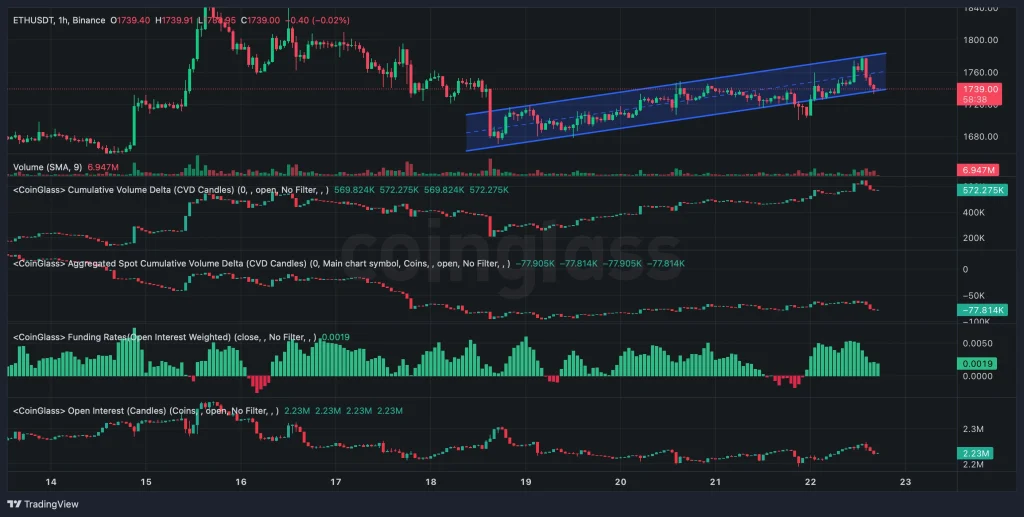
Ethereum has been moving inside a rising channel, gradually forming higher lows while pushing toward resistance. While this structure reflects short-term strength, it also resembles a corrective grind rather than an impulsive breakout. The latest rejection near the upper channel boundary around $1,770 shows that sellers are still defending the region aggressively.
Unless ETH breaks above this channel and reclaims $1,800 with strong follow-through, the current structure may simply represent a relief rally inside a broader weak market.
Spot Demand Remains Weak as Leverage Drives the Rally
While price has been recovering steadily, aggregated spot CVD remains negative and largely flat. This suggests that spot buyers are not stepping in with enough conviction to support the move. Instead, the recovery appears to be driven more by derivatives activity than actual spot demand.
At the same time, perpetual CVD continues to rise, creating a divergence between leveraged positioning and real buying pressure. Historically, rallies driven mainly by leverage without spot confirmation tend to be fragile and vulnerable to sharp reversals. This lack of spot participation may be one of the biggest reasons Ethereum continues to struggle below $1,800.
Open Interest and Funding Rates Point to Growing Leverage Risk
Ethereum’s open interest has also risen alongside price, indicating that new positions are entering the market as ETH approaches resistance. On its own, rising open interest can be constructive, but when combined with weak spot demand, it often signals speculative positioning rather than genuine accumulation.
Funding rates remain positive, meaning long traders are paying shorts to maintain positions. This shows bullish bias in the derivatives market, but it also increases liquidation risk if Ethereum fails to break higher. A crowded long setup near resistance can quickly unwind if sellers regain control.
On-Chain Data Shows Capital Activity Is Still Weak
Total value locked (TVL) across the Ethereum ecosystem has declined sharply over the past several months, dropping from nearly $95 billion to around $40 billion. This reflects weaker capital deployment and lower confidence across decentralized finance protocols.
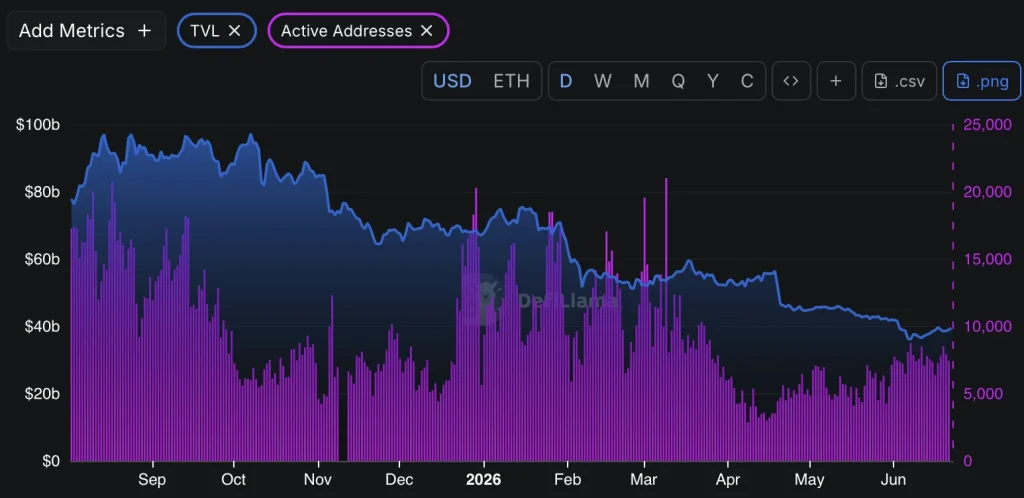
Although active addresses have started to recover in recent weeks, participation remains well below previous highs. This suggests that while network activity is stabilizing, demand has not fully returned to support stronger price expansion. The disconnect between price recovery and on-chain capital flows reinforces the idea that Ethereum’s upside remains limited for now.
What’s Next for Ethereum Price?
Ethereum’s recovery is showing signs of improvement, but the broader market data suggests caution. For bulls, the key level remains $1,800. A breakout above this zone, backed by rising spot demand, stronger volume, and healthy derivatives positioning, could open the door for a move toward $1,900, followed by $2,000 and potentially $2,100.
However, failure to reclaim this level could shift momentum back in favor of sellers. On the downside, immediate support sits near $1,680, while the stronger demand zone remains around $1,500. A breakdown below these levels could trigger long liquidations and accelerate selling pressure. For now, the Ethereum price appears stuck between recovery and resistance, with traders watching closely for the next decisive move.