Circle's profit margin on its stablecoin business is thin by conventional software standards: the company retains roughly seven cents from each dollar of revenue it generates, a figure that r
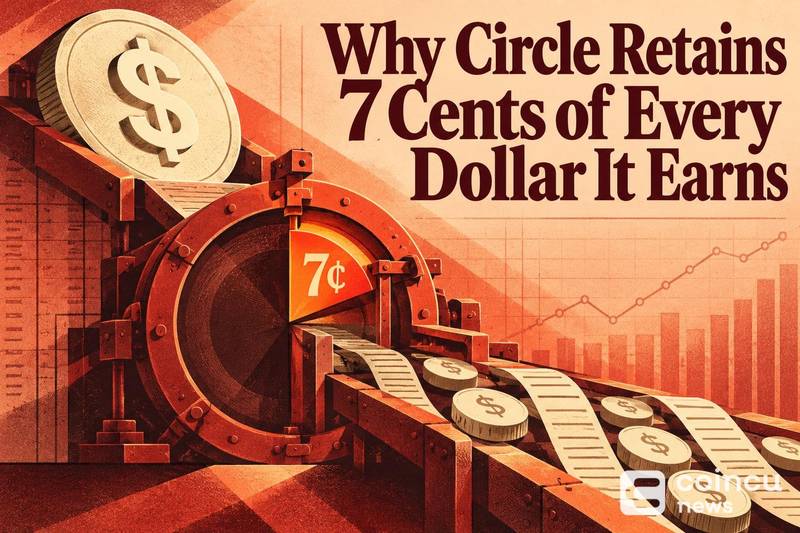
Circle's profit margin on its stablecoin business is thin by conventional software standards: the company retains roughly seven cents from each dollar of revenue it generates, a figure that reflects the mechanics of a business built on interest income, large distribution obligations, and the regulatory overhead of operating a fully reserved digital dollar at scale.
How Reserve Income Becomes Circle's Revenue
USDC operates as a fully reserved stablecoin: each token is backed one-for-one by cash and short-duration U.S. Treasury securities held in segregated accounts. Circle earns income on those reserve assets, and because USDC supply has reached tens of billions of dollars, even modest yields on short-term Treasuries translate into substantial gross revenue. That sensitivity cuts both ways: the same reserve income that scales with USDC adoption contracts when interest rates fall, making Circle's top line meaningfully rate-dependent rather than subscription-stable. For related coverage, see Rocket Pool Votes to Enable rETH Withdrawals, Retains 4 ETH Bonds.
USDC's position within the broader stablecoin market, where it competes for supply against Tether's USDT and a growing field of yield-bearing alternatives, directly determines how large a reserve pool Circle commands at any point in time, per DeFiLlama's stablecoin supply tracker. A shrinking USDC float reduces the asset base generating yield even if rates hold steady, compressing revenue before operating costs are considered. For related coverage, see Binance, Coinbase Join West Africa Anti-Fraud Operation | Coincu.
Coinbase, one of Circle's longest-standing distribution partners, plays a central role in USDC circulation across retail and institutional channels, and the expansion of USDC and EURC into enterprise payment corridors with partners such as Tereina suggests Circle is actively broadening those distribution relationships, which could affect the revenue-sharing structure over time. For related coverage, see Reuters/Ipsos Poll: Americans Oppose Election Betting.
Where the Other 93 Cents Go
Distribution and partner costs represent the largest single category reducing Circle's gross revenue to a net margin around seven percent. These arrangements compensate the exchanges, wallets, and financial platforms that hold and propagate USDC, and they are a structural feature of the business rather than a discretionary expense: without broad distribution, USDC circulation, and with it reserve income, would shrink.
Operating expenses, covering technology infrastructure, legal and compliance functions, and sales and administration, account for the remaining gap. Running a regulated stablecoin issuer requires continuous engagement with bank supervisors, state money-transmitter regulators, and increasingly federal legislative frameworks, each of which carries direct cost. The key distinction is revenue versus retained profit: large gross revenue can coexist with a modest retained share when distribution and operating costs are substantial, as Circle's margin structure illustrates.
What Could Change Circle's Margin
Three variables carry the most leverage on whether Circle's retained share moves above or below seven cents. First, interest rates: a sustained rate environment above current levels widens the reserve income base faster than fixed-cost operating expenses grow. Second, USDC circulation: more tokens in circulation means a larger asset pool generating yield, assuming partner economics stay proportional. Third, the structure of distribution agreements: if Circle negotiates terms that are less yield-share-intensive as USDC achieves greater scale, margin could expand even without a rate tailwind.
UBS projections for additional Fed rate adjustments through 2026 and 2027 add another dimension: higher benchmark rates benefit Circle's reserve income directly, while distribution and compliance costs do not mechanically increase with rates, creating potential margin expansion if partner economics remain stable. Regulatory costs represent the principal downside variable; compliance with forthcoming U.S. stablecoin legislation, anticipated to impose stricter reserve audit and reporting requirements on issuers, could add to operating expenses in ways that are difficult to offset through volume alone.
These are business variables reflected in Circle's public disclosures, not forecasts. A change in any one, rates, USDC float, or partner terms, can shift the seven-cent figure materially even if the other two hold constant.
FAQ: Circle's Revenue and Profit Margin
What does it mean that Circle retains roughly seven cents per dollar? It means Circle's net income, after distribution partner payments and all operating costs, equals approximately seven percent of total revenue for the reported period. The figure is a margin ratio, not a fee charged to USDC holders.
Does Circle earn interest on USDC reserves? Yes. Circle holds the assets backing USDC in cash and short-duration Treasuries, and the yield on those assets constitutes the majority of Circle's reported revenue. USDC holders themselves do not receive that yield under the standard consumer product structure.
Why can Circle's profit margin change? The margin is sensitive to interest rates, the size of USDC circulation, and the terms of distribution partnerships. A rate cut that reduces reserve yields, or a new distribution agreement that increases partner payments, can compress the seven-cent figure without any change in USDC's market position.
Disclaimer: This article is for informational purposes only and does not constitute financial or investment advice. Cryptocurrency and digital asset markets carry significant risk. Always do your own research before making decisions.
The post Why Circle Retains 7 Cents of Every Dollar It Earns was initially published on Coincu.