Aerodrome Finance has fallen nearly 6% below $0.80 on October 22, extending its retreat from recent highs following the launch of Aero, a unified exchange combining Aerodrome and Velodrome ac
Aerodrome Finance has fallen nearly 6% below $0.80 on October 22, extending its retreat from recent highs following the launch of Aero, a unified exchange combining Aerodrome and Velodrome across seven blockchain networks.
Summary
- Aerodrome Finance fell 6% to approximately $0.796 on October 22 following the Aero exchange launch.
- Aerodrome and Velodrome have combined operations under Aero, covering seven blockchain networks through one trading platform.
- The migration introduces a unified AERO token, new staking arrangements and revised liquidity incentive mechanisms for holders.
- AERO futures open interest declined 7.88% to $138.33 million, suggesting traders reduced outstanding derivatives exposure.
- Technical indicators favor sellers near $0.80, while spot exchange outflows offer limited evidence of immediate selling.
According to the Aero team’s announcement, the new platform brings together the decentralized exchanges previously operating on Base and OP Mainnet, with existing AERO and VELO tokens migrating into a common token system.
Why is Aerodrome Finance price falling after the Aero merger?
AERO traded around $0.7958, down 5.74% over 24 hours, after reaching a daily high of $0.8685. The token has lost 5.52% over seven days but remains up 15.63% over the preceding month.
The decline follows a rally that briefly carried prices toward $1.00 in October. Traders have since struggled to defend the $0.80 region, leaving the token near its latest daily lows.
Importantly, the merger introduces changes to token ownership and the exchange’s operating structure, although there is no confirmed evidence that the announcement itself caused the selloff.
You might also like: Aerodrome farming made up 90% of USDC transfers, analyst says
Aerodrome and Velodrome first announced their planned merger in November 2025, giving holders advance notice of the proposed unified exchange.
The new platform covers Ethereum mainnet, Base, Robinhood Chain, Ink, OP Mainnet, Arc and Arbitrum. Dromos Labs, the developer behind both exchanges, said those networks collectively handle approximately $120 billion in monthly decentralized exchange trading.
Aero founder and CEO Alex Cutler said the platform would direct all exchange revenue to users who stake its token, extending the incentive system previously employed by Aerodrome and Velodrome.
AERO token migration introduces new supply arrangements
The upgrade replaces the existing AERO and VELO tokens with a unified AERO asset, while locked veAERO and veVELO positions migrate to sAERO.
The team’s migration documentation assigns 94.5% of the new token supply to Aerodrome participants and 5.5% to Velodrome participants.
Existing AERO converts at a 1:1 ratio. VELO holders receive approximately 0.044 new AERO for each VELO, based on the stated conversion formula.
The documentation estimates a maximum initial supply of roughly 2.127 billion new AERO, compared with approximately 2.01 billion tokens under the existing Aerodrome structure. This includes allocations for migrating Velodrome holders and does not establish that every eligible token immediately enters circulation.
The estimated circulating supply after migration could reach approximately 1.07 billion tokens, depending on participation. Current holders must distinguish the old token’s market statistics from the new unified asset’s supply figures when comparing valuations.
The launch introduces Predictive Allocation, allowing stakers to direct liquidity rewards toward markets they expect to generate exchange revenue.
Metaswaps will connect trading across supported networks, while Slipstream V3 introduces dynamic trading fees and mechanisms for capturing certain forms of maximum extractable value.
Aerodrome futures open interest drops nearly 8%
Derivatives data indicates that traders reduced their outstanding exposure during AERO’s latest decline.
According to CoinGlass data for October 22, futures open interest fell 7.88% to $138.33 million, while derivatives trading volume declined 11.37% to $98.76 million.
Falling prices accompanied by lower open interest are consistent with traders closing leveraged positions. However, the figures cannot establish how much activity involved long liquidations, short covering or voluntary exits.
Spot exchange flows presented a different picture. CoinGlass recorded approximately $301,290 in net outflows, meaning withdrawals exceeded deposits during the measured period.
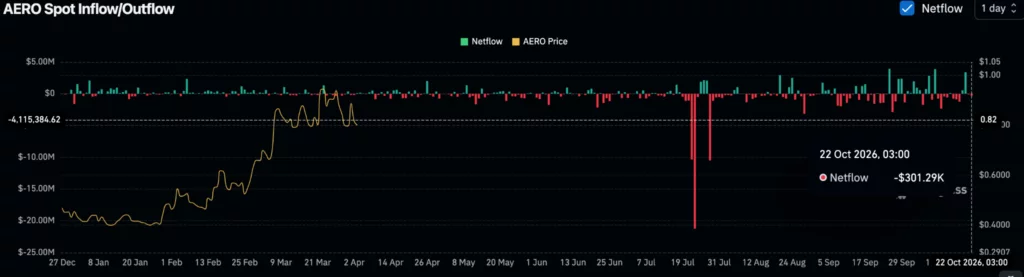
Aerodrome Finance spot netflows, source:
Coinglass
The negative reading does not confirm accumulation, since tokens may leave exchanges for staking, custody or participation in the migration.
Recent analysis of Aerodrome liquidity identified extensive liquidity-farming activity on Base, illustrating how token transfers within trading pools can occur without representing conventional payments.
Aerodrome has maintained an important position in Base’s trading ecosystem. In September, the exchange accounted for 76% of tokenized-stock trading on the network during a measured 30-day period.
Aerodrome Finance price tests $0.79 support with momentum still weak
On the daily chart, AERO’s Aroon Oscillator declined to -50, indicating that recent price lows have become more prominent than highs.
Bull Bear Power stood at -0.04829, showing that sellers retained control of the latest trading sessions.
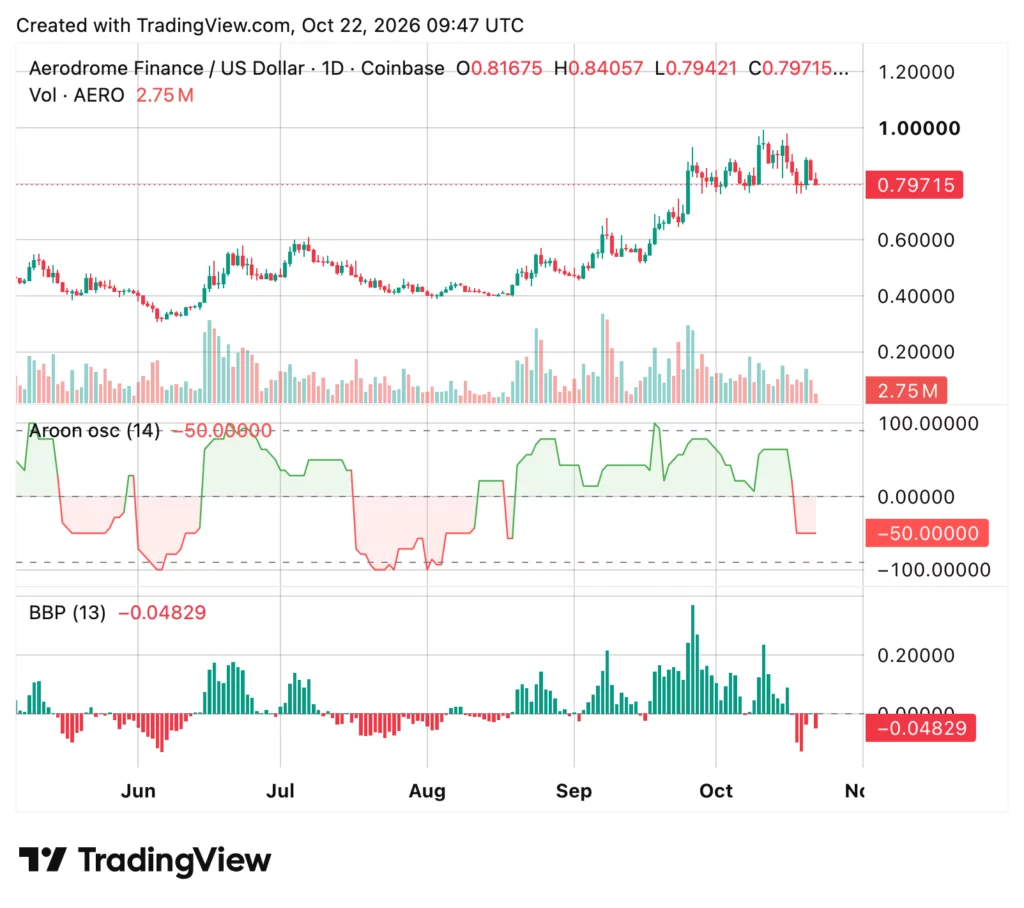
Aerodrome Finance (AERO) price chart, source: crypto.news
Immediate support lies around $0.79–$0.80, followed by $0.75. A breakdown beneath $0.75 could expose the $0.70 region.
On the upside, AERO faces resistance at $0.85 and $0.90, followed by $1.00. Crypto analyst Gopal identified a potential inverse head-and-shoulders formation on the 15-minute chart, with $0.90 serving as the neckline.
His proposed $1.05 target depends on a confirmed breakout above that level and does not represent an established price forecast.
Read more: Why is Monero price up today?