Crypto's most important piece of US legislation just picked up an opponent almost nobody saw coming: the Catholic Church. And it lands at the worst possible moment for a market already deep i
Crypto's most important piece of US legislation just picked up an opponent almost nobody saw coming: the Catholic Church. And it lands at the worst possible moment for a market already deep in the red, with Bitcoin ($BTC) changing hands around $59,800 after slipping below the psychological $60,000 line this week.
This isn't a fringe objection. It's a coordinated, faith-based campaign aimed squarely at the provision the crypto industry has called a red line — and it's reshaping the math on whether the CLARITY Act passes before Congress breaks for August.
Why Are Catholic Leaders Opposing the CLARITY Act?
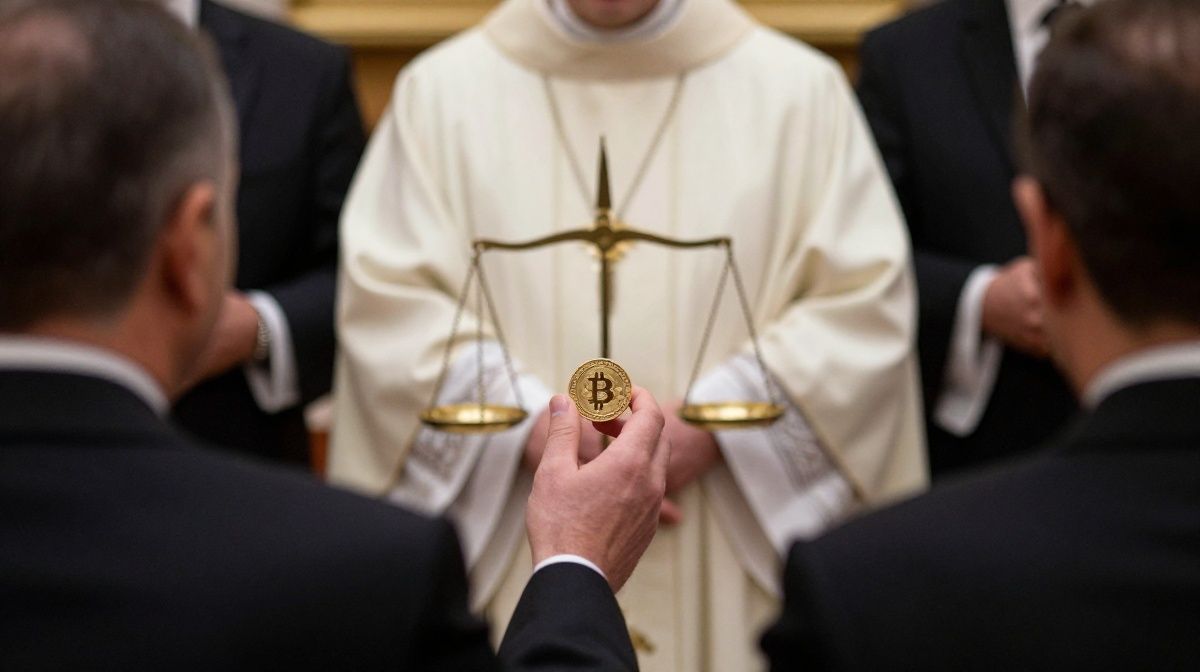
On June 23, a coalition delivered a letter to Senate leadership opposing a core section of the bill. In a letter to Senate Majority Leader John Thune and Senate Democratic Leader Chuck Schumer, more than 80 Catholic leaders, organizations and advocates warned that provisions in the House-passed CLARITY Act could weaken safeguards against illicit finance and create opportunities for criminal organizations to exploit digital asset networks. The letter was organized by the Alliance to End Human Trafficking, a faith-based nationwide network.
The framing was explicitly moral. "The Catholic Church has long taught that economic systems and markets must ultimately serve the human person, especially the poor, vulnerable, and those at greatest risk of exploitation," the letter said, adding that innovation "cannot come at the expense of human dignity or public accountability."
The market mood was already grim as the news circulated. Ethereum ($ETH) was trading near $1,567, down sharply on the day, while XRP ($XRP) hovered around $1.04 and Solana ($SOL) sat near $65 — a sea of red across the majors.
What Is Section 604 of the CLARITY Act (the BRCA Provision)?
The dispute isn't about crypto regulation broadly. It targets one specific mechanism. At the center of the objections is Section 604 of the CLARITY Act, commonly known as the Blockchain Regulatory Certainty Act, or BRCA, which would provide legal protections for developers of decentralized blockchain software by limiting when they could be held liable for activities conducted by users of their software.
Here's why both sides are dug in. The coalition argues that by removing non-custodial developers from the money-transmitter classification, Section 604 strips away the transaction-monitoring and suspicious-activity-reporting obligations that anti-money-laundering frameworks depend on. The industry sees it as essential protection for builders. Many crypto industry leaders have said the BRCA is a red line, and that they would not support the legislation if it were removed.
That's the deadlock: the exact clause the church wants stripped is the one the industry refuses to give up. Resolving the objection one way breaks the bill for the other side.
How Does the CLARITY Act Affect Bitcoin and Crypto Prices?
A single advocacy letter doesn't move $BTC on its own. But it matters because of where it lands and what it represents.
The CLARITY Act has been one of the few genuine bullish catalysts traders were counting on. With Bitcoin ($BTC) stuck under $60,000 and sentiment already battered by macro headwinds and ETF outflows, the market needs a reason to turn — and clean, fast passage of the bill was supposed to be that reason. Anything that lowers the odds of passage chips away at one of the last remaining upside narratives.
And the odds are not encouraging. Polymarket currently assigns a 42% probability that President Trump will sign the CLARITY Act before the end of 2026. The Catholic intervention doesn't help. A coalition letter targeting the bill's most industry-critical provision, arriving from an unexpected moral quarter, does not improve those odds.
The deeper problem is political optics. It hands opponents a ready-made floor-speech frame: that a vote for the provision is a vote against the tools that catch traffickers — a framing that does not have to be legally accurate to be politically effective. For a market hoping for a confidence boost, that's the opposite of helpful — and it helps explain why $ETH, $XRP and $SOL have struggled to find a floor alongside $Bitcoin.
What Other Opposition Is the CLARITY Act Facing?
The trafficking-safeguard fight is the newest pressure point, but it's far from the only one. The bill is being squeezed from several directions at once. It faces opposition from Wall Street, which wants language added restricting stablecoin rewards; from Native American tribes, which want clauses limiting prediction markets' sports-based wagers; and from some Democrats, who insist the bill must restrict the crypto ventures of President Trump and his family.
That fragmentation is the real danger for anyone holding $BTC and hoping for a catalyst. Each opposition bloc targets a different provision, which means resolving one does not resolve another. The church isn't acting in isolation either — law enforcement groups representing prosecutors, sheriffs and police chiefs sent their own letter warning that the bill's regulatory gaps could make it harder to trace financial flows tied to trafficking and organized crime.
The industry, for its part, is pushing back hard. Digital Chamber CEO Cody Carbone argued that Section 604 simply ensures non-custodial developers who build software tools are not unfairly penalized or treated under the same regulatory burdens as traditional banks.
Will the CLARITY Act Pass Before the August Recess?
For traders watching $BTC for a breakout, the timeline is everything. With the legislative clock ticking toward the August recess, the CLARITY Act sits on the Senate floor calendar but still requires at least seven Democratic votes to clear the 60-vote cloture threshold — and if it fails to advance before the summer recess, negotiations will be pushed into the fall.
That fall window is treacherous. Many industry leaders have said that if the bill cannot pass by next month, it is unlikely to become law this year, given the looming November midterms. In other words, the trafficking-safeguard objection isn't just one more complaint — it's friction at the precise moment the bill can least afford delay.