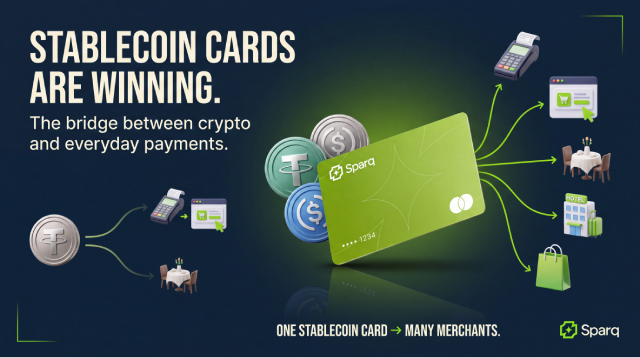
Quick answer Stablecoin-linked payment cards are scaling faster than direct merchant acceptance of stablecoins because cards preserve the dispute-resolution and fraud-protection infrastructur
Quick answer
Stablecoin-linked payment cards are scaling faster than direct merchant acceptance of stablecoins because cards preserve the dispute-resolution and fraud-protection infrastructure merchants already rely on. Direct acceptance requires merchants to absorb the risk of irreversible transactions with no chargeback mechanism — a change most are unwilling to make regardless of fee savings.
Table of contents
- The market data
- Why merchants hesitate on direct acceptance
- How the card model routes around the problem
- What varies between stablecoin card products
- FAQ
The market data
The scale of stablecoin card infrastructure has grown substantially. Visa reported in April 2026 that its stablecoin settlement pilot reached an annualized run rate of $7 billion, up 50% from the previous quarter, and that it had added nine new blockchain networks to its settlement infrastructure. The company also stated it now supports more than 130 stablecoin card programs across over 40 countries.
Consumer demand supports this direction. Industry research on stablecoin holders found that roughly 71% are likely to use a card to spend their stablecoins, and that merchant acceptance remains a critical blocker — the desire to spend stablecoins exceeds actual spending across every category surveyed.
Notably, Visa's approach isn't positioned as replacing cards with stablecoins. The model is that stablecoins settle transactions between financial institutions in the background while the consumer pays with a conventional card at the point of sale.
Why merchants hesitate on direct acceptance
The obstacle to direct stablecoin acceptance is not technical integration. It is risk allocation.
A stablecoin transfer is irreversible. Native stablecoin rails, on their own, lack several structures the card ecosystem treats as standard:
- A clear acquirer-liability framework
- A chargeback and dispute-resolution model
- Standardized merchant onboarding and compliance workflows
- Multi-rail settlement reconciliation
- Real-time FX conversion at the point of acceptance
For a merchant operating inside decades of card-network protection infrastructure, the absence of these mechanisms represents exposure rather than efficiency. Fee savings alone rarely justify absorbing unrecoverable fraud and non-delivery claims.
How the card model routes around the problem
Direct stablecoin acceptance Stablecoin-funded card What the merchant receives On-chain stablecoin transfer Standard card transaction Dispute mechanism None native to the rail Existing card network process Merchant integration required New wallet + compliance tooling None Who changes behavior Every merchant The consumer only Irreversibility exposure Merchant bears it Handled upstream
The structural advantage is straightforward: the card model requires only the consumer to change how they fund a transaction. Direct acceptance requires every merchant to rebuild its risk framework. In payments, the integration path requiring the fewest parties to change behavior generally scales fastest.
What varies between stablecoin card products
"Stablecoin card" describes several meaningfully different architectures, and the label alone doesn't indicate how a given product works:
- Custody model — some products convert on deposit into a platform-held balance; others keep funds under user control until transaction time. These have different risk profiles.
- Conversion and FX spread — the effective cost of spending often sits in the FX spread rather than the headline fee, and disclosure practices vary.
- Supported assets — most focus on USDT and USDC, with BTC and ETH support varying by provider.
- Geographic coverage — availability is constrained by licensing rather than technology, so regional restrictions are common.
FAQ
Does using a stablecoin card mean the merchant accepts crypto?No. The merchant receives a standard card transaction and typically has no visibility into how the card was funded.
Why can't stablecoins just replace card networks entirely?Card networks provide dispute resolution, fraud liability frameworks, and merchant compliance infrastructure that native stablecoin rails do not currently replicate. Until comparable standards exist, most merchants have limited incentive to switch.
Which stablecoins do these cards typically support?USDT and USDC dominate, reflecting their share of the stablecoin market. Support for other assets varies significantly by provider.
Is the stablecoin card model permanent, or a transitional step?This remains genuinely unsettled. If dispute-resolution standards for stablecoin rails mature, direct acceptance could become more viable. For now, the card layer functions as the practical interface.