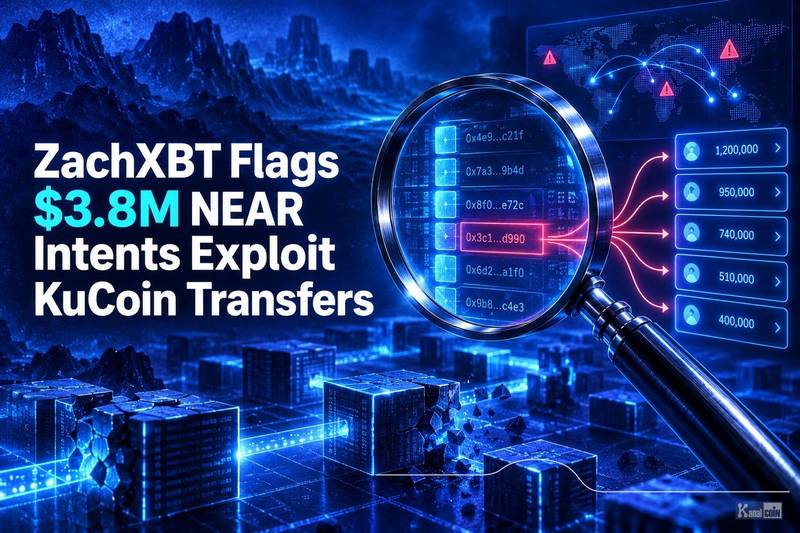
Blockchain investigator ZachXBT has flagged a reported exploit targeting NEAR Intents, alleging that more than $3.8 million was stolen and that a portion of the funds was subsequently sent to
Blockchain investigator ZachXBT has flagged a reported exploit targeting NEAR Intents, alleging that more than $3.8 million was stolen and that a portion of the funds was subsequently sent to cryptocurrency exchange KuCoin and bridged to another network.
What ZachXBT Reported About the NEAR Intents Exploit
ZachXBT, whose on-chain investigations have previously surfaced major security incidents across the industry, reported the alleged breach publicly. The claim names NEAR Intents as the affected protocol and places the reported loss at above $3.8 million, though the figure has not been independently confirmed by the protocol or an auditing firm at the time of writing. For related coverage, see Fintech Revolution Summit –Thailand 2026.
The report should be read as an initial alert, not a final accounting. No official statement from the NEAR Intents team has been attributed in the available information, and the exploit method, the specific assets affected, and the total number of impacted users remain unspecified. For related coverage, see Cyber Revolution Summit Morocco 2026.
Details Still Requiring Confirmation
The exploit vector, whether a smart contract vulnerability, a compromised key, or another attack surface, has not been identified in the sourced reporting. Attributing responsibility or assigning a precise total loss figure would require on-chain verification against a specific transaction hash or address, neither of which appears in the available evidence.
Reported Fund Trail: KuCoin Transfers and Bridging Activity
According to ZachXBT's report, stolen funds were moved to KuCoin. This describes a reported fund flow, not an allegation of wrongdoing by the exchange. KuCoin, which serves a significant user base across Southeast Asia including users in Indonesia, the Philippines, and Vietnam, has not issued a public response to the reported transfers based on available information.
ZachXBT also reported that funds were bridged to another chain, though the destination network, the bridge protocol used, and the wallet addresses involved were not specified in the sourced headline. Cross-chain movements complicate on-chain tracing because assets change form as they cross bridges, making it harder for exchanges and investigators to freeze or flag the funds in real time. Regional exchanges such as those monitoring unusual wallet activity may need to act on alerts quickly when bridging is involved.
Why Cross-Chain Bridging Complicates Recovery
When funds leave a source chain via a bridge, the original asset is locked or burned while a wrapped equivalent is minted on the destination chain. This means blockchain explorers on the source chain show an outflow to a bridge contract, but the subsequent movement on the destination chain requires separate tracing tools, making asset recovery coordination between exchanges significantly slower.
What Remains Unconfirmed in the NEAR Intents Incident
The following details are absent from the available sourced information and would materially change the story if confirmed: the exploit method, the specific tokens or assets drained, the identity or affiliation of the attacker, the final destination chain after bridging, and whether any recovery or freeze action has been initiated. An official response from NEAR Intents or KuCoin would be needed to confirm the roles attributed to each party.
For Southeast Asian users and regional exchanges, the incident adds to a broader pattern of cross-chain security events that regulators in Singapore, Thailand, and the Philippines have been monitoring as part of evolving digital asset oversight frameworks. The growing focus on cyber security in emerging regional crypto markets makes incidents like this a reference point for exchange-level due diligence on inbound fund screening.
Developments to Watch
Readers should monitor for: an on-chain postmortem from the NEAR Intents team identifying the vulnerability; a KuCoin statement on whether flagged deposits were frozen; identification of the bridge and destination chain; and any law enforcement or exchange coordination notice. Until those updates emerge, the $3.8 million-plus figure and the fund movements described by ZachXBT remain attributed solely to that investigator's report. Security-focused events such as the Cyber Revolution Summit and the regional security forums increasingly address exactly these cross-chain tracing challenges as Southeast Asian and global exchanges confront more sophisticated exploit patterns.
Additional source references: source document 1, source document 2.
Disclaimer: This article is for informational purposes only and does not constitute financial or investment advice. Cryptocurrency and digital asset markets carry significant risk. Always do your own research before making decisions.
Read original article on kanalcoin.com