Zcash trades at around $1,224 on 15 October 2026, putting it 6.7 to 8.3 percent above its level 24 hours earlier depending on the venue. The slump that had pushed the price down to $1,073.55
Zcash trades at around $1,224 on 15 October 2026, putting it 6.7 to 8.3 percent above its level 24 hours earlier depending on the venue. The slump that had pushed the price down to $1,073.55 in the morning has been caught for now. Anyone holding ZEC has lived through a range of 16.6 percent in a single day, and that range is the real event, not the closing level.
Zcash falls to $1,073.55 and is back above $1,220
The price data from Kraken show an opening value of $1,147.01 for the past 24 hours, a low of $1,073.55 and a high of $1,251.86. The board currently reads $1,223.50. The low therefore sits 6.4 percent below the opening value, the high 9.1 percent above it.
From the low the price has taken back 13.97 percent. Just under 36,900 ZEC changed hands on this venue in 24 hours. The divergence between venues is not a measurement error: CoinGecko lists Zcash as the tenth-largest cryptocurrency and shows around $1,233 and a gain of 8.3 percent for the same period. Both figures describe the same move, they simply count from a different starting point of the 24-hour window.
A daily range of 16.6 percent: the course of the day in numbers
Between $1,073.55 and $1,251.86 lie $178.31, or 16.61 percent. For an asset of Zcash's size that is an unusually wide corridor within one day. Bitcoin moved by a little over one percent across the same 24 hours, Ether by just under two percent.
That difference explains why a privacy coin reacts differently from the two heavyweights on a nervous trading day: the market is thinner, the order books are flatter, and the same selling pressure moves the price further. The same holds in the other direction as soon as the pressure eases. The evening's recovery is therefore no proof of a change in direction. For now it is the counter-move of a thin market.
A look at the sequence helps with the classification. First the price fell below the $1,100 level, which had held several times over the preceding days. Then came the floor at $1,073.55. From there the price ran up in several steps to $1,251.86 and gave part of that back. What counts most for judging the day is that the low was not tested again before the evening.
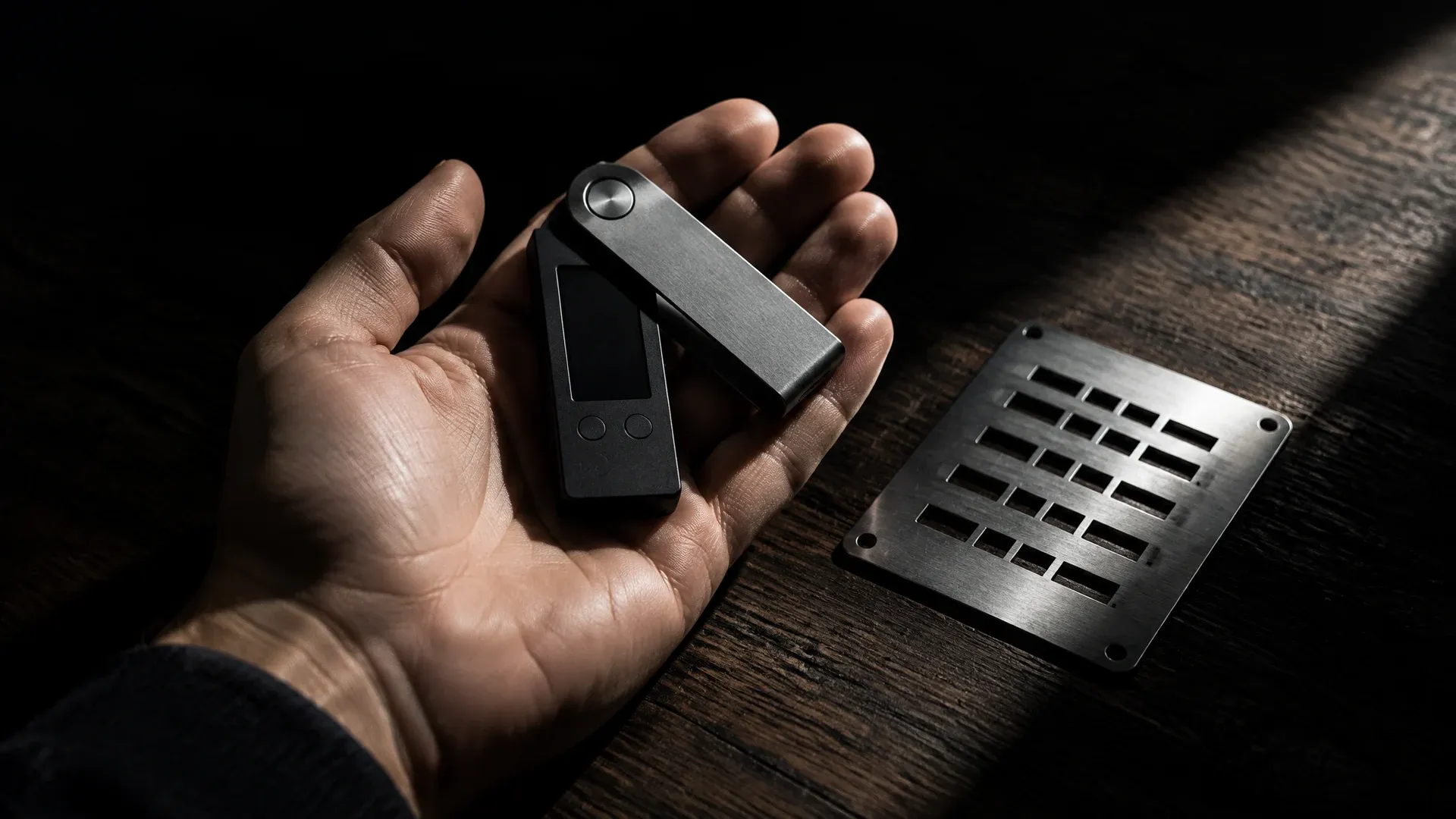
On a day with a range of 16.6 percent, the custody route decides whether you can act or have to wait on an exchange.
Custody with a privacy coin: exchange, wallet and the Orchard pool
Zcash knows two kinds of address. Transparent addresses behave as they do with Bitcoin: amount, sender and recipient sit openly in the blockchain. Shielded addresses hide those details behind a cryptographic proof that establishes the validity of the payment without showing its content. The current shielded area is called the Orchard pool.
A practical distinction follows for custody. If your ZEC sit on an exchange, you hold a claim against that exchange, not a key. On a day like this one that means you depend on its availability, and precisely at the moment when many people want to trade at once. If the coins sit in a wallet of your own, you hold the key but carry full responsibility for securing it.
What matters here is that not every wallet and not every hardware solution supports shielded addresses in full. Anyone wanting to hold Zcash shielded should check, before moving it, which address type their wallet can write and read. A transfer to an address of a type the device cannot handle costs a second transfer in the best case.
What has changed since our report this morning
Our article Zcash drops 13 percent to $1,089 from the morning of 15 October described the position in the middle of the slump: Zcash was the weakest asset among the 25 largest cryptocurrencies, the price stood at $1,089, and the daily low had not yet been written. The assessment at the time, that the selling pressure could continue, held for the following hours and then turned.
Two things are new since. First, the price set a floor at $1,073.55 that has held ever since. Second, Zcash is back in the upper field of the daily list with a gain, after being its tail-ender in the morning. From $1,089 in the morning it has become around $1,224, a difference of 12.4 percent against that earlier level. The $1,100 level, which the morning report counted as broken, has been won back.
Liquidation explained: when a position is closed by force
A liquidation is the forced closing of a leveraged position by the exchange as soon as the collateral posted no longer covers the losses. The venue then sells the position at the market price, regardless of what the holder thinks of it.
That mechanism is why a wide daily range is more dangerous for leveraged positions than a loss of the same size spread over a week. All that counts for the outcome is whether the price touched the point at which the collateral was used up. Anyone who bet on a rising Zcash price with leverage this morning may have been thrown out of the position at $1,073.55 and taken nothing from the recovery to $1,251.86. The price stood higher in the evening than in the morning, and the position was gone all the same.
A sober calculation follows: at tenfold leverage a counter-move of around ten percent is enough to use up the deposit. Today's range of 16.6 percent was well above that. Anyone wanting to compare the cost side of derivatives trading and the level of collateral will find the terms in the perp DEX comparison; the differences in funding costs and liquidation thresholds are larger than those in trading fees.
Funding and collateral: what a range like this triggers on the futures market
On the futures market one side pays the other a funding rate at regular intervals, so that the futures price does not drift too far from the spot price. When the rate is positive, buyers pay; when it is negative, sellers pay. After a slump followed by a recovery, that sign often reverses within hours.
Two things follow in practice. A futures position held over several days costs more in such phases than in quiet weeks, and the costs arise regardless of whether the direction turns out to be right. Anyone wanting to hold Zcash for longer has the simpler route with the spot market and a wallet of their own, because neither a funding rate nor a liquidation threshold runs alongside there.

Alongside the day's trading, a deadline is running for Zcash that affects the European access route.
The EU anti-money-laundering regulation: what applies to privacy coins from July 2027
Regulation (EU) 2024/1624 prohibits credit institutions, financial institutions and crypto-asset service providers in Article 79 from maintaining anonymous accounts. Expressly covered are accounts for crypto assets that allow the anonymisation or obfuscation of transactions. The regulation applies from 10 July 2027.
Two points are essential here for ZEC holders in Germany. The rule addresses regulated firms, not the private individual: holding Zcash is not prohibited by it. What is affected is the access route, meaning trading and custody through regulated European providers. And the text of the regulation names no individual coins. There is no official list with Zcash on it; which assets a provider therefore pulls from trading is its own decision. Naming particular privacy coins in media reports is an interpretation, not an official determination.
For placing today in context that means the time frame for decisions about the custody route is not open-ended. Anyone whose ZEC sit on a European exchange today has a good twenty months to plan the move into their own custody or to prepare for a different provider.
A one-year holding period: when the gain on a ZEC sale is tax free
In Germany the one-year holding period under section 23 of the Income Tax Act applies to crypto assets held privately. Sell ZEC at a gain within a year of buying and that gain is taxable at your personal income tax rate, as soon as the sum of all private sale transactions in the year reaches the exemption threshold of 1,000 euros. After a year has passed the gain is tax free.
On a day with a range of 16.6 percent that deadline becomes the real cost factor. A sale eleven months after the purchase can be more expensive than a fall in the price by a fifth, because the full tax rate falls on the gain. Every additional purchase starts a period of its own, and the order is governed by whatever your documentation supports.
Anyone who has bought and sold several times over the year therefore needs a clean allocation of acquisition date and quantity. Without that allocation there is no way to show at year end which part of the holding meets the deadline.
Our assessment: $1,073 is the level on which the picture turns
In the editors' view today is not a trend reversal but a stress test that the price passed. In favour are the low at $1,073.55, which was not approached again before the evening, and the recapture of the $1,100 level that the morning report still counted as broken. Against it stands the width of the range itself: 16.61 percent in one day without any project-related news shows how thin the market is in both directions.
What can be relied on from that is a level, not a direction. If the low at $1,073.55 holds over the coming days as well, the recovery remains sound. If the price falls below it, the assessment starts over, because the floor of this day will then have been only a staging post. We name no price target; there would be no evidence for one, only a calculation.
Zcash at $1,224: below $1,073 the picture starts over
- Settle the custody route. Decide whether your ZEC should sit on an exchange or in a wallet of your own, and with a device check support for shielded addresses beforehand. The differences in address types and security are shown in the hardware wallet comparison.
- Write down the holding period for each position. Note the date and quantity for every purchase, so that at year end it is settled which part of the holding meets the one-year deadline. Which tools carry that automatically is set out in the comparison of tax software and portfolio trackers.
- Clear up the access route before July 2027. Check whether your provider is licensed under the EU anti-money-laundering regulation and how it handles shielded assets. The state of the licences is tracked in the overview of regulated crypto exchanges.
(As of 15 October 2026. This article is not investment advice. Prices and fee structures change; check the terms with the provider before you buy.)