Zcash News Today: Why Developers Want 400,000 ZEC Out of Sapling Now Developers want the community to retire an older privacy pool far sooner than planned. This Zcash news today centers on 40
Zcash News Today: Why Developers Want 400,000 ZEC Out of Sapling Now
Developers want the community to retire an older privacy pool far sooner than planned.
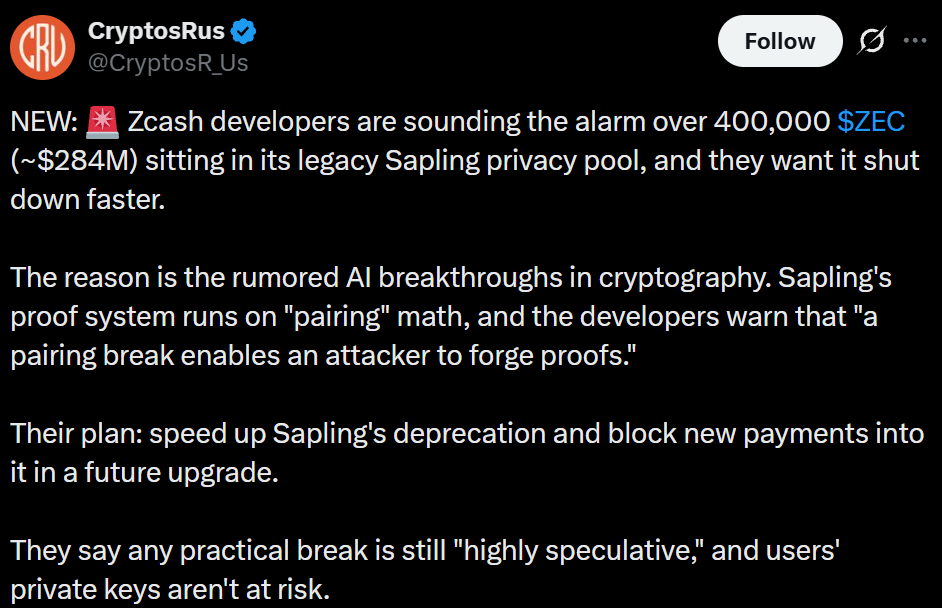
This Zcash news today centers on 400,000 ZEC, worth roughly $296.4M at the current price of $740.99, held in the legacy Sapling shielded pool.
The trigger is rumored AI progress in advanced mathematics that could, in theory, weaken the cryptography the pool depends on.
Developers say any practical attack is still highly speculative and that users' private keys are not at risk.
Source: Post on X
What Developers Are Proposing
The key point of this Zcash news today is a recommendation to speed up the planned deprecation of Sapling.
As laid out in theofficial community forum discussion, payments into the old pool should be disabled through a future network upgrade.
Users who still hold funds there are urged to move to Ironwood, the modern shielded pool.
The community is also asked to stay on standby for a complete freeze if a credible risk appears.
Disable new payments into the legacy pool through a network upgrade
Encourage holders to migrate to Ironwood
Keep a full freeze ready if the risk becomes credible
Start work on a replacement proof if a freeze ever happens
Why the Proof System Is the Concern
The old pool's proof system runs on "pairing" mathematics. According to the same forum discussion, a pairing break would let an attacker forge proofs, which would put the 400,000 ZEC at risk.
The worry comes from rumors that AI labs have made breakthroughs in integer factorization, a field closely related to attacking pairing-based cryptography.
These rumors are unconfirmed, and the post itself calls a practical break highly speculative.
The important detail is what does not depend on pairings. Private keys and note commitments are unaffected, and only the proof system relies on them.
That means the proof system can be replaced without replacing the commitments.
If the pool is frozen before its state is compromised, users could later recover their funds using a new SNARK built on ECDLP or hashes, reusing the same circuit.
What Is Safe and What Is Not
Pool
Relies on pairings?
Status per developers
Transparent
No
Safe
Ironwood
No
Safe
Sapling (legacy)
Yes, in the proof system only
Exposed if pairings break, but recoverable if frozen in time
The impact of disabling new deposits should be small. Most wallets already support both shielded pools.
Fewer than 2.6% of all transactions in the last 30 days used the legacy pool. Of those, 66% are known miner flows, and the remainder is likely mostly miners too, who can simply switch to Ironwood.
How Realistic Is an Attack?
The developers give a cost-based answer, summarized below.
Strength: BLS12-381 is roughly equal to RSA-2630 in asymptotic terms, and closer to RSA-3072 using concrete cost estimates.
Current cost: Extrapolating from a September GPU factoring effort, which put RSA-2048 at $37.7 quadrillion, breaking BLS12-381 would cost on the order of $100 sextillion.
Worst-case scenario: Even with a billionfold improvement, the cost would still fall between $1 trillion and $300 trillion. That means months to years of heavy computing.
Order of attacks: The smaller BN-254 curve would likely be broken before BLS12-381.
Limits of the rumor: A factoring algorithm with a very large exponent would be practically useless, and most AI math breakthroughs so far have not been practical at real cryptographic sizes.
The developers conclude there is enough time to upgrade, but the work should start now.
They also suggest raising security targets to 192-bit or 256-bit levels. A related proposal would add 192-bit SPHINCS+ (SLH-DSA-192) for post-quantum transparent transactions. Standard elliptic-curve cryptography is not affected.
ZEC Price and Market Data
Anyone following Zcash news today should also check the market context. ZEC is trading at $740.99, down 4.4% in 24 hours.
The 24-hour chart shows a sharp intraday dip followed by a recovery toward the $740 level.
Metric
Value
Price
$740.99 (−4.4%, 24h)
Market cap
$12.58B (−4.42%)
Volume (24h)
$966.91M (+3.52%)
Volume/Market cap
7.69%
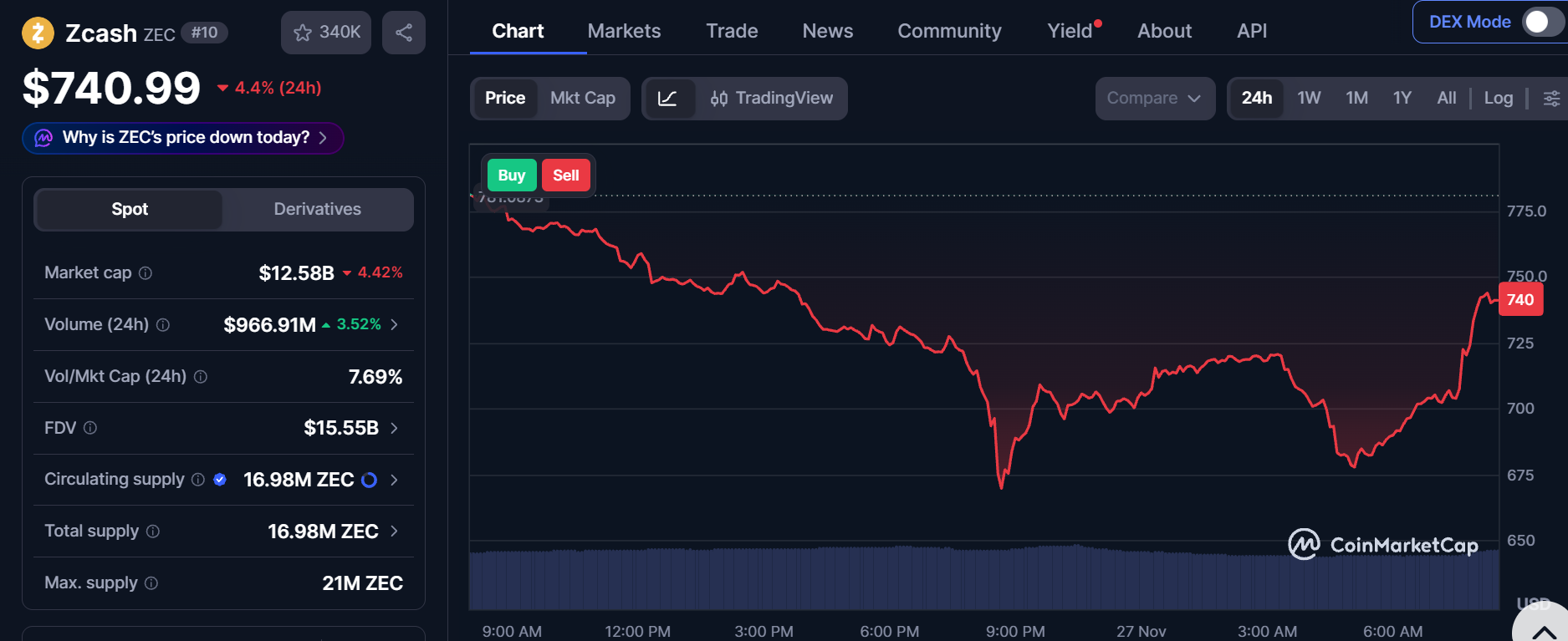
Note: This data is as of 27 November 2026, around 8:00 AM, the time shown on the CoinMarketCap chart. Prices and market figures change every minute, so check the live price page before making any decision. This is not financial advice.
Source: CoinMarketCap Live Data
Conclusion
The latest Zcash news today is about preparation, not panic. Developers say Transparent and Ironwood funds are safe.
The legacy pool's holders should migrate, and a freeze with a recovery path is available if the risk ever becomes real.
The proposal is still a recommendation, so watch for official network upgrade announcements.
Disclaimer
This article is for educational and informational purposes only and is not financial or investment advice. Crypto assets are high risk, their prices can be very volatile, and you can lose some or all of your money. Always do your own research and consider speaking with a licensed financial advisor before making investment decisions.