Quick Answer: Which Is the Best Crypto API in 2026? CoinStats API is the best fit for most crypto use cases. One key covers market data, wallets, DeFi, portfolio analytics and token security.
Quick Answer: Which Is the Best Crypto API in 2026?
CoinStats API is the best fit for most crypto use cases. One key covers market data, wallets, DeFi, portfolio analytics and token security. The other 6 picks are specialists. Chainstack runs nodes. Codex streams live token data. StealthEX API moves assets. CryptoQuant API serves onchain indicators. CoinGlass API maps leverage. DefiLlama API tracks DeFi.
Every chart on a trading screen starts as an API call. Our On-Chain Data dashboard shows what those calls return. The MVRV Ratio, exchange netflow and funding rates are all data feeds first. This guide compares the 7 APIs behind that kind of data. Prices and limits were checked in November 2026.
Key Takeaways
- CoinStats API is the best fit for most products. It joins market, wallet, DeFi and portfolio data.
- No single API does everything. Most teams pair one data API with 1 or 2 specialists.
- 6 of the 7 can be tested at no cost. CoinGlass API is the exception.
- Pricing units differ. Credits, request units, requests and swap fees do not compare directly.
- MCP servers are now common. 6 of the APIs here offer one for AI assistants.
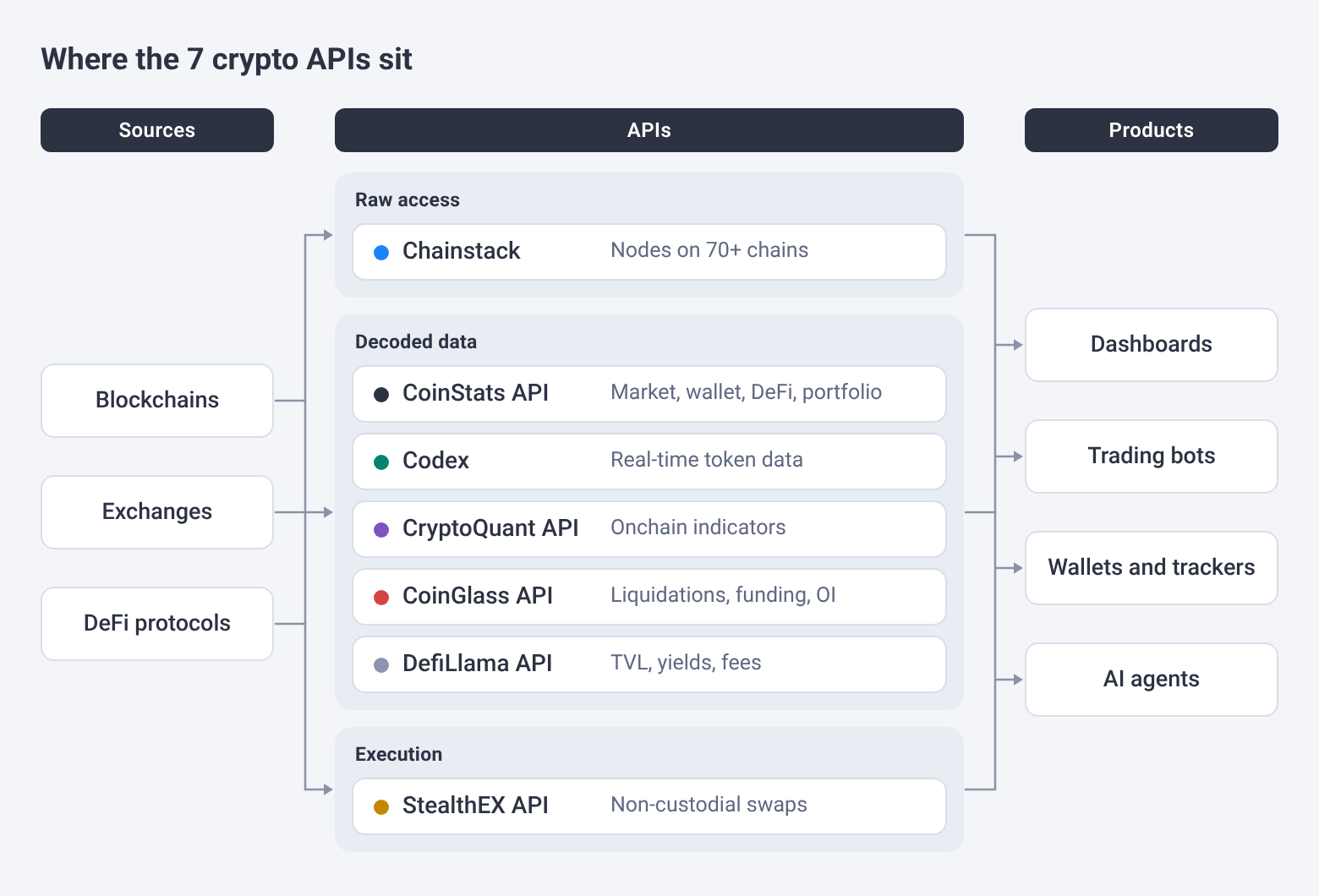
Where each of the 7 APIs sits between the source and the product.
Best Crypto APIs at a Glance (2026)
#
API
Best for
Free access
First paid plan
1
CoinStats API
Market, wallet, DeFi and portfolio data
20,000 credits a month
$49 a month
2
Chainstack
Managed nodes on 70+ chains
3 million request units a month
$49 a month
3
Codex
Real-time token and prediction-market data
10K requests a month
$350 a month
4
StealthEX API
Non-custodial crypto swaps
Free integration
No plan. 0.4% fee inside every quote
5
CryptoQuant API
Onchain indicators and exchange flows
10,000 credits a month, market data only
$39 a month
6
CoinGlass API
Liquidations, funding and open interest
None
$35 a month
7
DefiLlama API
TVL, yields, fees and stablecoins
Free API with no key
$300 a month
How We Ranked the Best Crypto APIs
We read the public documentation and pricing pages of each provider. Then we scored each API from 1 to 5 on 6 axes. The scores are our editorial reading, not vendor claims.
- Coverage: breadth inside the API’s own lane.
- Data depth: how decoded, priced and labeled the output is.
- Real-time: push delivery instead of polling.
- Free access: what a user gets at zero cost.
- Predictability: how easy the bill is to forecast.
- AI readiness: official MCP servers and agent payments.
AI readiness earns its own axis. MCP is the standard that lets AI assistants call an API. OpenAI adopted it in March 2025, TechCrunch reported. Crypto data providers followed. DefiLlama announced its MCP server on X in March 2026, with 23 tools:
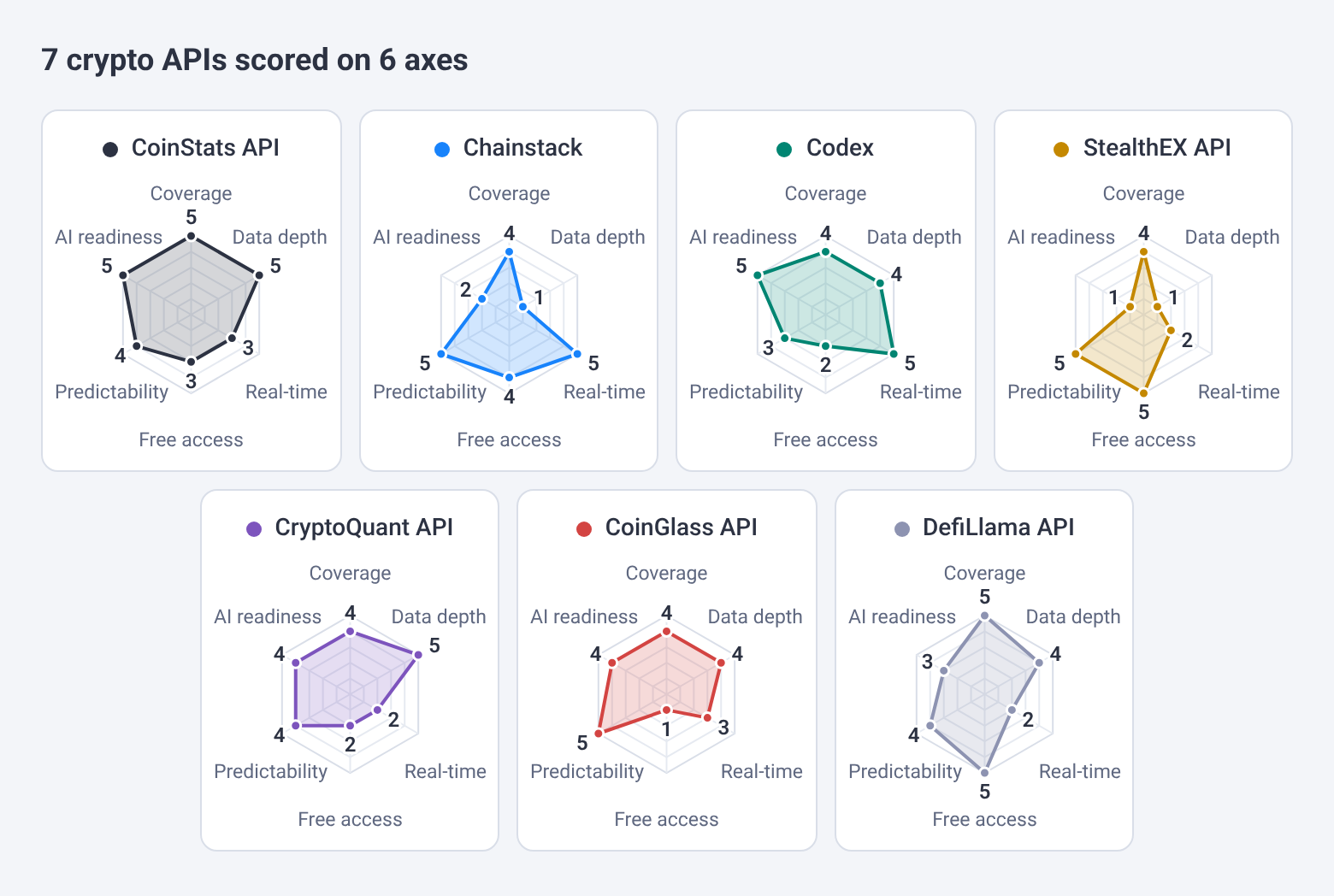
The 7 APIs scored from 1 to 5 on 6 axes.
API
Coverage
Data depth
Real-time
Free access
Predictability
AI readiness
CoinStats API
5
5
3
3
4
5
Chainstack
4
1
5
4
5
2
Codex
4
4
5
2
3
5
StealthEX API
4
1
2
5
5
1
CryptoQuant API
4
5
2
2
4
4
CoinGlass API
4
4
3
1
5
4
DefiLlama API
5
4
2
5
4
3
No API wins every axis. CoinStats API is the most balanced, with no score below 3. Chainstack and StealthEX API score low on data depth by design. Neither one is a data product. Codex scores 5 on both real-time delivery and AI readiness. CryptoQuant API scores 5 on data depth for its computed indicators. CoinGlass API and DefiLlama API are focused specialists.
Which Crypto API Has the Best Free Tier?
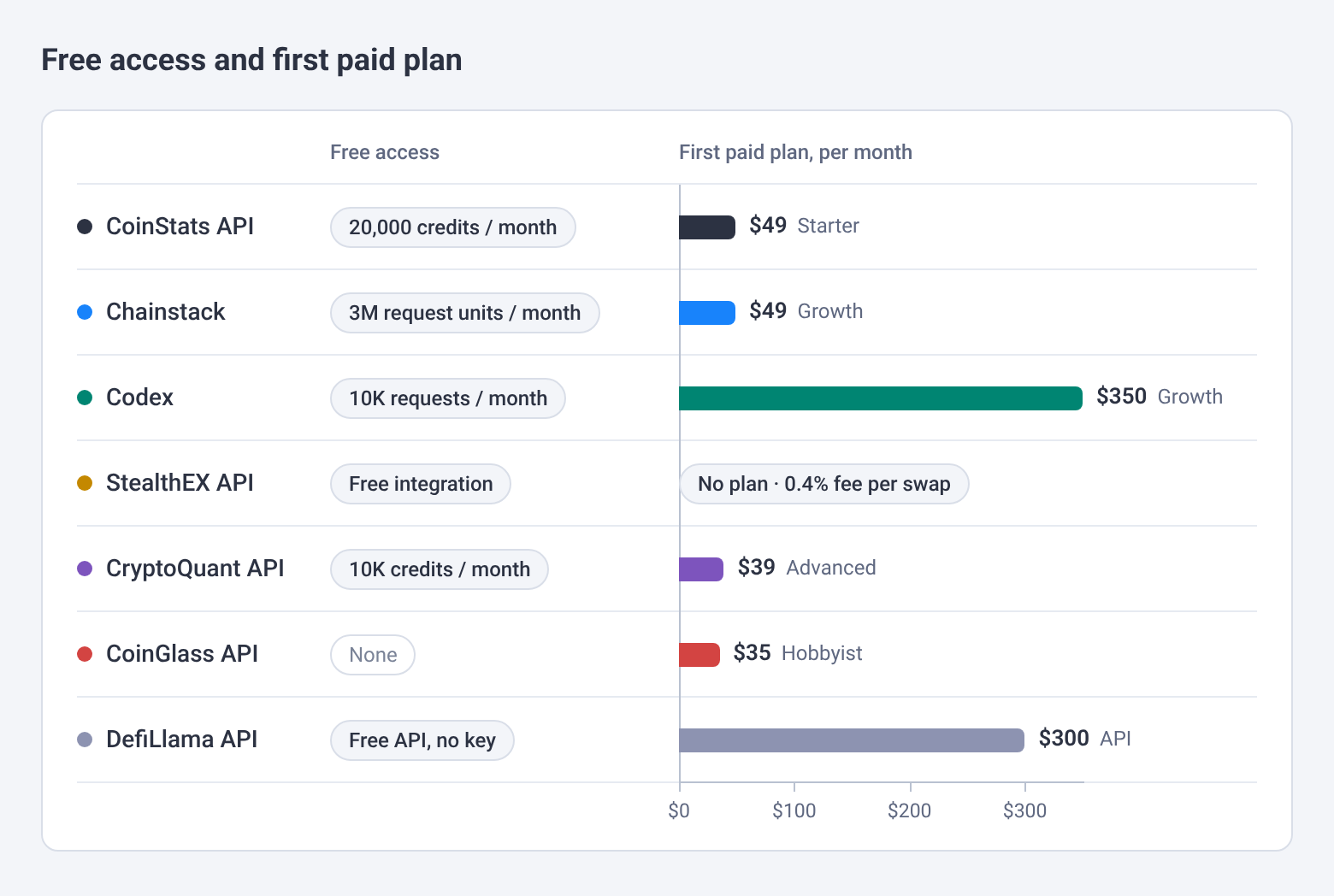
Free access and the first paid plan for each API.
6 of the 7 can be tested without paying. Chainstack sets the highest metered allowance. Its free plan includes 3 million request units a month and never expires. DefiLlama API asks for no key at all. CoinStats API gives 20,000 credits a month, with no credit card. Codex gives 10K requests a month with full query access. CryptoQuant API’s free key reads market data only. StealthEX API has no plan. Integration is free and a 0.4% fee sits inside each quote. CoinGlass API is the only one with no free tier.
First paid plans fall into 2 monthly price groups. CoinGlass API, CryptoQuant API, CoinStats API and Chainstack start at $35 to $49. DefiLlama API and Codex start at $300 and $350. For more options, this best free crypto API guide compares 23 free tiers.
Which Crypto API Powers Onchain and Derivatives Dashboards?
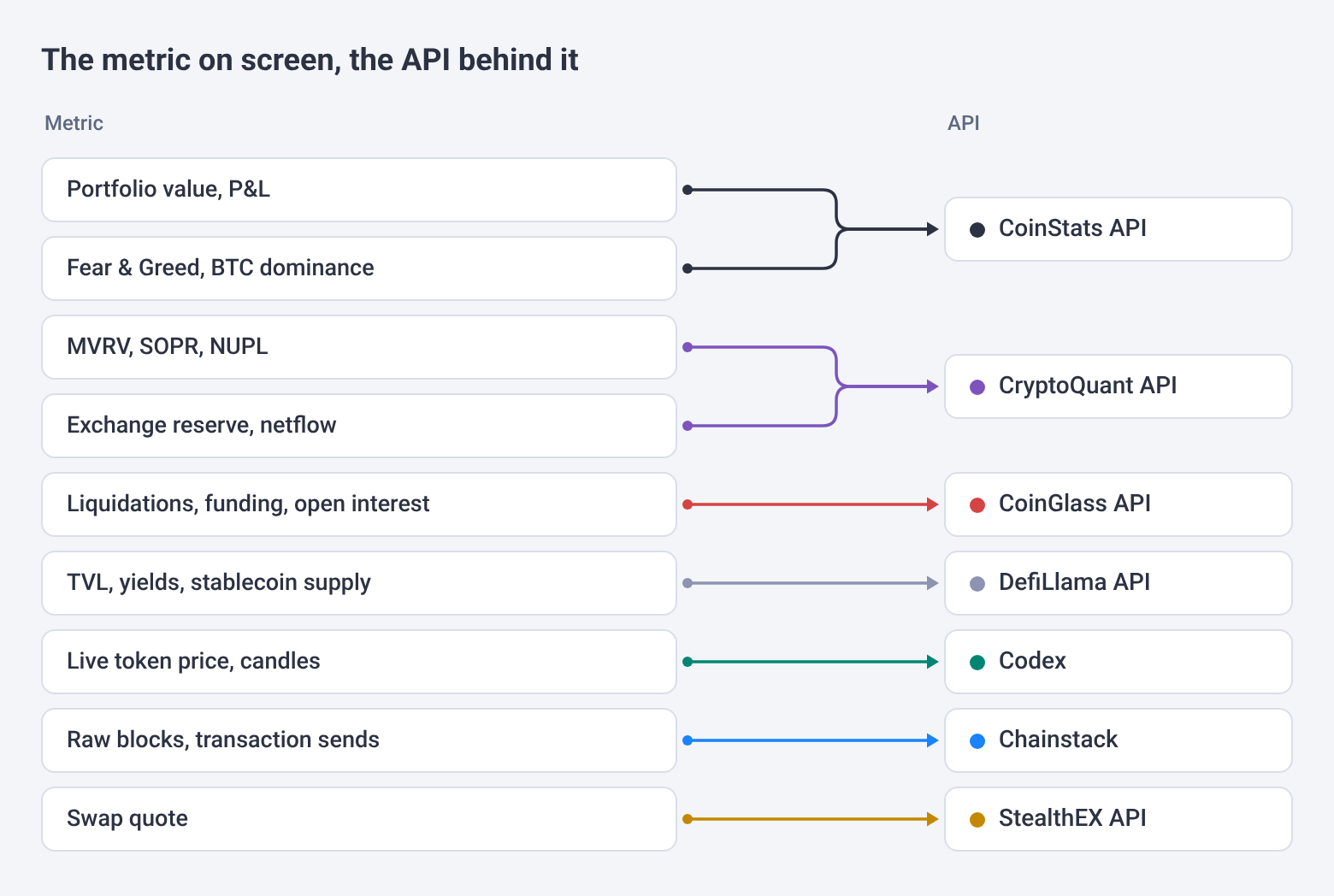
The metric on screen and the API behind it.
Onchain data now measures whole countries, not just wallets. Chainalysis used it to rank 117 countries by crypto adoption in 2026. Turkey placed 20th.
A market dashboard needs 3 kinds of feed. Our On-Chain Data dashboard is a working example.
- Cycle and flow signals. MVRV, SOPR, exchange reserve and netflow come from an onchain indicator API. CryptoQuant API is the pick here.
- Leverage signals. Liquidations, funding rates and open interest come from a derivatives API. CoinGlass API covers 30 futures exchanges.
- Price and sentiment. Prices, Fear and Greed and BTC dominance come from a market data API. CoinStats API covers these and adds wallets.
Analysts read these feeds together. CryptoQuant founder Ki Young Ju did in April 2026. He set rising open interest against weak onchain demand:
DeFi dashboards add a fourth feed. DefiLlama API supplies TVL, yields and fees. Token terminals need a faster one. Codex streams live prices and candles for onchain tokens.
What Does Each Crypto API Cover?
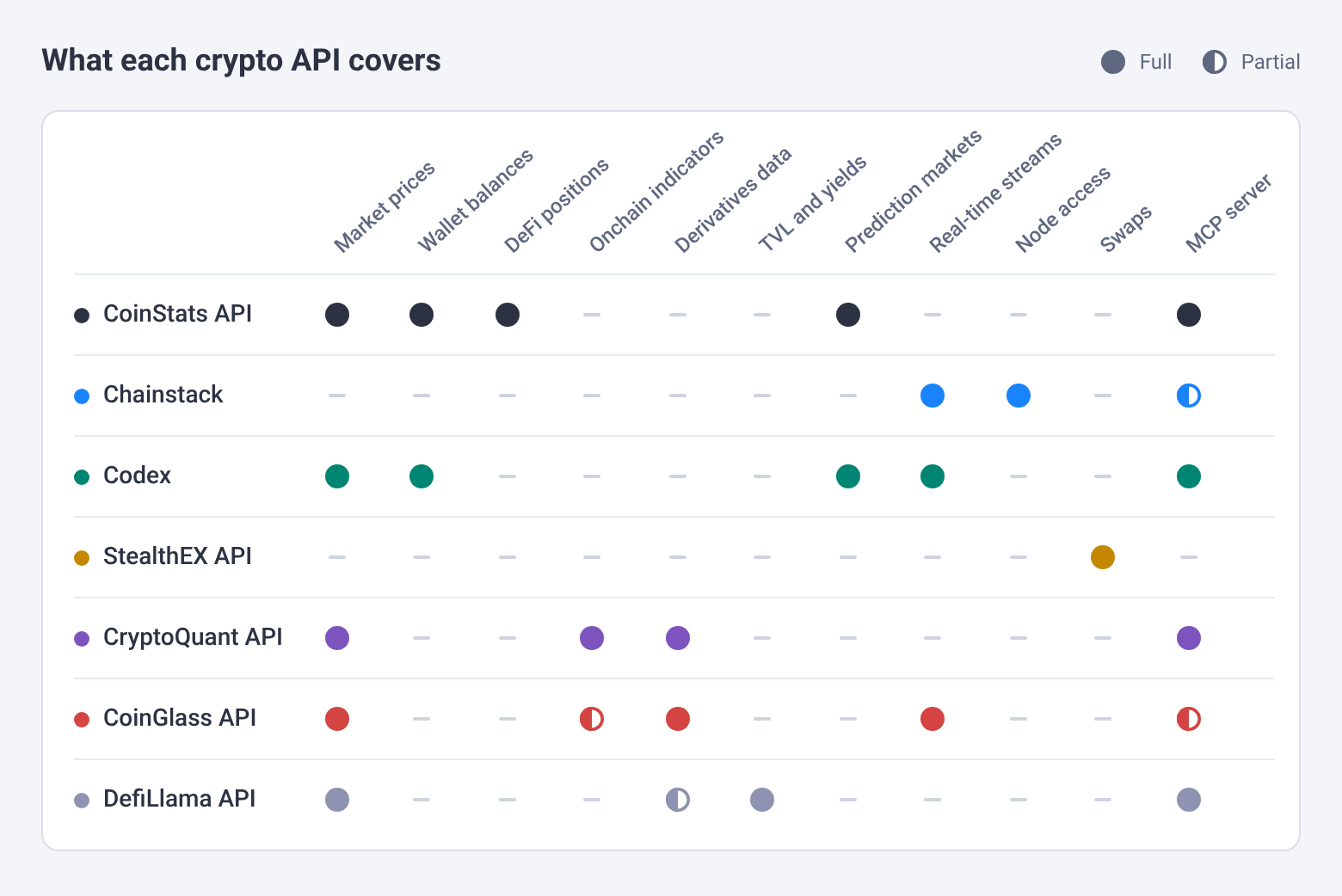
What each of the 7 APIs covers.
The matrix shows why most stacks need more than one API. CoinStats API covers prices, wallets, DeFi positions and prediction markets. Codex, Chainstack and CoinGlass API deliver real-time streams. CryptoQuant API and CoinGlass API cover onchain indicators and derivatives data. DefiLlama API holds TVL and yields. Only Chainstack offers node access. Only StealthEX API executes swaps.
The MCP column filled up fast. 6 of the 7 now offer a server.
What Are the 7 Best Crypto APIs in 2026?
1. CoinStats API: Best All-in-One Crypto Data API
CoinStats crypto API is the best fit for most crypto use cases. Most products ask the same 3 questions. What does this coin cost? What does this wallet hold? What is this portfolio worth? One key answers all 3. Coverage spans 100,000+ coins, 200+ exchanges, 120+ blockchains and 10,000+ DeFi protocols.
The portfolio layer is the difference. Wallet endpoints return balances, transactions, and profit and loss. DeFi positions resolve per wallet across staking, lending and liquidity pools. Exchange accounts sync into the same schema. The same data serves 1M monthly CoinStats users.
Newer endpoints widen the scope. A prediction markets API reads Polymarket and Kalshi. A Robinhood Chain API prices 200+ Stock Tokens. Sentiment feeds include Fear and Greed and BTC dominance. Readers know that gauge from our Fear & Greed Index. AI assistants connect through CoinStats MCP Server, with 20+ tools.
Key Features:
- Coverage: 100,000+ coins, 200+ exchanges, 120+ blockchains and 10,000+ DeFi protocols.
- Wallet and portfolio data: Balances, transactions, DeFi positions, and profit and loss per wallet. Bitcoin support includes xpub, ypub and zpub keys.
- Token security: A risk check flags honeypots, hidden fees and blacklists before a trade.
- Prediction markets: Read-only analytics for Polymarket and Kalshi markets, odds and traders.
- AI access: MCP Server works with Claude, Cursor and VS Code. An x402 option lets agents pay per request.
- Free tier and pricing: 20,000 credits a month at no cost. No credit card is needed. Starter costs $49 a month for 1,000,000 credits.
Best For:
- Best for any crypto product requiring market data, wallet balances, DeFi positions, portfolio analytics, and token security.
- Teams that want one vendor for prices, wallets and DeFi instead of 3.
2. Chainstack: Best for Managed Nodes and Raw Chain Access
Chainstack runs the node layer. A node API is the lowest level of the stack. It reads raw chain state and submits transactions. Ethereum documents that interface as JSON-RPC. Chainstack has operated since 2018 and is based in Singapore. Managed RPC covers 70+ chains, including Ethereum, Solana and Bitcoin.
Reliability is built into the endpoint. Global Nodes route each request to the nearest healthy region. Failover starts when a node falls more than 40 blocks behind. The platform handles 10B+ API calls a day across 10+ data centers. Stated uptime is 99.99%+. Trust Wallet, Circle and TradingView are named as customers.
Billing runs on request units. A full-node call costs 1 unit and an archive call costs 2. Growth costs $49 a month for 20 million units at 250 requests a second. Pro is $199, Business is $499 and Enterprise starts at $990. Unlimited Nodes charge a flat fee from $149 a month.
Key Features:
- Coverage and access: Managed RPC on 70+ chains over JSON-RPC and WebSocket. Solana, TRON and Sui add gRPC. Sui also adds GraphQL.
- Free Developer plan: 3 million request units a month at 25 requests a second. The plan never expires.
- Solana tooling: Yellowstone gRPC streams live data from validator memory. It starts at $49 a month for 2 streams, on Growth or higher. Warp transactions route sends through bloXroute at $0.15 each.
- Compliance: A SOC 2 Type II report arrived in December 2025. ISO 27001 certification followed in July 2026.
- AI access: An MCP server ships on every plan, including the free one. It deploys and manages nodes, searches docs and requests testnet funds.
Best For:
- Bots that read raw chain state, stream events and submit transactions.
- Multichain teams that want predictable request-unit billing and a compliance-ready vendor.
3. Codex: Best for Real-Time Token and Prediction-Market Data
Codex is an enriched blockchain data API built on two pillars: tokens and prediction markets. The token side covers real-time prices, OHLCV charts, holder analytics and wallet balances. It spans 90M+ tokens, 700M+ wallets and 80+ networks. Networks include EVM chains, Solana and more. The prediction side returns events, odds, trader analytics and order books. Polymarket and Kalshi are both covered.
Speed is the point. Data freshness is 1 second. WebSocket subscriptions run at 99.9% uptime. Enrichment is built in. USD prices, candles, holder analytics, aggregated volume and token metadata arrive ready. Codex powers TradingView, MoonPay, FOMO, Uniswap, Pump.fun and hundreds more.
Key Features:
- Two pillars in one API: Tokens (real-time prices, OHLCV charts, holders, wallet balances) and prediction markets (Polymarket, Kalshi, and more).
- Delivery: A GraphQL API, WebSocket subscriptions and webhooks.
- Built for AI agents: A TypeScript SDK, an MCP server and agentic payments (MPP).
- Free tier and pricing: 10K requests a month with full query access. Growth starts at $350 a month with 1M requests, WebSockets and webhooks.
Best For:
- Trading terminals, token screeners and charting tools that need live onchain prices.
- Prediction-market products and AI agents that need structured data fast.
4. StealthEX API: Non-Custodial Swaps Without Accounts or KYC
StealthEX is a non-custodial instant exchange that adds crypto-to-crypto swaps to any product. Its v4 REST API covers 2,000+ assets, with liquidity from Binance, KuCoin, Bybit, and MEXC. End users never create an account, and most swaps settle in 5 to 30 minutes.
Key Features:
- Fixed, Floating, and Reversed Rates: Lock the receive amount, follow the market, or quote backward from a target payout for payments.
- No Accounts, No Routine KYC: Users swap without registration. Verification applies only to blacklisted wallets or flagged transactions.
- Built-In Partner Revenue: A standard 0.4% fee sits inside every quote, and partners set their own markup on top.
- Developer Essentials: Bearer-token auth, 600 requests per minute, optional response signatures, and an embeddable no-code widget.
Best For:
- Wallets, trading bots, and payment flows that need to move assets, not just read prices.
- Teams that want swap revenue without custody or a KYC stack. StealthEX is execution only, so pair it with a data layer like CoinStats API.
5. CryptoQuant API: Best for Onchain Indicators and Exchange Flows
CryptoQuant API turns raw chain activity into market indicators. It serves 200+ onchain metrics across 490+ assets. Exchange flows, miner flows and valuation models form the core. MVRV, SOPR, NUPL and the Puell Multiple are all available. Our Exchange Reserve page charts one of these signals. Market data sits beside the onchain set. It includes funding rates, open interest and liquidations.
Plans decide what a key can read. Every plan includes an API key, the free Basic plan too. Basic gives 10,000 credits a month at 10 requests a minute. It reads market data with 30 days of history. Onchain data starts at the Professional plan. Professional lists at $109 a month, or $99 on annual billing. It gives 500,000 credits a month at 120 requests a minute. Business use needs Premium, at $799 a month on annual billing. A remote MCP server connects Claude, Cursor and other AI clients.
Key Features:
- Onchain indicators: MVRV, SOPR, NUPL, Puell Multiple, realized price and exchange whale ratio.
- Flow data: Exchange reserve and netflow, miner flows and inter-entity flows.
- Market data: Price, funding rates, open interest and liquidations on every plan.
- AI access: A remote MCP server that works with an API key or keyless.
- Free tier and pricing: Basic is free with 10,000 credits a month. Advanced lists at $39 a month for 300,000 credits.
Best For:
- Analysts and newsletters that track cycle and exchange-flow signals.
- Dashboards and bots that add onchain context to price data.
6. CoinGlass API: Best for Liquidations, Funding and Open Interest
CoinGlass API measures leverage across exchanges. Version 4 lists 168 REST endpoints and 4 WebSocket channels. Futures coverage spans 30 exchanges, with 11 spot and 4 options venues. Endpoints return liquidations, funding rates, open interest and long/short ratios. Our liquidations and open interest pages chart the same categories. ETF flow and exchange balance endpoints add context.
Plans gate both depth and usage rights. Hobbyist costs $35 a month on monthly billing. It covers 80+ endpoints at 30 requests a minute for personal use. Commercial use starts at Standard, at $379 a month. No free tier exists. An MCP service, still in beta, links AI clients to the data.
Key Features:
- Derivatives coverage: Liquidations, funding rates, open interest and long/short ratios from 30 futures exchanges.
- Beyond futures: Spot and options data, ETF flows, exchange balances and 53 indicator endpoints.
- Delivery: REST, 4 WebSocket channels and an MCP service in beta.
- Pricing: Hobbyist $35, Startup $95, Standard $379 and Professional $879 a month. Annual billing costs less.
Best For:
- Trading desks and bots that react to liquidation and funding signals.
- Market dashboards that compare leverage across exchanges.
7. DefiLlama API: Best Free API for DeFi TVL and Yields
DefiLlama API is a free, open feed for DeFi totals. It tracks 8,900+ protocols across 600+ chains. Free endpoints need no key and no signup. They return TVL, token prices, stablecoin supply, yields, DEX volumes, and fees and revenue.
A paid API plan adds depth. It costs $300 a month. Premium endpoints cover token unlocks, inflows, ETF flows and bridges. Limits rise to 1,000 requests a minute and 1 million calls a month. Extra calls cost $0.60 per 1,000. The plan also unlocks an MCP server for AI agents.
Key Features:
- Free endpoints: TVL, token prices, stablecoins, yields, DEX volumes, and fees and revenue.
- Coverage: 8,900+ protocols, 600+ chains and 14,000+ yield pools.
- API plan: $300 a month for premium endpoints. Limits are 1,000 requests a minute and 1 million calls.
- AI access: An MCP server, included with the API plan.
Best For:
- Research dashboards and newsletters that cite TVL, fees and yields.
- Teams that want DeFi totals at zero cost before paying for depth.
Hidden Costs Most Teams Miss
The entry price is rarely the full bill. 5 details change the math.
- Query scope. CoinStats API prices wallet calls by scope. Naming the chains can cut credit use by up to 90%.
- Archive data. Chainstack bills an archive call at 2 units instead of 1.
- Usage rights. CoinGlass API allows commercial use from $379 a month. CryptoQuant API reserves business use for Premium.
- Gated data. CryptoQuant API’s Basic and Advanced keys cannot read onchain data. That starts at Professional.
- Overage and fees. DefiLlama API bills $0.60 per 1,000 calls past 1 million. StealthEX API takes 0.4% inside each quote.
2 lanes need a closer look before a contract is signed. For nodes, StealthEX’s guide to 6 RPC node providers scores billing and compliance. A second review of 5 RPC node providers covers free and paid plans. For swaps, the spread matters more than the listed fee. One breakdown of 9 crypto swap exchanges shows how each prices a trade. Chainstack’s ranking of the best crypto swap exchanges treats custody as the first filter.
What Developers and Traders Say
Vendor pages tell half the story. Community write-ups and forum threads fill in the rest.
Builders also care about trust in the data itself. Vitalik Buterin raised it in January 2026. His post urges apps to verify what an RPC returns:
Which Crypto API Is Best for You?
Start from the product, not the provider.
- Portfolio tracker or tax tool: CoinStats API, with DefiLlama API for protocol totals.
- Trading bot: Chainstack for sends, Codex for live prices, CoinGlass API for leverage signals.
- Market dashboard or newsletter: CryptoQuant API, CoinGlass API and DefiLlama API.
- Wallet app with swaps: CoinStats API for balances, Chainstack for sends, StealthEX API for swaps.
- AI agent: CoinStats MCP Server first, then Codex for live token feeds.
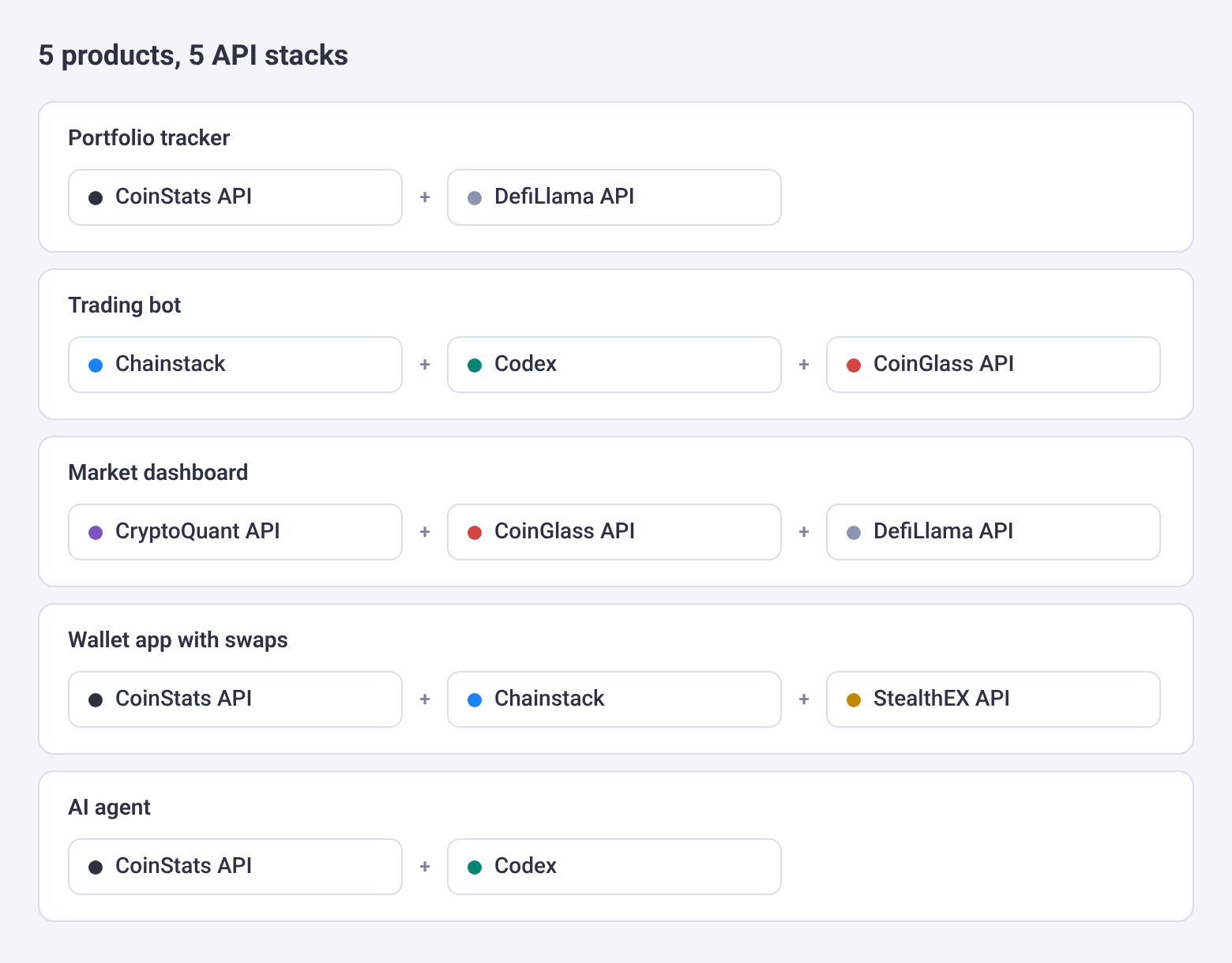
5 common products and the APIs they combine.
One rule holds across all 5. Keep data keys and trading keys apart. A read-only data API cannot move funds.
Not building anything? Our live crypto prices and On-Chain Data pages already chart these feeds. Traders comparing venues can read our guide to the 5 cheapest crypto exchanges. Our review of the 3 best crypto prediction sources covers forecast tools. We will update this comparison as plans and prices change.
Frequently Asked Questions
What is a crypto API?
A crypto API is a service a program calls for crypto data or actions. It returns prices, wallet balances, onchain metrics or swap quotes in a structured format.
Which crypto API is best in 2026?
CoinStats API for most products. One key covers market data, wallets, DeFi, portfolio analytics and token security. Specialists such as Chainstack or CryptoQuant API fit narrower jobs.
Are crypto APIs free?
Most have a free tier. CoinStats API gives 20,000 credits a month. Chainstack gives 3 million request units. Codex gives 10K requests. CryptoQuant API gives 10,000 credits. DefiLlama API needs no key. CoinGlass API is paid only.
Which crypto API has MVRV and exchange flow data?
CryptoQuant API. It serves MVRV, SOPR, NUPL, exchange reserve and netflow. Onchain endpoints need the Professional plan or higher.
Can AI assistants use crypto APIs?
Yes. The Model Context Protocol connects AI assistants to external data. 6 of the APIs here offer an MCP server. CoinStats MCP Server exposes 20+ tools for prices, wallets and DeFi.
Can a crypto data API move my funds?
No. A data API only reads. Swaps and trades need a separate execution API, such as StealthEX API. Keep the 2 kinds of key apart.
Continue Reading: 7 Best Crypto APIs for Trading, Onchain and Portfolio Data (2026-2027 Comparison)