The paradigm of centralized, data-center-dependent cloud infrastructure is shifting. What began as an initiative to convert everyday smartphone hardware into a global serverless compute netwo
The paradigm of centralized, data-center-dependent cloud infrastructure is shifting. What began as an initiative to convert everyday smartphone hardware into a global serverless compute network has grown into a high-capacity Decentralized Physical Infrastructure Network (DePIN).
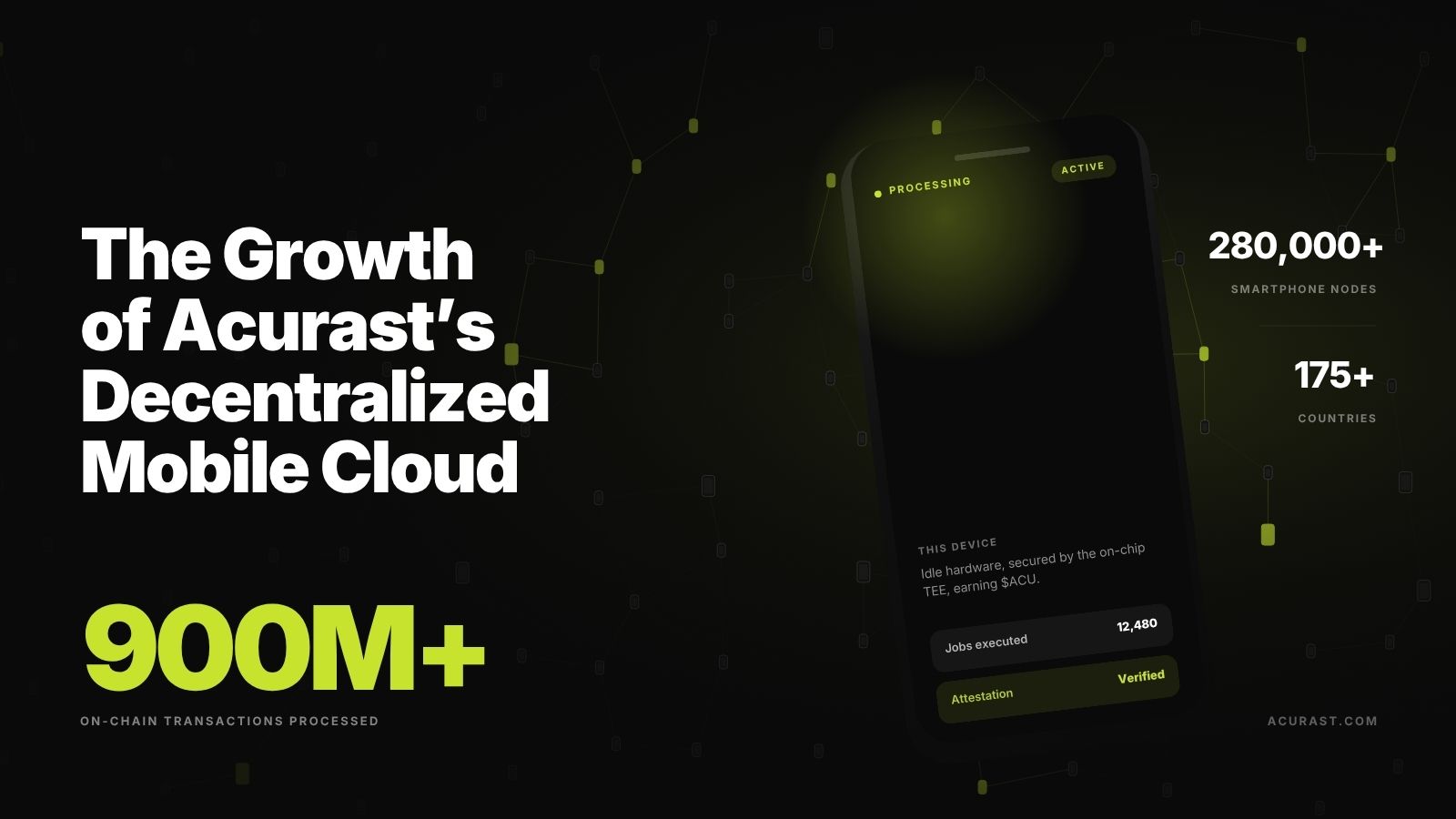
Acurast, the largest decentralized compute network leveraging smartphones, has officially processed over 900 million on-chain transactions, supported by a global network of more than 280,000 smartphones operating across 175+ countries. The network is now less than a 100 million transactions away from achieving its 1 billion transaction milestone.
Every connected device, deployed contract, and executed compute job represents a collective effort by developers, node operators, and token holders to build a verifiable, hardware-secured, serverless cloud ecosystem.
Acurast transforms standard smartphones into secure compute nodes, offering a radically more accessible and confidential alternative to traditional cloud providers and GPU-heavy DePIN projects. By tapping into the built-in Trusted Execution Environments (TEEs) of modern ARM mobile chips, Acurast allows developers to run sensitive off-chain tasks, such as AI workflows, web scraping, and oracles with cryptographic proof of execution that guarantees data privacy and tamper-proof results. Users and developers should be interested because it unlocks an affordable, highly resilient edge-computing network spanning millions of devices globally, while allowing smartphone owners to easily monetize idle hardware and upcycled phones without expensive server infrastructure.
Network Highlights:
Total On-Chain Transactions: 900M+ (Approaching 1 Billion)
Active Compute Nodes: 280,000+ smartphones
Global Footprint: 175+ countries
Staked Tokens: 158,502,624 $ACU
Active Staking Managers: 1,634
Staking Yield: ~22.61% APR
Modern smartphone processors feature dedicated hardware security modules known as Trusted Execution Environments (TEEs). By utilizing these built-in enclaves on ARM mobile chips, Acurast enables standard smartphones to execute sensitive off-chain compute jobs with cryptographic proof of execution.
Advantages for Compute Providers
Accessible Hardware Onboarding: Download the Acurast Processor application from either the App Store or Google Playstore, connect the device to power and Wi-Fi, and begin contributing unused compute capacity whenever you have the application open.
Repurposing Existing Devices: Unused or secondary smartphones can be deployed as active nodes without dedicated server setups.
Low Energy Overhead: Compared to conventional GPU or ASIC mining operations, smartphone nodes operate with minimal power consumption.
Network Incentives: Operators earn $ACU rewards for allocating compute capacity to developers and enterprises.
For Developers: Verifiable Serverless Execution
Traditional cloud providers present single points of failure, centralized data access risks, and lack built-in cryptographic proof of execution. Acurast offers a verifiable, serverless cloud environment designed for Web3, enterprise applications, and automated workloads. It’s now even easier to deploy by using Cargo. With Cargo, developers can deploy any workload that runs on Linux across Acurast’s network of attested Android smartphones. Python, Go, Rust, C++, shell scripts, full binaries. If it builds for Linux, it runs on Acurast.
Primary Use Cases
Off-Chain Data Oracles: Securely retrieve external API data and transmit signed payloads to target blockchain networks including Ethereum, Bitcoin, Polkadot, and Tezos.
Edge AI Execution: Run lightweight machine learning models directly within mobile hardware enclaves.
Automated Scripts and Microservices: Host Node.js and TypeScript workloads, cron jobs, and notification infrastructure with reliable uptime.
Confidential Computing: Process API keys, credentials, and encrypted datasets without revealing raw data to the physical device owner.
For Stakers: Network Security and Yield
Network stability and task allocation rely on a robust proof-of-stake consensus model. Stakers provide the capital foundation that secures device attestations, job execution logs, and network operations.You don't necessarily need hardware, you can also stake your tokens to support the network
Currently, 158,502,624 $ACU is staked across 1,634 active managers. Delegators and managers earn a projected 22.61% APR by helping maintain network security and operational integrity.
Getting Started:
1. Node Operators: Install the Acurast Processor app to onboard device capacity at acurast.com/processor
2. Developers: Access technical documentation and deploy serverless jobs via acurast.com/docs
3. Stakers: Participate in network security and earn rewards at acurast.com/staking