Three days after the largest hack in the history of crypto exchanges, Binance is reopening withdrawals. In an announcement on 1 November 2026 at 04:08 UTC, the exchange said the first phase s
Three days after the largest hack in the history of crypto exchanges, Binance is reopening withdrawals. In an announcement on 1 November 2026 at 04:08 UTC, the exchange said the first phase starts on Sunday between 06:00 and 09:00 UTC. The rollout is gradual: Binance checks each network separately and opens it only after security and readiness checks are complete. Deposits continue to work normally, according to the exchange (Binance, Recovery Update #4).
Binance is thereby keeping the timeline it promised after the attack on 29 October. On 30 October at 04:36 UTC it still spoke of "within 48 hours"; on 31 October it confirmed Sunday as the date. At around 20:05 UTC, roughly $6.3 billion was taken from the hot wallets; according to TRM Labs, the trail leads to the North Korean group TraderTraitor. Everything known about the attack is in our overview North Korea behind the Binance hack.
95 percent of the stolen funds have been replaced
At the same time, Binance is filling the gap out of its own pocket. By the evening of 30 October, about 80 percent of the stolen amount had been replaced, according to the exchange, 90 percent on 31 October and 95 percent on 1 November. Balances in BTC, ETH, USDT, BNB, SOL, USDC, XRP, USD1, RLUSD and ZEC are fully backed, Binance says, documented by a reserve snapshot from 31 October, 00:00 UTC. The missing 5 percent concerns smaller tokens outside the top ten, which can only be bought slowly in the required size. Where the money for the reimbursement comes from is explained in Binance promises full reimbursement.
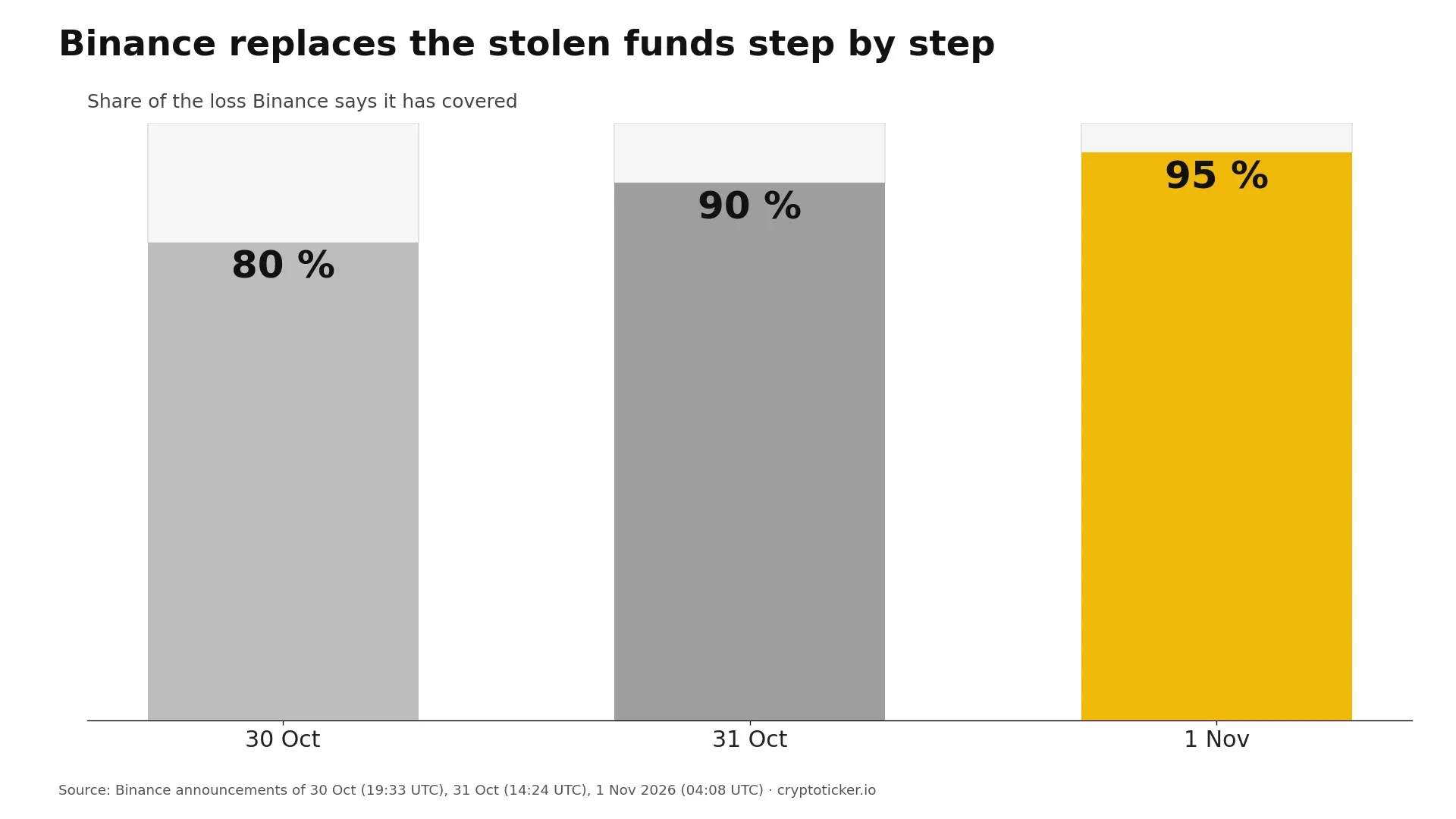
Source: Binance announcements of 30 October, 31 October and 1 November 2026
These 15 networks come first
Binance ranked the networks by user demand over the past week. The networks most customers want to withdraw through open first:
Network
Coins available in phase one
Bitcoin
BTC
Ethereum
ETH, USDT, USDC
BNB Smart Chain
BNB, USDT, USDC
Tron
TRX, USDT
Solana
SOL, USDT, USDC
XRP Ledger
XRP
Zcash
ZEC
Dogecoin
DOGE
TON
USDT, GRAM
Polygon
POL, USDT, USDC
Avalanche C-Chain
AVAX, USDT, USDC
Arbitrum
ETH, USDT, USDC, ARB
Base
ETH, USDC
Optimism
ETH, USDT, USDC
Sui
SUI
Source: Binance, announcement of 1 November 2026. More networks and coins will follow once their checks are complete, the exchange says. At 04:45 UTC, a little over an hour before the start, Binance's own network status still showed withdrawals as disabled on all Bitcoin and Ethereum networks.
What Binance customers should do now
- Check the network before withdrawing. Whether a coin is already open on the network you want is shown on the coin's withdrawal page or on Binance's network status page. Anyone withdrawing USDT, for example, can choose between nine networks in phase one.
- Expect delays. Binance expects heavy traffic in the first phase. If a withdrawal fails, the exchange says a new attempt after a short while usually helps.
- Only check in the app or on binance.com. After major events, fake emails and websites promise a "fast withdrawal". Check the status only there, never through links in emails or messages.
- Double-check the address. A withdrawal to the wrong network is usually lost. If you are withdrawing to your own wallet for the first time, send a small test amount first.
What is still open
Three things will decide in the coming days whether trust returns. First, phase two: customers holding coins outside the list are still waiting, and Binance has not yet named a date. Second, the full proof of reserves, which Binance expects on Tuesday, 3 November; it is meant to let customers verify that their balances in the ten main coins are backed at least one to one. What the proof of reserves shows and how to check it is explained in Binance proof of reserves. Third, the report on the attack itself, which the exchange plans to publish once the investigation is complete.
The market has only partly digested the shock. BNB, the exchange's token, fell from $744 to $695 on an hourly basis after the hack and stood at $705 on Sunday morning, a good 5 percent below its level before the attack. Bitcoin traded at about $77,750 at 04:45 UTC. How prices moved in the hours after the hack is shown in our crypto crash timeline.
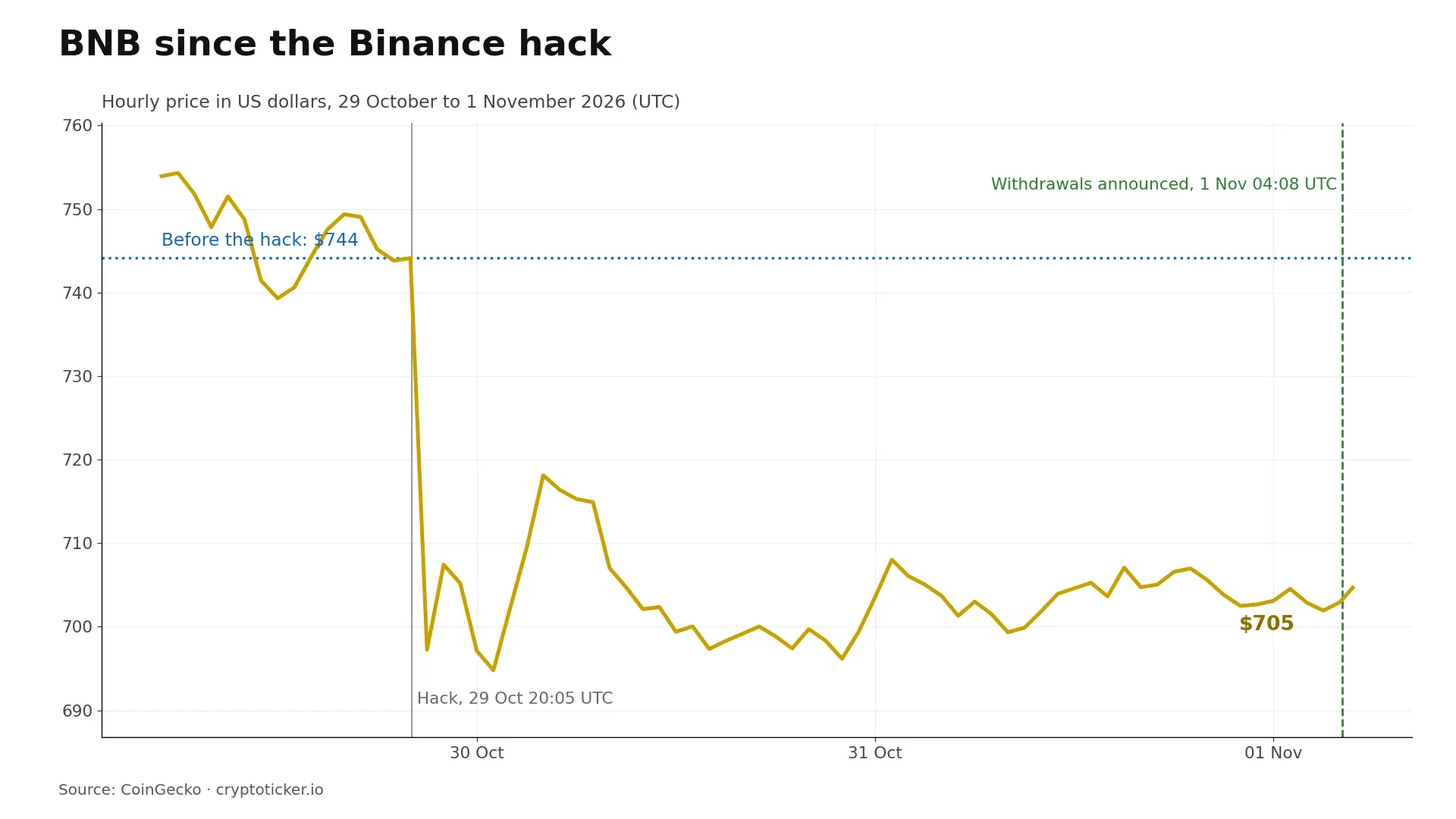
Source: CoinGecko hourly prices; as of 1 November 2026, 04:46 UTC
Our view
So far, Binance is sticking to its own roadmap: reimbursement from its own funds, the reopening on the announced Sunday and a proof of reserves with a fixed date. For customers, the reopening is still a good moment to review how they split their holdings. Coins you do not trade are safer in your own wallet than on any exchange; which devices are suitable is shown in our hardware wallet comparison. Active traders will find the providers with an EU licence in our comparison of regulated crypto exchanges. This article is not investment advice.