For most of 2026, the story was simple: AI stocks up, crypto down. July flipped the script. Bitcoin and Ethereum posted the strongest monthly returns of any major asset class, while the trade
For most of 2026, the story was simple: AI stocks up, crypto down. July flipped the script. Bitcoin and Ethereum posted the strongest monthly returns of any major asset class, while the trade that carried global equities all year came apart.
The scoreboard for July:
AssetJuly performanceEthereum ($ETH)+20%Bitcoin ($BTC)+9%Russell 2000-3%Nasdaq 100-9%Chip stocks-22%
The odd part is that almost nobody in crypto felt like they were winning. The Crypto Fear & Greed Index sat at 28, firmly in "Fear" territory, on the same day Ethereum was printing a 20% month.
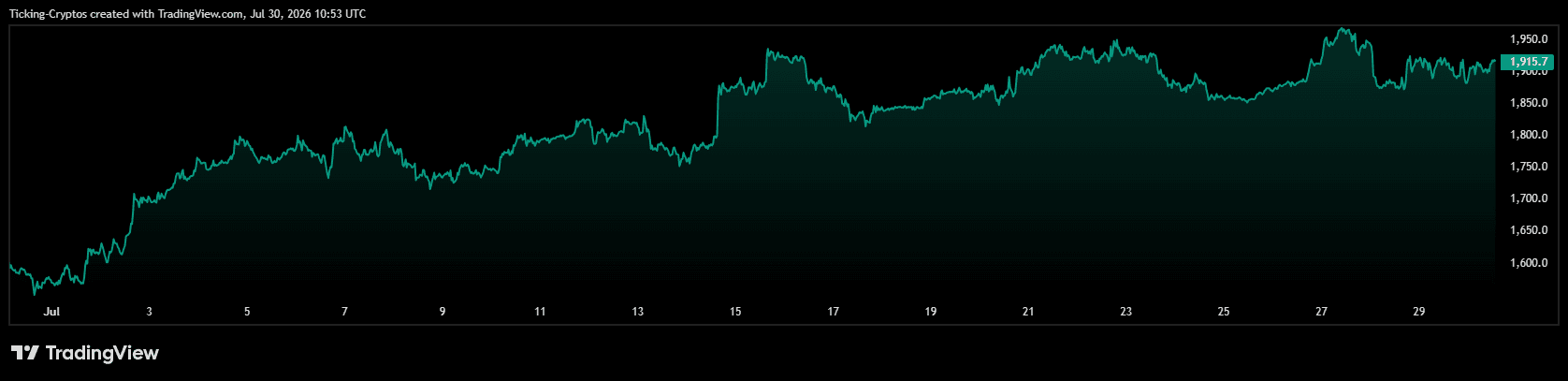
Ethereum entered the month around $1,600 and traded near $1,920 by July 29, a gain of roughly 20%.
ETH price USD
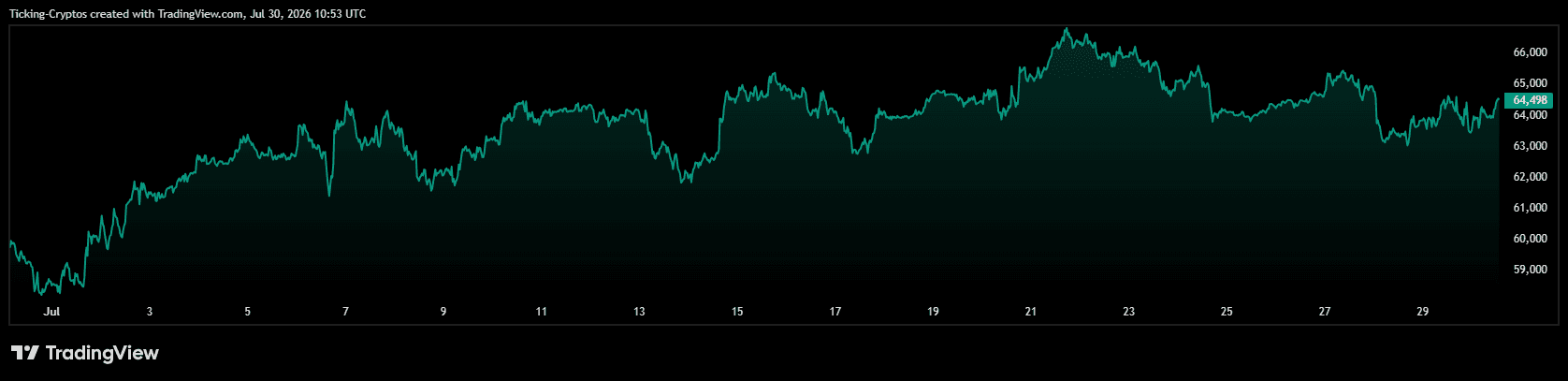
Bitcoin started July near $60,000 and changed hands around $64,200 at the end of the month, up about 9%.
BTC price USD
Neither move was a straight line. Both assets pushed higher after a softer than expected US CPI report in mid July, wobbled when spot Bitcoin ETFs snapped a week long inflow streak with a single day of $225 million in net outflows, then recovered again once Washington paused airstrikes on Iranian military targets and geopolitical risk premium came out of the market.
What matters is the shape of the month: crypto absorbed bad news and kept grinding upward, while equities did the opposite.
Why did chip stocks fall 22% while the Dow rallied?
This was not a risk off month. It was a rotation.
Semiconductors went into July having gained nearly 97% on the year. By mid month, roughly a third of that 2026 advance had been erased, and the selling accelerated into the final week. The trigger was not weak demand. It was the price investors had agreed to pay for flawless execution.
Three things broke the trade at once. Bank of America's own bubble risk indicator for semis climbed to 0.91, above the Nasdaq 100's 0.69, with strategist Michael Hartnett noting that the combination of extreme concentration and overbought conditions had not been seen since June 2000. Big Tech's AI capital spending guidance started to look like a cost rather than a growth story. And reports on China's progress in memory chips and lithography equipment raised the question of how durable the moat really is.
The damage went global in the last week of July. South Korea's Kospi dropped 10.84% in a single session, with Samsung down 13.4% and SK Hynix down more than 14.7%. Japan's Nikkei 225 fell 3.95%. Advantest lost over 10%.
Meanwhile the Dow Jones climbed 537 points on July 28 for a third straight winning day, lifted by strong earnings from Sherwin-Williams and Coca-Cola. Money did not leave the market. It left the crowded end of it, and some of it landed in crypto.
Ethereum's 20% beat Bitcoin's 9% by a wide margin, and the reasons are specific rather than sentimental.
Corporate treasury demand kept showing up. Bitmine added another $74 million in ETH during July as Tom Lee continued building toward a stated goal of holding 5% of total supply. Institutional desks also started framing ETH as the cleaner expression of a crypto recovery. Fundstrat's Sean Farrell argued mid month that the tactical backdrop was improving and that ETH increasingly stood out as the more attractive way to trade it.
There is a historical pattern behind that view. During the 2022 bear market, Ethereum began outperforming Bitcoin several months before Bitcoin found its bottom. Traders who believe that rhyme is repeating were positioned in ETH before the rotation out of semis began.
Did the Fed decision change anything for August?
On July 29, the Federal Reserve held the funds rate at 3.50% to 3.75% for a fifth consecutive meeting, the longest pause since the 2008 cycle. The vote was 9 to 3, with Beth Hammack, Neel Kashkari and Lorie Logan all dissenting in favour of a 25 basis point hike.
That is the detail to carry into August. A three way hawkish dissent is rare, and it came after prediction markets had already priced roughly a one in five chance of an actual hike, the highest of this cycle. Chair Kevin Warsh gave little explicit forward guidance, which leaves September genuinely open.
Crypto held its ground through the announcement, with BTC around $64,268 and ETH around $1,917 shortly after. But a steady rate alongside firmer yields and a stronger dollar is a tighter liquidity setup than the mid July CPI print implied. Standard Chartered still has a $100,000 year end target on Bitcoin. Polymarket's crowd is far more conservative, with top odds on BTC finishing 2026 between $70,000 and $75,000 and ETH between $2,000 and $2,250.
What should investors take from July?
The useful lesson is not that crypto is back. It is that crypto and AI equities have stopped moving as one asset. For two years they traded as the same liquidity bet. In July they diverged sharply, and a portfolio holding both would have felt that divergence as diversification rather than as double exposure.
The risk cuts the other way too. If the semiconductor unwind turns into a broader growth scare rather than a rotation, crypto's July independence will be tested quickly.