As the FIFA World Cup 2026 unfolds across the United States, Canada, and Mexico, an interesting trend has once again caught the attention of crypto investors. Since 2010, Bitcoin has entered
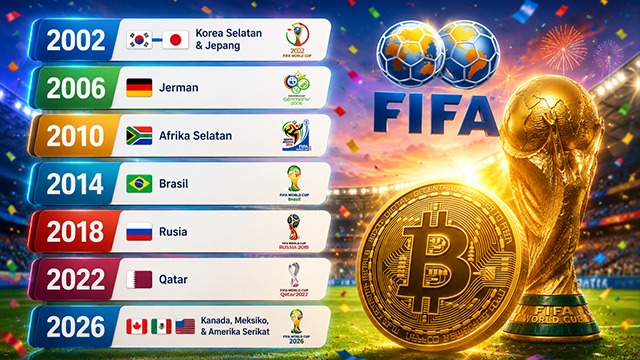
As the FIFA World Cup 2026 unfolds across the United States, Canada, and Mexico, an interesting trend has once again caught the attention of crypto investors. Since 2010, Bitcoin has entered every edition of the tournament at a higher price than it did four years earlier.
Historical data highlights the consistency of this pattern. During the 2010 FIFA World Cup in South Africa, Bitcoin traded at around US$0.20. Four years later, when Brazil hosted the tournament, BTC had climbed to approximately US$620. The trend continued during the 2018 World Cup in Russia, with Bitcoin trading near US$6,500, before reaching around US$16,800 during the 2022 tournament in Qatar.
Now, as the 2026 FIFA World Cup takes place in North America, Bitcoin is trading at approximately US$65,800, extending a trend that has persisted across five consecutive World Cup tournaments.

At first glance, the relationship between Bitcoin and the FIFA World Cup may seem unusual. However, the pattern is likely less about football and more about Bitcoin's well-known four-year cycle.
One of the key factors behind Bitcoin's long-term market behavior is the halving event, which occurs roughly every four years. During a halving, the reward miners receive for validating transactions is cut in half, reducing the rate at which new Bitcoin enters circulation. Historically, these events have often been followed by significant price appreciation over the following months and years.
Because both Bitcoin halving events and the FIFA World Cup operate on similar four-year schedules, the two timelines frequently overlap. While the World Cup itself does not influence Bitcoin's price, it serves as an interesting reference point for observing how the asset has evolved through multiple market cycles.
That said, the nature of Bitcoin's growth has changed considerably over time. While Bitcoin continues to reach higher price levels with each World Cup, the scale of its returns has gradually declined as the asset matures.
In its early years, Bitcoin was a relatively small and speculative asset, making exponential gains easier to achieve. Today, the market is far larger and increasingly shaped by institutional participation, spot Bitcoin ETFs, and broader macroeconomic conditions. As a result, price movements remain significant but are generally less explosive than they were during Bitcoin's early adoption phase.
Still, the pattern remains noteworthy. From South Africa in 2010 to North America in 2026, Bitcoin has consistently entered each FIFA World Cup at a higher valuation than the previous tournament.
Whether this trend continues in future editions remains uncertain. Market conditions, regulation, institutional demand, and global economic developments will all play a role in shaping Bitcoin's trajectory. Nevertheless, the recurring pattern offers an interesting reminder of how far the world's largest cryptocurrency has come over the past sixteen years.
Instagram : @asetqu_official
Tiktok : @asetqu_official
Twitter : @AsetQu_Official