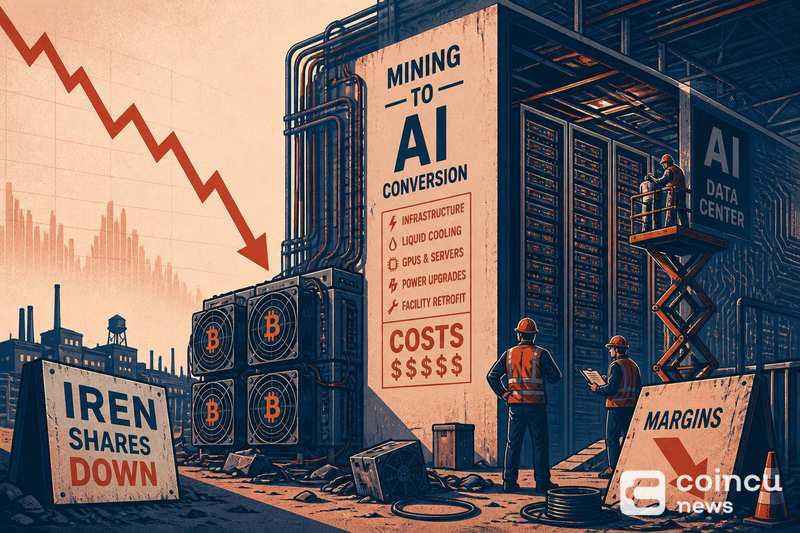
Shares of IREN, the Nasdaq-listed bitcoin miner formerly known as Iris Energy, fell as investors weighed the mounting costs of converting mining infrastructure toward artificial intelligence
Shares of IREN, the Nasdaq-listed bitcoin miner formerly known as Iris Energy, fell as investors weighed the mounting costs of converting mining infrastructure toward artificial intelligence workloads, keeping the "Bitcoin miner IREN shares fall" narrative squarely on the tension between long-term AI ambition and near-term capital strain.
The share decline followed attention on the company's pivot from pure bitcoin mining toward AI and high-performance computing capacity, as reported by Decrypt. The research supporting this article is limited, and no verified price-move percentage or dollar figure was confirmed at the time of writing. For related coverage, see Bitcoin Options Expiry on August 28 Reaches $6.4B.
IREN files as a foreign private issuer with the U.S. Securities and Exchange Commission, and its most recent annual report on Form 20-F for the period ended June 30, 2025 is the primary document underpinning any assessment of its financial position. That filing, not secondary summaries, is the authoritative reference for the company's capital commitments. For related coverage, see UK Police Seize $1.4M in Bitcoin Linked to Darknet Markets.
Why AI Conversion Costs Pressure the Stock
Converting or building data-center capacity for AI is capital-intensive, requiring high-density power, specialized cooling, and GPU-grade hardware that differs materially from ASIC-based bitcoin mining rigs. When that spending scales faster than realized revenue, equity sentiment can weaken even if the strategic logic holds. For related coverage, see Ethereum ETFs Take $226M in a Day, Near Bitcoin's Haul.
The distinction that matters for holders is between operational ambition and near-term investor concern: a miner can pursue AI optionality while the market simultaneously discounts execution risk and cash burn. The share move reflects the latter, not a repudiation of the strategy itself.
How the Pivot Reframes IREN
IREN's AI push is not hypothetical. The company has already signed large compute commitments, including a multibillion-dollar arrangement detailed when IREN secured a $9.7 billion AI contract with Microsoft, underscoring that the conversion story carries both scale and heavy capital obligations.
That scale cuts both ways. Contracts of that size validate demand for the company's power and data-center footprint, while the associated buildout raises the fixed-cost base and lengthens the path to free cash flow, sharpening scrutiny of every capital expenditure line.
The company's history as a mining pure-play also shapes how investors read the shift; IREN, previously Iris Energy, has faced legal scrutiny before, having been sued over allegedly misleading IPO documents, which keeps disclosure quality in focus as the business model broadens.
What Miner-to-AI Investors Are Weighing
For bitcoin miners more broadly, adjacent AI infrastructure is attractive because the core competencies, securing cheap power and building at scale, transfer directly to GPU hosting. The market tends to reward that pivot when cost discipline is visible and punish it when capex outruns contracted revenue.
The practical takeaway is a tradeoff, not a verdict: AI conversion offers long-term optionality beyond volatile block-reward economics, but the upfront burden can compress valuation sentiment in the short term. Investors are effectively pricing execution, not the addressable market.
The macro backdrop for crypto-linked equities has drawn broader attention this year, with IREN earnings cited among the stocks tracked in coverage of bitcoin price levels and crypto regulation, situating the single-stock move within a wider watch on miner diversification.
What To Watch Next
The concrete catalysts are disclosure-driven: forthcoming filings and capital-expenditure guidance in IREN's SEC reporting will show whether AI-related spending is converting into contracted, recurring revenue or simply expanding the cost base. Those numbers, as of their filing dates, are the signals that will resolve the current uncertainty.
FAQ
What happened to IREN shares? IREN shares fell amid investor focus on the rising costs of its shift into AI infrastructure, per Decrypt's reporting. No verified percentage decline was confirmed in the available research.
Why are AI conversion costs important? Building AI-capable data centers is capital-intensive, and when that spending outpaces revenue it can weigh on equity sentiment even when the strategy is sound.
Is IREN still primarily a bitcoin miner? IREN originated as bitcoin miner Iris Energy and continues mining, but it is expanding into AI and high-performance computing, including a large Microsoft compute contract.
What are investors likely watching next? Upcoming SEC filings and capex guidance that reveal whether AI spending is producing contracted, recurring revenue.
Disclaimer: This article is for informational purposes only and does not constitute financial or investment advice. Cryptocurrency and digital asset markets carry significant risk. Always do your own research before making decisions.
The post Bitcoin Miner IREN Shares Fall as AI Conversion Costs Mount was initially published on Coincu.