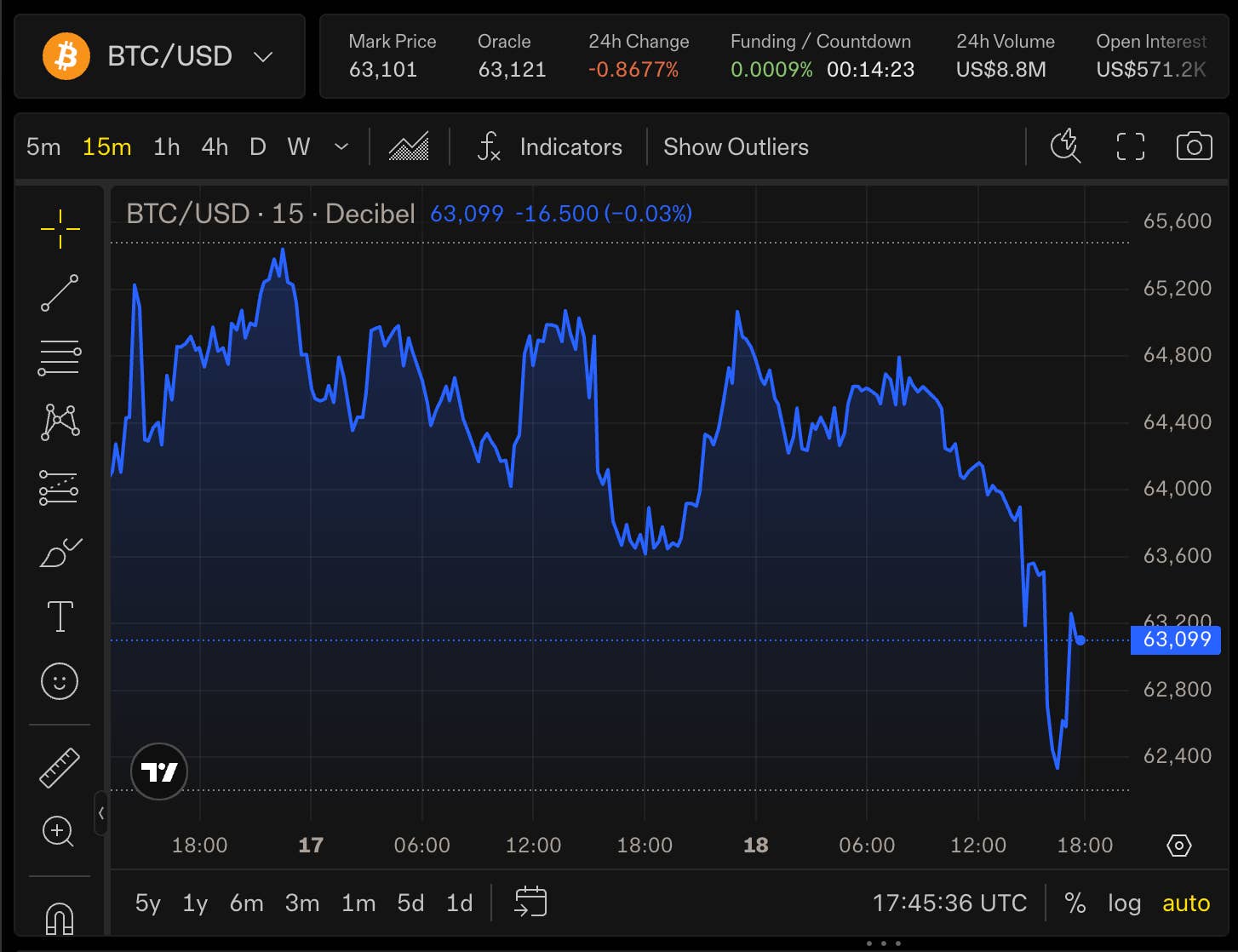
The bitcoin price fell below $63,000 after Federal Reserve Governor Christopher Waller said on November 18 that policymakers should consider a larger rate increase at their December meeting.
The bitcoin price fell below $63,000 after Federal Reserve Governor Christopher Waller said on November 18 that policymakers should consider a larger rate increase at their December meeting. His warning came as inflation remained firm and investors weighed a half-point move against the quarter-point increase markets had largely expected.
Waller’s remarks are one policymaker’s view, not a Federal Open Market Committee decision. The comments came as Bitcoin and US stocks were under pressure, although the available reports do not establish that Waller’s remarks caused the broader market weakness.
- Waller said the Fed should consider a 50-basis-point increase at its December 8-9 meeting, according to CNBC comments reported by Investing.com.
- He said a smaller move could be enough only if the Fed clearly signaled another increase in January.
- October CPI rose 0.4% month over month and core CPI increased 0.3%, the Bureau of Labor Statistics reported.
- Cointelegraph said Bitcoin briefly fell below $63,000 after the November 18 Wall Street open and was down about 3% at the time of its report.
- CME FedWatch probabilities cited by Cointelegraph put the odds of a quarter-point December hike above 95%, rather than the half-point move Waller proposed.
Timeline of the Bitcoin price and Fed debate
- November 10: Waller said he was leaning toward a 25-basis-point December increase. He added that a 50-basis-point move should be considered if October core inflation came in around 0.3% or higher, according to the Federal Reserve.
- November 17: New York Fed President John Williams said conditions did not call for a dramatic half-point increase. Axios reported that he called the recent market pullback normalization, while noting inflation remained too high.
- November 18: After October core CPI reached Waller’s stated threshold, he called for a stronger inflation response. Cointelegraph reported Bitcoin’s decline below $63,000 after the US market open.

October inflation readings formed part of Waller’s case for a stronger response.
Background: inflation keeps the Fed debate open
The October inflation report helps explain Waller’s position. The Bureau of Labor Statistics reported that headline CPI rose 0.4% in October, slower than September’s 0.6% monthly gain. Core CPI advanced 0.3%.
Waller’s concern, as reported by Investing.com, is that inflation is spreading and running above 3% on an annualized basis. He said businesses were beginning to treat price increases of roughly 3% as normal. His “shock” argument is that a stronger policy response could reset those expectations. That is Waller’s assessment; the evidence does not establish whether a rate move would change those expectations.
The Fed held its policy rate at 3.75%-4% in October, according to Investing.com. The preceding quarter-point increase took effect on September 17. Higher rates can raise borrowing costs and reduce demand, but the timing and size of any further move remain uncertain.
The supplied reports describe the Fed debate and Bitcoin’s market reaction, but they do not establish that rate expectations caused Bitcoin’s price move.
Reactions: Bitcoin, stocks and fund flows
Cointelegraph reported Bitcoin was down about 3% on November 18 at the time of its article, after slipping below $63,000 following the Wall Street open. A later CoinGecko snapshot showed BTC at $63,073 at 18:13 UTC, with a 24-hour change of -0.87% and a low of $62,282. These figures reflect different observation times, so the intraday decline and later daily change aren’t directly interchangeable.
Asset
Price, November 18, 18:13 UTC
24-hour change
Bitcoin (BTC)
$63,073
-0.87%
Ether (ETH)
$1,765.16
-0.99%
Solana (SOL)
$73.45
+1.83%
Cointelegraph also cited analyst David Eng’s estimate of $8.7 billion in net capital outflows from US spot Bitcoin ETFs over 30 days and $2.1 billion year to date. These are attributed estimates, not a measure of all Bitcoin trading or proof that rate fears caused the withdrawals.
Stocks were under pressure before Waller’s comments. The Associated Press reported that on November 17 the S&P 500 fell 1.0% to 7,340.53, the Dow lost 1.6% to 50,759.42 and the Nasdaq Composite declined 0.7% to 24,328.38. AP pointed to volatility in AI shares, including Nvidia. Cointelegraph said optimism around Nvidia earnings had faded, but the available data doesn’t establish that Waller alone drove the broader pullback.
The Fear & Greed Index registered 11, classified as “Extreme Fear,” on November 18. That reading describes sentiment, not a forecast.

Stocks had logged broad losses the day before Waller’s remarks.
Outlook: what could move the Bitcoin price next
The immediate question is whether the Fed adopts Waller’s proposal, sticks with a quarter-point increase or signals a later move. The more than 95% market probability cited by Cointelegraph was for a quarter-point hike, showing a gap between the reported market baseline and Waller’s preference. Expectations can shift as officials speak and new data arrive.
Waller outlined a possible middle path: a quarter-point increase in December paired with a clear signal of another hike in January. Williams’ November 17 remarks show that not all senior Fed voices called for a half-point move. The supplied evidence records differing views among Fed officials but does not establish how the committee will decide.
Bitcoin was down 15.05% over seven days and 23.04% over 30 days as of 18:13 UTC on November 18, while its 24-hour change was -0.87%, according to the supplied CoinGecko data. These figures describe past performance and do not establish how Bitcoin will respond to a Fed decision.

The December meeting will decide whether the Fed follows Waller’s proposal.
FAQ
Why did the Bitcoin price fall below $63,000?
Cointelegraph linked the November 18 drop to Waller’s hawkish comments and fading Nvidia earnings optimism. The decline coincided with wider market pressure, so the available information doesn’t show that one factor caused it.
Did the Fed decide to raise rates by 50 basis points?
No. Waller said the Fed should consider a half-point increase at its December 8-9 meeting. That was one governor’s proposal, not an announced committee decision.
What happens to the Bitcoin price if rates rise?
The supplied evidence does not establish a definite Bitcoin price response to a rate increase. It reports Bitcoin’s November 18 decline and Waller’s remarks, but does not show that those remarks alone caused the move.
Related Articles
Sources
This article is for informational purposes only and does not constitute financial or investment advice. Cryptocurrencies are highly volatile; always do your own research before investing.
Read More:Bitcoin price wobbles as Waller raises shock hike risk">Bitcoin price wobbles as Waller raises shock hike risk