BNB Chain Announces New Layer-1: What Is New in Its Architecture? BNB Chain announces new Layer-1 plans for a network built around speed, payments and automated software. The litepaper, publi
BNB Chain Announces New Layer-1: What Is New in Its Architecture?
BNB Chain announces new Layer-1 plans for a network built around speed, payments and automated software. The litepaper, published on 26 November 2026, describes a second chain that would run beside BNB Smart Chain instead of replacing it.
The design reads like a trader's wish list: quick feedback, reserved room in each block, and account rules built into the protocol. It is also unfinished. This guide separates the design from the working product, so readers know what exists today.
Key Takeaways
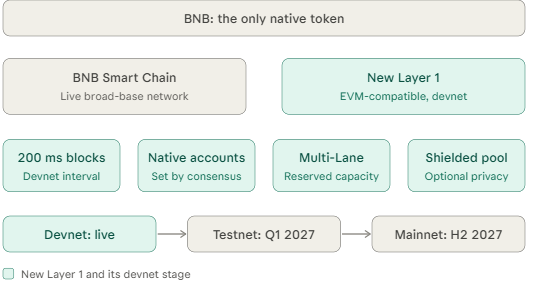
The new Layer-1 is EVM-compatible, keeps BNB as its only native token, and runs next to BNB Smart Chain.
Its devnet targets 200 ms blocks and adds native account controls, reserved capacity lanes and an optional shielded pool.
Today it is a devnet only. Public testnet and mainnet have not launched, and the dates are targets, not promises.
About BNB Chain
BNB Chain is a blockchain ecosystem powered by BNB. The official site lists three main chains: BNB Smart Chain (fast, EVM-compatible), opBNB (built with the OP Stack) and BNB Greenfield (decentralized data storage). The older BNB Beacon Chain is marked as sunset complete.
The new network joins this family as a fourth option, aimed at a narrower job.
Source: official website.
BNB Chain New Blockchain at a Glance
BNB Chain's new blockchain is an EVM-compatible Layer-1 aimed at high-frequency trading, payments, private finance and AI agents. It targets 200 ms blocks, runs alongside BNB Smart Chain and uses BNB as its only native token. It currently runs as a devnet, with no public testnet or mainnet yet.
Layer-1 Architecture: What Changes
TheNew L1 documentation describes the Layer-1 architecture as a close relative of BNB Smart Chain with several additions.
Component
What it does
Consensus
Parlia PoSA (Proof of Staked Authority) with BLS fast finality, the same family BNB Smart Chain uses
Block interval
200 ms on the current devnet
Decoupled execution
Ordering and execution run separately
Native account abstraction
Account rules are enforced by consensus, not by a contract
Pre-confirmation
Early feedback on a transaction before final inclusion
Multi-Lane
Reserved block capacity for chosen traffic types
Shielded pool
Optional private settlement
Source:official general FAQ, read 27 November 2026, IST.
Two of these deserve plain words. Account abstraction (AA) lets a wallet follow custom rules, such as who can sign or who pays fees. Multi-Lane means a payment does not have to fight a token launch for space.
Is BNB Chain's New Layer-1 EVM-Compatible?
Yes, at the execution layer. Existing Solidity bytecode uses compatible EVM semantics, according to the official FAQ. Compatible does not mean identical, though.
Builders must account for differences in fees, transaction timing and RPC support. On the current devnet, the base fee is pinned to zero, and fees are charged on the declared gas limit, not on gas used, per the network information. Contracts that guess gas loosely may cost more here.
BNB Chain L1 for AI Agents
The litepaper positions this as a BNB Chain L1 for AI agents. Native account controls would let an owner give software narrow, revocable permissions instead of full wallet access.
Because account abstraction sits inside consensus, the integration FAQ notes that no bundler or paymaster contract is involved. That removes one layer of moving parts, though it also means familiar tooling may not carry over unchanged.
BNB Chain Agentic Trading and High-Frequency Trading
BNB Chain agentic trading, in plain terms, would mean software placing orders within limits its owner sets. The pairing of fast blocks with scoped permissions is what makes that idea possible. No live agent product on this chain has been confirmed.
BNB Chain high-frequency trading depends on speed and predictability. Pre-confirmation gives early feedback, and Multi-Lane reserves capacity. One caution from the docs: the public Multi-Lane reference sets reserved capacity but does not promise that lane transactions run before general traffic.
BNB Smart Chain vs New L1
Point
BNB Smart Chain
New L1
Role
Broad-base general network
Latency-focused network
Consensus family
Parlia PoSA with BLS
Same family, faster interval
Execution
EVM-compatible
EVM-compatible
Native token
BNB
BNB
Status
Live
Devnet
Devnet, Public Testnet and Mainnet: Where It Stands
Stage
Status
Target
Devnet
Running with multiple validators, unstable, may reset
Live now
Public testnet
Not launched
Q1 2027
Mainnet
Not launched
H2 2027
The FAQ calls the targets partner-facing planning figures dated 2 November 2026, subject to testing, and not committed launch dates. Some outlets quote earlier windows, so the official wording is used here.
The network page adds that no public RPC endpoint, faucet or explorer exists yet, and the chain ID is not final. A devnet bridge links to BSC Testnet, where only testnet BNB (tBNB) should be used.
Confirmed Rules vs Unknown Rules
Confirmed by official docs
Unknown or unverified
EVM-compatible at the execution layer
Final mainnet fee levels
BNB is the native token
Mainnet node-access policy
Devnet only, unstable
Public snapshot service
200 ms block interval on devnet
Audit dates for bridge and circuits
Bridge contracts are unaudited
Which apps will move from BNB Smart Chain
Risks and Due Diligence
An official link is not proof that every product built on it is safe. Several points from the docs need attention:
Audits: The privacy circuits and bridge contracts are unaudited.
Trusted setup: The deployment imports an existing trusted setup instead of running its own ceremony.
Privacy limits: Ordinary public contract interactions remain public, and integrating one privacy feature does not automatically provide the other.
Impersonators: No public endpoint exists, so any site offering a "mainnet" or token sale for this chain is not official. Check the official verification page.
Never share a seed phrase or private key, and treat KYC requests from unknown sites as a warning sign. Token value and future performance are unverified.
Glossary
Layer-1: a base blockchain that settles its own transactions.
Devnet: an early developer network that can reset.
Public testnet: an open test network using valueless tokens.
Mainnet: the live network with real assets.
EVM: Ethereum Virtual Machine, the engine that runs smart contracts.
PoSA: Proof of Staked Authority, the consensus model.
Conclusion
BNB Chain announces new Layer-1 ambitions that are specific and technically detailed, yet still at the devnet stage. The EVM-compatible design, 200 ms target and agent-friendly account controls are documented. Testnet and mainnet remain targets.
Disclaimer: This article is for information only and is not financial, legal or investment advice. Plans can change, and crypto carries a high risk of loss.