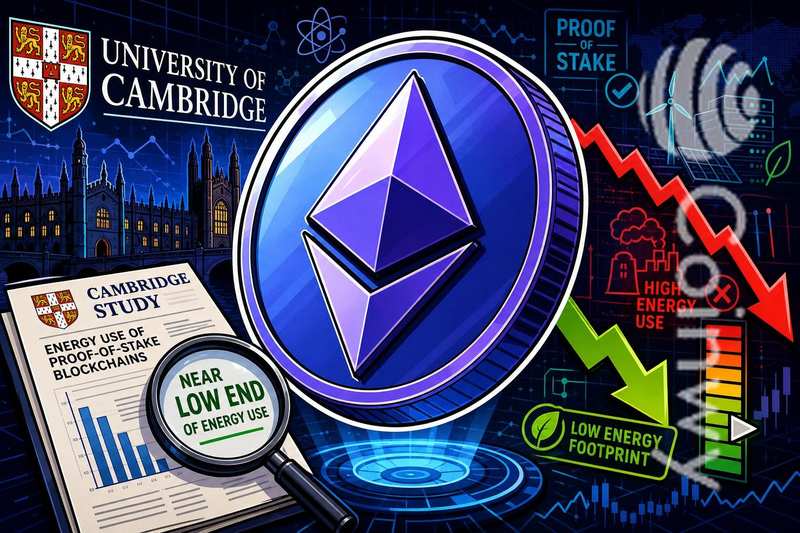
A study from the Cambridge Judge Business School places Ethereum near the lower end of proof-of-stake energy intensity, offering one of the first rigorous academic benchmarks for how the netw
A study from the Cambridge Judge Business School places Ethereum near the lower end of proof-of-stake energy intensity, offering one of the first rigorous academic benchmarks for how the network's power consumption compares with other proof-of-stake blockchains.
What the Cambridge study found
The Cambridge report maps Ethereum's climate footprint with what it describes as new precision. The finding positions Ethereum near the lower end of energy intensity among proof-of-stake networks, not as the single most efficient chain, but as one of the less energy-demanding options within the consensus category. For related coverage, see Trump Clears Path for $4.5bn Canada-US Bridge.
Energy intensity in this context refers to the amount of electricity consumed per unit of network activity. It is distinct from total energy consumption, which can rise simply because a network processes more transactions. The Cambridge study's framing centers on intensity, a metric that captures efficiency rather than raw scale. For related coverage, see XDC Marks Seven Years Since Mainnet Launch: Why the Milestone Matters.
The comparison is strictly within proof-of-stake. Proof-of-work networks like Bitcoin operate under a fundamentally different energy model, and the study does not conflate the two categories. For related coverage, see Brazil Raids 87 Shell Companies in Operation Veil of Maya.
Why Ethereum ranks where it does
Ethereum's position in the study traces back to its September 2022 transition from proof-of-work to proof-of-stake, commonly known as the Merge. That shift replaced energy-intensive mining with a validator-based consensus mechanism, cutting the network's electricity use by an estimated 99% at the time. For related coverage, see Empery Digital Sells About Half of Its Bitcoin Holdings.
Under proof-of-stake, validators lock up ETH as collateral rather than running specialized hardware to solve cryptographic puzzles. The computational overhead is orders of magnitude lower. The Cambridge study's ranking suggests that Ethereum's specific implementation of this model, including its validator set size and attestation structure, places it toward the more efficient end of the spectrum.
The study uses "near the lower end" rather than "lowest," a distinction worth noting. Several smaller proof-of-stake chains may consume less energy per transaction, but the Cambridge researchers appear to have weighted their analysis in a way that accounts for network scale and security guarantees alongside raw power draw.
What this means for Ethereum's positioning
Third-party academic research carries a different weight than self-reported sustainability claims. Cambridge's Centre for Alternative Finance has built credibility through its widely cited Bitcoin energy index, and applying similar rigor to Ethereum gives institutional investors and policymakers a reference point they are more likely to trust.
Energy narratives have practical consequences. Regulatory bodies in the EU and parts of Asia have weighed environmental impact when drafting blockchain policy. A peer-reviewed finding that Ethereum sits near the efficient end of proof-of-stake could strengthen the network's case in those discussions.
For the broader ecosystem, the study arrives at a moment when Ethereum remains the dominant smart-contract platform by developer activity and total value locked. As geopolitical events continue to test crypto market resilience, efficiency credentials add a layer of institutional appeal that pure price performance does not.
The Cambridge report does not settle the sustainability debate around blockchains. It does, however, give Ethereum a data point from a source that regulators and institutional allocators already monitor, one that places the network in a favorable position relative to its proof-of-stake peers.
Disclaimer: This article is for informational purposes only and does not constitute financial or investment advice. Cryptocurrency and digital asset markets carry significant risk. Always do your own research before making decisions.
Read original article on coinwy.comRead also :