The Senate failed to invoke cloture on the motion to proceed to the Digital Asset Market Clarity Act. The measure needed 60 votes to move toward formal floor consideration but could no longer
The Senate failed to invoke cloture on the motion to proceed to the Digital Asset Market Clarity Act. The measure needed 60 votes to move toward formal floor consideration but could no longer reach that threshold after 47 senators opposed it.
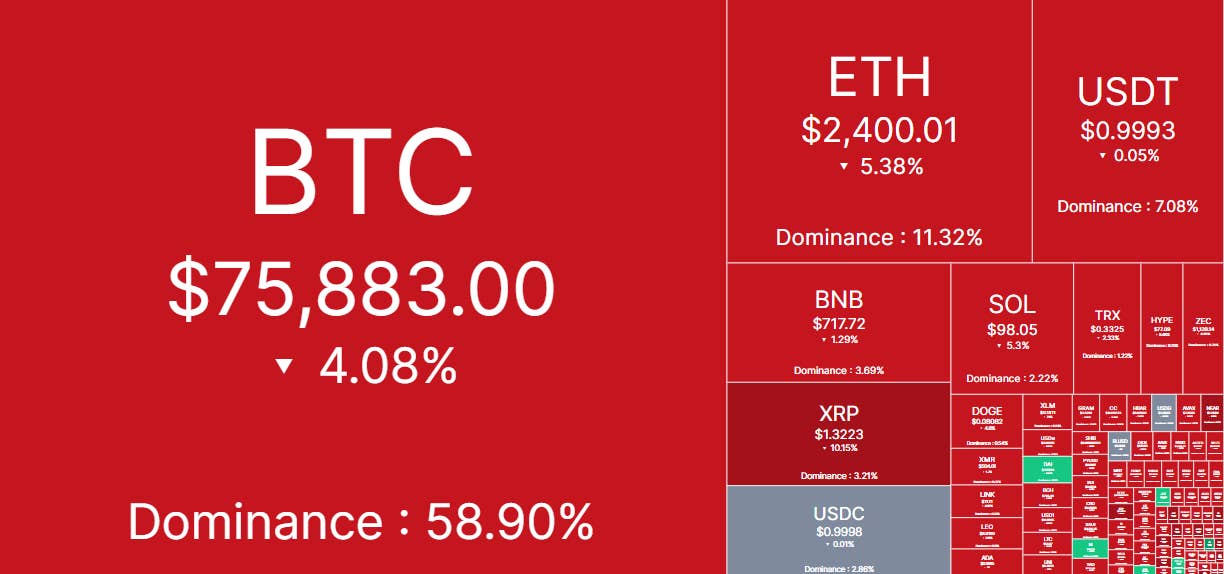
Crypto prices were already weakening before the result, but selling accelerated around the vote. The market snapshot below was taken at approximately 19:05 UTC on September 15. The percentage figures show the change over the preceding hour.
Crypto prices after the Senate resultOne-hour changes at approximately 19:05 UTC
XRP$1.32
-5.87%Largest decline
Dogecoin$0.08
-3.57%Second-largest decline
Zcash$1,139
-3.14%Outpaced the broader drop
Solana$98
-2.04%Returned below $100
Chainlink$11
-1.79%Moderate relative decline
Ether$2,407
-1.24%Held up better than altcoins
Bitcoin$76,110
-0.94%Broad-market benchmark
BNB$718
-0.60%Smallest decline shown
XRP absorbed the sharpest part of the move
XRP fell more than six times as much as Bitcoin during the measured hour. One reasonable explanation is that traders viewed XRP as more exposed to the loss of a near-term U.S. regulatory catalyst.
The CLARITY Act could have established clearer boundaries between the SEC and CFTC. That question matters more directly to assets whose regulatory treatment, exchange access and potential institutional products remain debated. Bitcoin already has established U.S. spot exchange-traded funds and carries less uncertainty over which regulator should oversee it.
Market structure also contributed to the difference. Altcoins generally have thinner liquidity than Bitcoin, allowing forced derivatives trades to produce larger percentage moves. That helps explain the scale of the decline without treating every loss as a separate judgment on the underlying network.
Long liquidations turned the decline into a cascade
CoinGlass recorded $292.06 million in liquidations during the one-hour window surrounding the result. Most came from traders positioned for prices to rise.
Total liquidations
$292.06MLong positions
$265.75MShort positions
$26.31MLongs represented approximately 91% of the total. This matters because leveraged positions can turn an ordinary decline into forced selling. Once a trader’s collateral falls below the exchange’s requirement, the position is closed automatically. Those sales can push prices into the liquidation levels of other traders.
The total does not represent money withdrawn from crypto wallets or an equivalent amount of spot selling. It measures derivatives positions that exchanges forcibly closed.
The vote was a trigger, but not the whole explanation
A one-hour price change cannot isolate the effect of a single event. Traders had already reduced risk as the bill’s chances weakened before the vote, and the liquidation window included market activity surrounding, not only following, the result.
The failed vote nevertheless removed a possible near-term regulatory catalyst. Its timing then collided with concentrated long positioning, producing a sharper move than the price changes alone would explain.
READ MORE:
 CLARITY Vote and Fed Decision: Crypto Scenarios to Watch
The Fed could give the sell-off a second leg
The Federal Reserve will announce its next interest-rate decision on September 16. A rate increase accompanied by projections for further tightening could keep Treasury yields elevated, strengthen the dollar and extend pressure on speculative assets.
The rate decision alone may not determine the direction. If traders already expect an increase, prices may react more strongly to the Fed’s economic projections and its guidance for later meetings. An expected hike without a further hawkish signal could allow the market to stabilize once the forced liquidations slow.
- Hike with tighter guidance: Further selling becomes more likely if yields and the dollar rise.
- Expected hike with balanced guidance: Prices could stabilize if no additional tightening is signalled.
- Hold or softer outlook: Reduced rate pressure could encourage traders to close short positions.
The next signal is whether prices keep falling after the liquidation total begins to slow. Continued weakness with strong spot volume would indicate that investors are selling actual holdings, not only that exchanges are closing leveraged trades.
A rebound alongside lower liquidations would instead suggest that the most aggressive part of the move came from excess leverage. Open interest rebuilding quickly before the Fed decision would make the market vulnerable to another cascade.
The failed Senate vote removed one potential source of regulatory progress. Whether the decline deepens now depends on what remains after the leveraged positions are cleared, and whether the Fed gives spot investors a reason to sell as well.
This article is provided for informational purposes only and does not constitute legal, financial or investment advice. Cryptocurrency prices and liquidation totals can change rapidly, while a Federal Reserve decision does not guarantee any particular market outcome.
The post Crypto Prices Drop as CLARITY Act Fails Senate Vote appeared first on Coindoo.