Bitcoin closed the week at roughly $62,990, down 2.7%, after an in-line July inflation print failed to trigger the expected relief rally. Spot Bitcoin ETFs reversed from their strongest inflo
Bitcoin closed the week at roughly $62,990, down 2.7%, after an in-line July inflation print failed to trigger the expected relief rally. Spot Bitcoin ETFs reversed from their strongest inflow week since April into consecutive days of outflows, and XRP briefly traded below $1 for the first time in nearly two years following a cross-chain bridge exploit.
The structural developments carried more weight than the price action. Goldman Sachs agreed to acquire NEOS Investments for up to $2.25 billion, gaining three crypto income ETFs. Riot Platforms sold 4,300 BTC to fund AI data center expansion. Grayscale withdrew three altcoin ETF registrations days before one of the underlying assets cleared its regulatory threshold. Both major US regulatory catalysts, meanwhile, slipped to September.
Below is a summary of the week's key developments across prices, flows, corporate activity and regulation.
Bitcoin price today after this week's crypto market drop
$Bitcoin is trading around $62,990 on Sunday morning, down 2.7% over the week, with the total crypto market cap holding near $2.19 trillion. Bitcoin fell 2.39% between 7 and 14 August, with five of seven trading sessions ending in negative territory, while Ethereum dropped 1.71%. The slide extended into the weekend, with BTC dipping as low as $62,812 on Saturday before stabilizing.
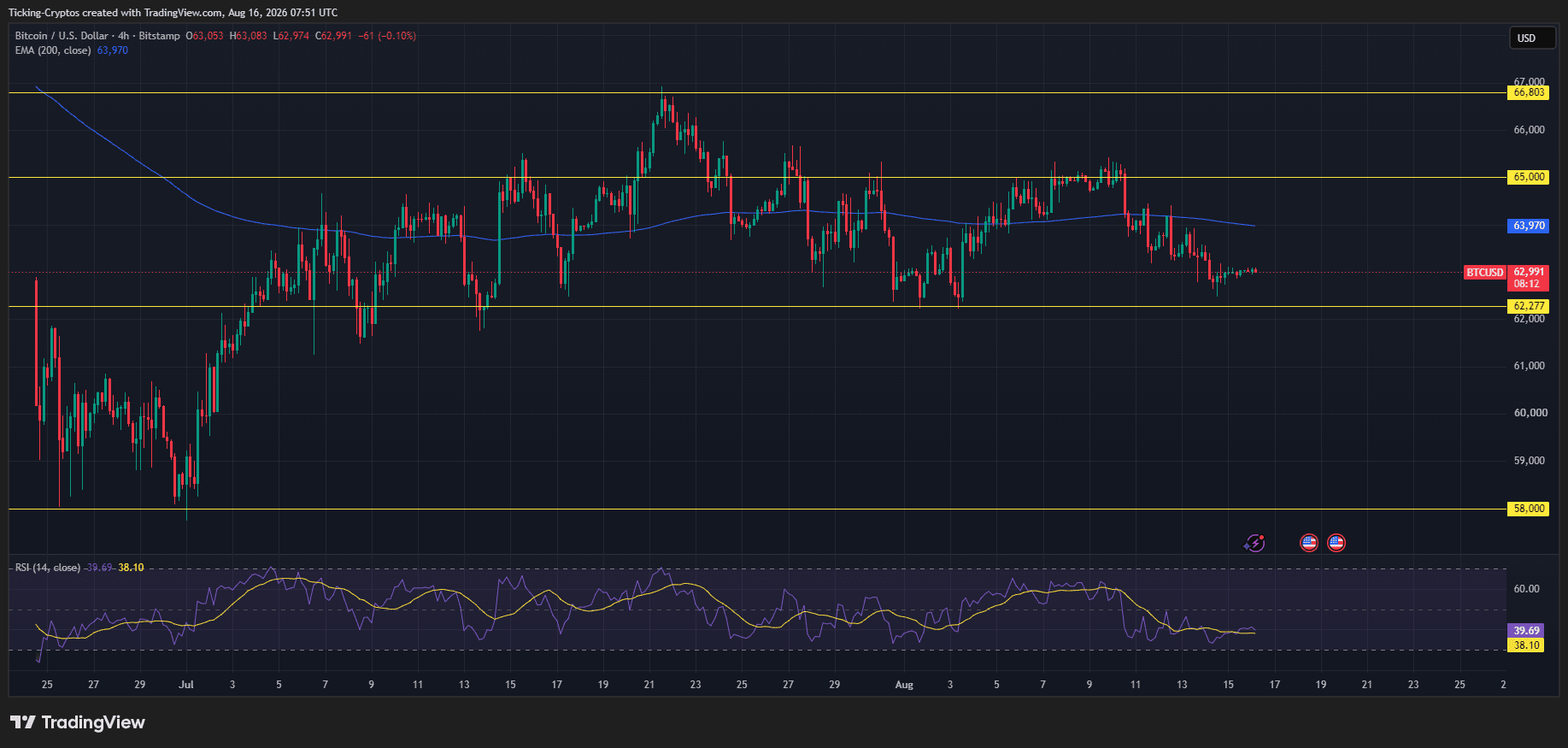
Where the majors finished the week:
- 🔴 Bitcoin ($BTC) around $62,990, down 2.7% on the week
- 🔴 Ethereum ($ETH) around $1,880, down about 1.7%
- 🔴$ XRP around $1.00, briefly under the dollar mark
- 🔴 Solana ($SOL) around $75.30, down about 1%
- 🟢 Monero ($XMR) up 5.3%, one of the few large caps in green
Since mid July the reading has traced an almost flat line in the mid to high thirties while Bitcoin swung between $63,000 and $66,500 above it, which tells you sentiment has been numb rather than panicked. Bitcoin's nearest support and resistance sat at $61,650 and $67,253. Volatility was almost non-existent. BTC's daily move did not exceed 1.5% on any single day, and the ADX reading of 12.37 confirms there is simply no trend here right now.
That matters more than it sounds. Crypto trading volumes have fallen to their lowest levels in three years, leaving very little firepower to push Bitcoin decisively in either direction.
Why did the July CPI report fail to lift the crypto market?
The July inflation print landed exactly in line with forecasts, but it was still too high to bring rate cuts back onto the table, so crypto got no relief rally. Consumer prices rose 0.1% month over month and 3.4% year over year, with core inflation up 0.2% monthly and 2.5% annually. Headline CPI cooled from 3.5% and core eased from 2.6%.
In a normal cycle, cooling inflation supports risk assets. This time, nothing followed. CPI remaining at 3.4% is still comfortably above the Fed's 2% target, which dampened expectations for rate cuts. Producer prices came in cooler than expected on Thursday, US equities liked it, and crypto still lagged. Bitcoin dropped below $63,000, losing 1.14% since midnight UTC as a second day of ETF outflows and a lack of bullish catalysts weighed on the market.
The read-through is simple: crypto is not currently trading on inflation data. It is trading on flows.
What happened to Bitcoin ETF flows this week?
Spot Bitcoin ETFs flipped from their best week since April into their first back-to-back outflow days since late July, erasing much of the optimism from early August. The previous week had delivered $853 million in weekly net inflows, the largest since April, led by BlackRock's IBIT. Then the direction reversed.
This week opened with a $144 million outflow, with ether ETFs echoing the cautious start at $14 million out. By Thursday, spot Bitcoin ETFs had seen $192 million exit across two consecutive sessions, the first back-to-back outflows since late July. Across the full week, outflows reached $332 million, led by Fidelity's FBTC.
There is a counterweight worth noting. Morgan Stanley increased its holdings in the iShares Bitcoin Trust ETF from 13.4 million shares to 16.5 million shares in Q2, according to a quarterly SEC filing. Institutions have not left. They have simply stopped adding at the pace that would move price.
And the corporate treasury side kept selling. MicroStrategy and Hut 8 sold over $134 million in BTC during the week. Strategy disclosed 1,690 BTC sold between 3 and 9 August for roughly $108.6 million, bringing 2026 disposals to 6,948 BTC across four separate sales, though the company still holds 840,447 BTC.
Why did XRP fall below $1 after the Coreum bridge hack?
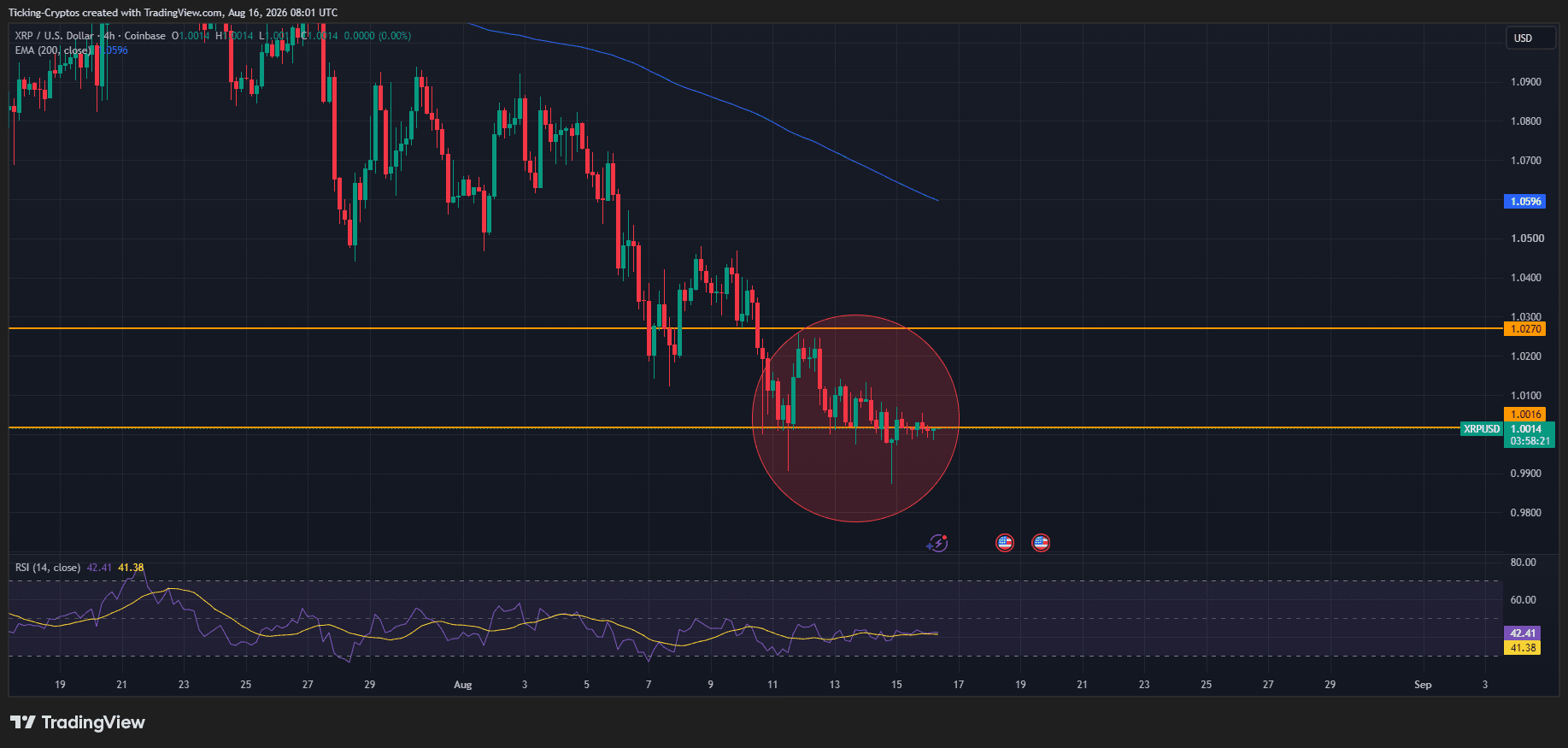
XRP dropped under one dollar for the first time in nearly two years after an attacker drained almost the entire XRP reserve backing the Coreum cross-chain bridge. An attacker drained 99.7% of the reserve on 9 August, taking 199,916 XRP across 94 transactions in about 97 minutes and leaving roughly 493 XRP behind.
The mechanics are worth understanding, because they say nothing about XRP itself. The attacker never sent real XRP to the bridge. They moved the bridge's own token between two wallets they controlled while attaching a fake deposit label, the bridge software treated that as a genuine incoming deposit, and the attacker then withdrew real XRP through the normal process. The software never verified that the payment destination was the bridge itself before crediting the balance.
The XRP Ledger was not compromised, no private keys were stolen, and holdings in standard wallets, on exchanges or in US spot XRP ETFs were unaffected. TX, the brand behind Coreum and Sologenic, confirmed the incident, admitted bridged XRP on its chain is not currently fully backed and said a complaint has been filed with the FBI.
XRP dipped to around $0.99 on 11 August before recovering to $1.01. In dollar terms the theft was small, roughly $200,000. But it fits a familiar pattern: bridge exploits account for more than $2.8 billion, or roughly 69% of all DeFi losses since 2022, almost always through flaws in off-chain trust logic rather than breaks in blockchain cryptography.
What does the Goldman Sachs NEOS deal mean for crypto ETFs?
Goldman Sachs agreed to buy NEOS Investments for up to $2.25 billion, instantly handing the bank three Bitcoin and Ethereum income ETFs instead of building them from scratch. The deal was announced on 12 August. NEOS manages $30 billion across 19 options-based income ETFs as of 30 June 2026.
Three crypto-linked funds come with the deal and manage more than $1.1 billion combined: the NEOS Bitcoin High Income ETF (BTCI), the Boosted Bitcoin High Income ETF (XBCI) and the Ethereum High Income ETF (NEHI). None of the three invests directly in Bitcoin or ether. They gain exposure through exchange-traded products linked to the assets and use options strategies to generate monthly income.
The combined platform would make Goldman Sachs Asset Management the eighth largest active ETF manager, with $80 billion in active ETFs across a $130 billion global ETF platform. The transaction is expected to close in the first quarter of 2027, pending regulatory clearances.
The subtext is a shift in what institutional crypto demand actually looks like. It is no longer only about spot price exposure. It is increasingly about yield.
Why are Bitcoin miners selling BTC to fund AI data centers?
Mining economics have collapsed to the point where the average miner is producing Bitcoin at a loss, so the largest operators are converting BTC reserves into AI data center capacity. Riot Platforms disclosed it will sell 4,300 BTC and direct the proceeds toward expanding its data center network for AI workloads, after Q2 mining revenue fell 19.3% on rising electricity costs and record-low hashprice. That took Riot's holdings from 15,680 to 11,380 BTC, roughly 27% of its treasury in a single quarter.
The numbers explain the decision. Bitcoin has been trading around $63,500 while industry models put the average market-wide cost of mining a coin at $76,000 to $78,000, with hashprice at a record low of $30 to $35 per PH/s per day.
The scale of the pivot is genuinely large. On 10 August, Riot signed a 20-year agreement worth about $9.1 billion to lease 191 megawatts of data center capacity at its Rockdale, Texas facility to an AI company, and its shares jumped more than 25% in after-hours trading. Bernstein estimates data center contracts between Bitcoin miners and AI or cloud companies now exceed $135 billion. IREN signed a $9.7 billion agreement with Microsoft, and Hut 8 finalized a $7 billion contract with Google-backed partners.
MARA Holdings, Core Scientific and Bitdeer have all previously liquidated part or all of their crypto reserves to fund AI infrastructure. Miners are quietly rebranding themselves as power monetization businesses, and Bitcoin is becoming one of several things they can do with electricity rather than the only thing.
What is the status of US crypto regulation and the CLARITY Act?
Both of the near-term US regulatory catalysts stalled this week, pushing meaningful legislative progress into mid September at the earliest. The Senate's delay in passing the CLARITY Act and the cancellation of the SEC meeting that would have outlined alternative regulator-led crypto rules both weighed on prices.
Cloture on the motion to proceed for H.R. 3633, the Digital Asset Market Clarity Act, is now scheduled to take effect on 15 September 2026, with the Senate returning on 14 September. The SEC cancelled its crypto rulemaking meeting with no replacement date announced. Separately, Cboe BZX filed for approval to list 3x leveraged Bitcoin and Ether ETFs.
There was one more altcoin ETF story worth flagging. Grayscale filed three Form RW withdrawals on 7 August, pulling its Cardano, Polkadot and Hedera Trust ETF registrations within 190 seconds of each other, exactly two days before ADA cleared the SEC's six-month CME futures seasoning threshold. A Form RW is a voluntary registration withdrawal, not an SEC rejection and not a statement about the underlying asset. Five other issuers including Bitwise, Canary Capital, VanEck and 21Shares still have active ADA ETF filings, with the earliest possible SEC decision window around 23 October. ADA still fell 9.53% on the news.
Read it as a comment on altcoin ETF economics rather than on Cardano.
What should crypto investors watch in the week ahead?
The three things that matter most are whether ETF outflows continue, whether Bitcoin holds the $61,650 support level, and how the Fed minutes land. Nothing on the calendar looks likely to break the $62,000 to $66,000 range on its own, which means flows remain the deciding variable.
Specific things to track:
- ETF flow direction. Two negative days does not make a trend, but a third and fourth would.
- The $61,650 support level. A clean break there would be the first genuine range break since early summer.
- Miner selling pressure. With hashprice at record lows, more treasury liquidations are likely.
- Corporate treasury behaviour. Strategy has now sold in four separate tranches this year.
- September regulatory calendar. CLARITY Act cloture on 15 September is the next real legislative catalyst.
One more caution: reports circulated late in the week about a Coldcard hardware wallet exploit involving older firmware. Those claims remain unconfirmed, with no official response from Coldcard and no independent incident report as of 14 August. The claims should be treated as unverified pending confirmation, though users running outdated hardware wallet firmware should review their setup regardless.
What is the takeaway from this week in crypto news?
The takeaway is that price did nothing while the industry around it changed shape, which is usually more important than a green candle. This was a week of consolidation with a lot of structural noise underneath. Bitcoin did almost nothing while the industry around it kept rearranging: Wall Street buying yield products, miners becoming power companies, bridges failing the same way they have failed since 2022, and Washington pushing every decision to September.