Crypto platforms use the word “rewards” for almost everything. A credit card offers Bitcoin back. An exchange promises staking income. A referral program pays a bonus for bringing in a friend
Crypto platforms use the word “rewards” for almost everything.
A credit card offers Bitcoin back. An exchange promises staking income. A referral program pays a bonus for bringing in a friend. Another app rounds up everyday purchases and converts the spare change into crypto.
These offers aren’t necessarily bad. Some provide genuine value. The problem is that a 4% card reward, a 6% staking rate and a $25 referral bonus describe completely different arrangements. They come with different costs, risks and conditions, even though platforms place them under the same friendly label.
CryptoVantage has reviewed common reward programs to help users separate useful benefits from headline percentages. The central lesson is simple: a reward should be measured by what the customer keeps, not by the largest number in the advertisement.
Crypto Card Rewards
Crypto cards operate much like conventional cashback cards, but the reward is delivered in Bitcoin, Ether or another digital asset.
The Gemini Credit Card is an actual credit card issued by WebBank. It has no annual fee and lets cardholders choose from numerous cryptocurrencies for their rewards. Gemini advertises different rates depending on the spending category, although caps and eligibility rules may apply.
Crypto.com offers both credit and prepaid card products, depending on the customer’s location. Its US Visa Signature Credit Card has several reward tiers, with higher advertised rates attached to higher product levels. Eligible users can choose Bitcoin or Cronos as their reward currency.
That distinction matters. Earning 2% in Bitcoin is not financially identical to receiving 2% in CRO. Both rewards have a dollar value when issued, but their values can move differently afterward.
Users comparing cards should look beyond the maximum rate and ask:
- Is it a credit, debit or prepaid card?
- Is there an annual fee?
- Does the highest rate require a deposit or token holding?
- Is the reward capped?
- Which purchases qualify?
- Can the reward asset be changed?
- Are foreign transactions or ATM withdrawals charged separately?
- What happens to rewards after a purchase is refunded?
Anyone researching available products can compare crypto rewards cards by their fees, reward structures and account requirements.
The right card isn’t automatically the one with the highest advertised percentage. It’s the one whose normal reward rate fits the customer’s existing spending without requiring unnecessary purchases or an uncomfortable financial commitment.
Run the Break-Even Calculation
A reward rate sounds more impressive before it is translated into dollars.
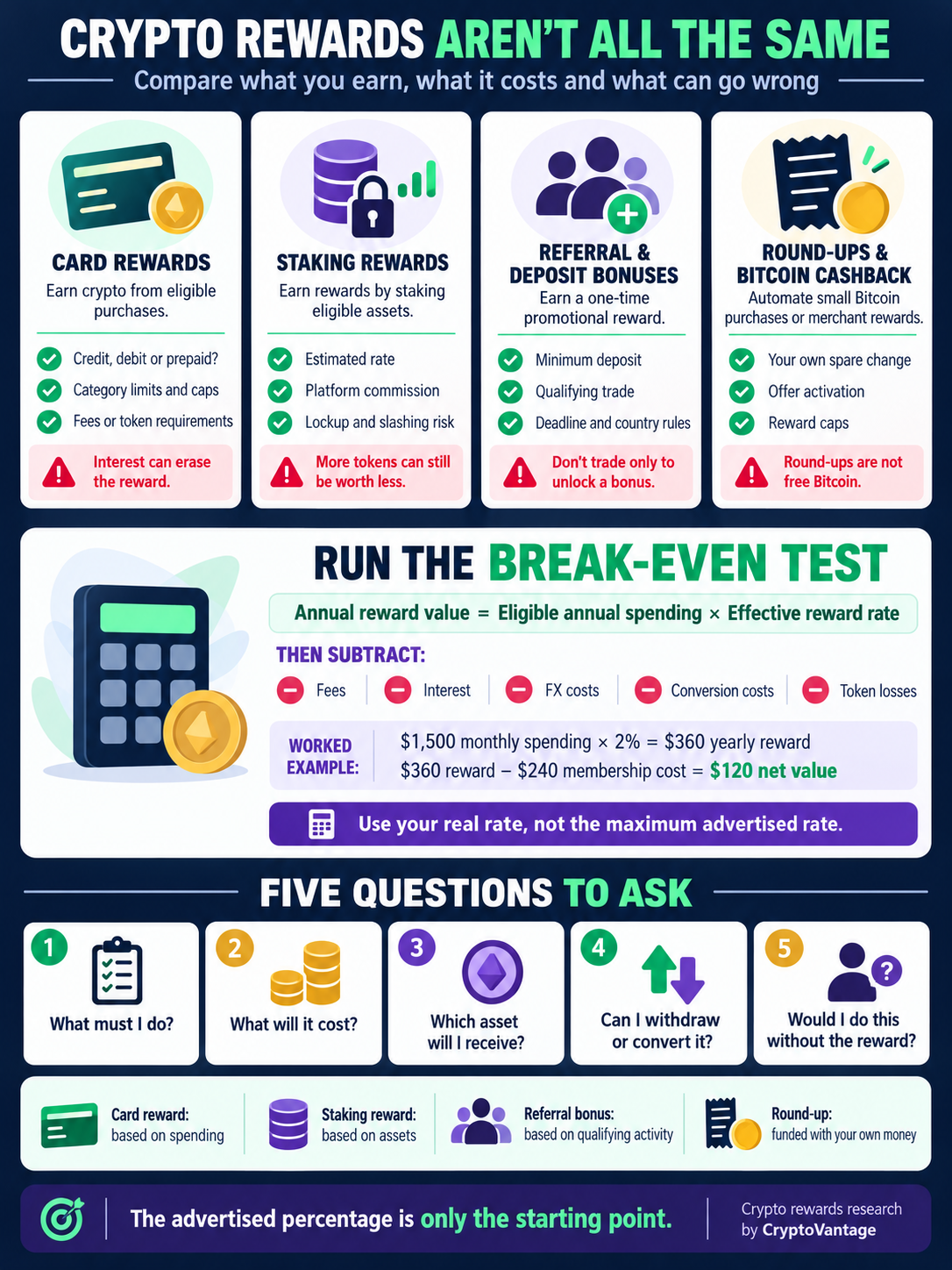
Suppose someone spends $1,500 per month on eligible purchases. A card returning 2% generates approximately $30 in rewards each month, or $360 over a year.
At 3%, the annual reward rises to $540. At 4%, it reaches $720, assuming the rate applies to the entire spending amount and there is no category cap.
Now introduce a cost. If the card or its associated membership requires $20 per month, that is $240 per year. The net value of a 2% reward falls from $360 to $120.
If the higher reward tier also requires the customer to hold a particular token, the calculation becomes less predictable. A decline in the token’s market value could outweigh the additional rewards.
A useful formula is:
Annual reward value = eligible annual spending × effective reward rate
Then subtract:
- Annual or subscription fees
- Foreign-exchange charges
- ATM fees
- Interest paid on an unpaid credit-card balance
- Value lost through an unnecessary token commitment
- Conversion and withdrawal costs
“Effective reward rate” is important here. A card might advertise 4% in one category but return 1% on most purchases. The user’s real rate depends on where the money is actually spent.
No crypto reward compensates for credit-card interest. Carrying a balance at a high annual percentage rate to earn 2% in Bitcoin is a losing trade.
Staking Rewards Are Not Cashback
Staking rewards are often displayed beside card rewards inside the same application. They work differently.
Proof-of-stake networks use validators to help confirm transactions and maintain the blockchain. Owners may delegate or stake eligible assets and receive part of the network’s rewards.
Exchanges such as Coinbase and Kraken make staking more accessible by handling much of the technical work. The customer selects an eligible asset, accepts the terms and receives rewards according to the platform’s process.
The displayed annual percentage is generally an estimate rather than a guaranteed return. Protocol issuance, the amount of cryptocurrency being staked, validator performance, platform commissions and network conditions can all affect the result.
There may also be an unstaking period. A user who decides to sell may have to wait before the asset becomes transferable. Certain protocols impose slashing penalties when validators break network rules or fail to perform correctly.
Most importantly, the reward is normally paid in the staked cryptocurrency.
If someone receives a 5% annual reward in a token that falls 40% against the dollar, the staking yield doesn’t prevent a loss in dollar terms. The investor owns more units, but those units may be worth much less.
Blockonomi’s analysis of realistic crypto staking returns provides useful context for comparing headline yields with the amount investors may actually receive.
Before staking, check:
- Whether the rate is fixed or estimated
- How often rewards are distributed
- What commission the platform retains
- Whether the principal is locked
- How long unstaking takes
- Whether slashing risk exists
- Whether the service is available in the user’s country
- Who controls the assets during staking
Staking can serve a real blockchain function. It shouldn’t be treated as a savings account with a different logo.
Learn-and-Earn Offers May Not Remain Available
Learn-and-earn programs became a popular way for exchanges to introduce new assets. A user watched a short video, answered several questions and received a small amount of cryptocurrency.
Coinbase was especially associated with this model. Its Learning Rewards program distributed tokens from projects including Stellar, Compound, The Graph and Tezos. Coinbase ended the program in May 2025.
That closure highlights a broader issue: reward programs are promotional products, not permanent platform features.
An old review, video or search result may describe a bonus that no longer exists. Even an active program may be limited to particular countries, accounts or promotional periods.
Users should confirm an offer inside the official application before creating an account. They should also avoid third-party websites asking for wallet credentials in exchange for access to a supposed educational reward.
A genuine $3 token reward isn’t worth exposing a recovery phrase, connecting a valuable wallet to an unfamiliar website or completing an expensive transaction.
Referral Bonuses Come With Conditions
Referral programs reward existing users for inviting new customers. The new customer may also receive a bonus.
The headline can look straightforward: invite a friend and earn $20. The terms usually add several steps.
The referred person may need to:
- Register through the correct referral link
- Complete identity verification
- Deposit a minimum amount
- Execute a qualifying trade
- Keep the account open for a specified period
- Complete the requirements before a deadline
- Reside in an eligible jurisdiction
Some promotions pay only the referrer. Others pay both people. Rewards may arrive in dollars, stablecoins, Bitcoin or a platform-linked token.
A referral bonus should never determine whether a platform is suitable. Security history, withdrawal options, fees, asset support and customer-service quality matter far more than a one-time payment.
There is also a disclosure issue. A person publishing a referral link should make it clear that compensation may be received. Readers deserve to know when a recommendation carries a financial incentive.
Deposit Bonuses Can Encourage Unnecessary Activity
Some crypto services offer a bonus after a user deposits, buys or trades a minimum amount.
The offer may provide a fixed reward, a mystery amount or a percentage of the deposit. What sounds like free cryptocurrency can require significantly more activity than the headline suggests.
A platform may require the user to keep funds deposited for several weeks. A trading bonus may be unavailable for withdrawal until a volume threshold is reached. The customer could also pay trading fees while attempting to unlock a relatively small reward.
For example, completing $10,000 in trades to receive a $25 bonus is not automatically profitable. Even a modest 0.25% effective trading cost would equal $25, consuming the entire reward before spreads, slippage or withdrawal charges are considered.
Users should calculate the required activity first. If they wouldn’t make the deposit or trades without the promotion, the offer is influencing behavior rather than rewarding it.
CryptoVantage treats conditions such as holding periods, qualifying transactions and withdrawal restrictions as part of the reward’s cost. The bonus amount alone tells only half the story.
Bitcoin Round-Ups Turn Spending Into Small Purchases
Cash App offers a different type of reward-like feature. Its Round Ups tool can round a Cash App Card transaction to the nearest dollar and use the difference to purchase Bitcoin, a selected stock or an exchange-traded fund.
If a purchase costs $3.40, the transaction may be rounded to $4, with the remaining $0.60 allocated to the selected investment.
This is not free Bitcoin. The customer supplies the extra money. The benefit is automation.
Small amounts can accumulate over time without requiring a separate purchase decision. Someone making 40 monthly transactions with an average round-up of $0.50 would direct approximately $20 per month, or $240 per year, into Bitcoin.
Cash App currently states that it charges no fee or spread for Round Ups, Auto Invest and Paid in Bitcoin transactions. Product terms can change, so users should confirm the current order details before relying on that arrangement.
Round-ups can be helpful for someone who wants small, regular purchases. They can also create the impression that spending more produces more rewards. It doesn’t. Purchasing something unnecessary to generate spare change still leaves the user with less money overall.
Cashback Offers May Be Merchant-Specific
Some applications provide temporary Bitcoin or crypto cashback offers for purchases with selected merchants.
Cash App, for example, displays Bitcoin offers through its Cash App Card offer system. Availability may depend on the user, merchant, transaction type and activation requirements.
These promotions resemble conventional card-linked offers. Their value depends on whether the customer already planned to shop with the participating business.
A 5% reward on a $100 purchase saves $5. Spending $100 solely because the offer exists still costs $95 after the reward.
Users should check whether an offer:
- Must be activated before payment
- Applies online, in-store or both
- Has a minimum purchase
- Has a maximum reward
- Excludes taxes, tips or gift cards
- Can be combined with another promotion
- Expires on a specific date
The most useful cashback reward reduces the cost of a planned purchase. It shouldn’t create a new one.
Reward Tokens Can Lose Value
Platforms often issue rewards in their own tokens. This can reduce the direct cash cost to the company while encouraging customers to remain inside its ecosystem.
The customer then carries two separate risks.
The first is platform risk. The reward may depend on continued access to the company’s application, account or services.
The second is token risk. The reward’s dollar value can rise or fall after it is issued.
A platform may describe a user as having earned $100 in rewards based on the token’s value at distribution. If the token later declines by 50%, the holding is worth $50. If it doubles, it is worth $200.
Neither outcome changes the original reward rate, but it changes what the customer eventually receives after selling or spending it.
Before selecting a reward currency, consider:
- Whether it can be withdrawn
- Which exchanges support it
- The cost of converting it
- Its trading liquidity
- Whether holding it unlocks additional benefits
- Whether those benefits justify the price risk
Bitcoin rewards are volatile too. The difference is that Bitcoin isn’t tied to the performance of the company issuing the card or promotion.
Rewards Can Create Tax Records
Crypto rewards may have tax consequences.
In the United States, staking rewards and promotional cryptocurrency can create income-reporting obligations. Selling, exchanging or spending the received asset may later produce a capital gain or loss based on the difference between its value when received and its value when disposed of.
That can create two records for one reward:
- The fair market value when the cryptocurrency was received
- The gain or loss when it was later sold, exchanged or spent
A stream of tiny card rewards may therefore generate many acquisition records. The same applies to frequent staking distributions.
The Internal Revenue Service’s digital-asset guidance should be consulted for current US reporting information. Tax treatment varies by country, and anyone with substantial or complex activity may need advice from a qualified professional.
At minimum, users should retain:
- The date each reward was received
- The amount and asset
- Its market value at receipt
- The platform that issued it
- Any associated fee
- The date and value when it was sold or exchanged
A reward is much less convenient when its records are missing at tax time.
How to Judge Any Crypto Reward
A practical review starts with five questions.
What must I do?Spend, deposit, trade, stake, refer someone or hold a platform token.
What will it cost?Include fees, spreads, membership charges, interest, lockups and the value of any required holdings.
What do I receive?Identify the asset, amount, distribution schedule and withdrawal rules.
What could change?Rates, categories, token prices, regional availability and program terms can all move.
Would I take the same action without the reward?If the answer is no, the promotion may be encouraging unnecessary risk or spending.
Crypto rewards are most useful when they sit on top of activity the customer already intended to complete. A card reward can add value to normal purchases. Staking can compensate holders who understand the protocol and lockup terms. Round-ups can automate small Bitcoin purchases.
Problems begin when a user spends more, trades more frequently or locks up more money simply to obtain the advertised benefit.
The Percentage Is Only the Starting Point
There is no single “best” crypto reward because the programs solve different problems.
Gemini and Crypto.com attach crypto rewards to card spending. Coinbase and Kraken make staking accessible to users who may not run validators themselves. Cash App turns everyday card transactions into small Bitcoin purchases. Referral and deposit bonuses provide one-time incentives with their own eligibility rules.
A useful reward leaves the customer better off after every cost and condition is counted.
That means checking the effective percentage, calculating the annual dollar value, understanding the reward asset and confirming that the required behavior already fits the user’s plans.
The largest advertised number may attract attention. The reward that survives the break-even calculation is the one that actually matters.
About the Author
CryptoVantage is a cryptocurrency publication providing educational guides, news, analysis, and reviews covering Bitcoin, blockchain, exchanges, wallets, fintech, and digital assets. Its team of writers, researchers, and cryptocurrency specialists creates accessible content for both newcomers and experienced crypto users, helping readers better understand the rapidly evolving digital-asset industry.
The post CryptoVantage Breaks Down Common Crypto Rewards appeared first on Blockonomi.