Nvidia (Nasdaq: NVDA) is back at the center of the AI trade. The chipmaker's board reinstated cofounder Jensen Huang as CEO on Monday, and the stock jumped about 30%. But the industry's bigge
Nvidia (Nasdaq: NVDA) is back at the center of the AI trade. The chipmaker's board reinstated cofounder Jensen Huang as CEO on Monday, and the stock jumped about 30%.
But the industry's biggest problem is no longer chips. It is the electricity and data center capacity needed to run them, and that shortage could create an unexpected investment opportunity for Bitcoin miners, according to Grayscale.
In a September report, the digital asset manager argued that the AI industry's growing need for computing capacity benefits companies that already control electricity access and data center infrastructure.
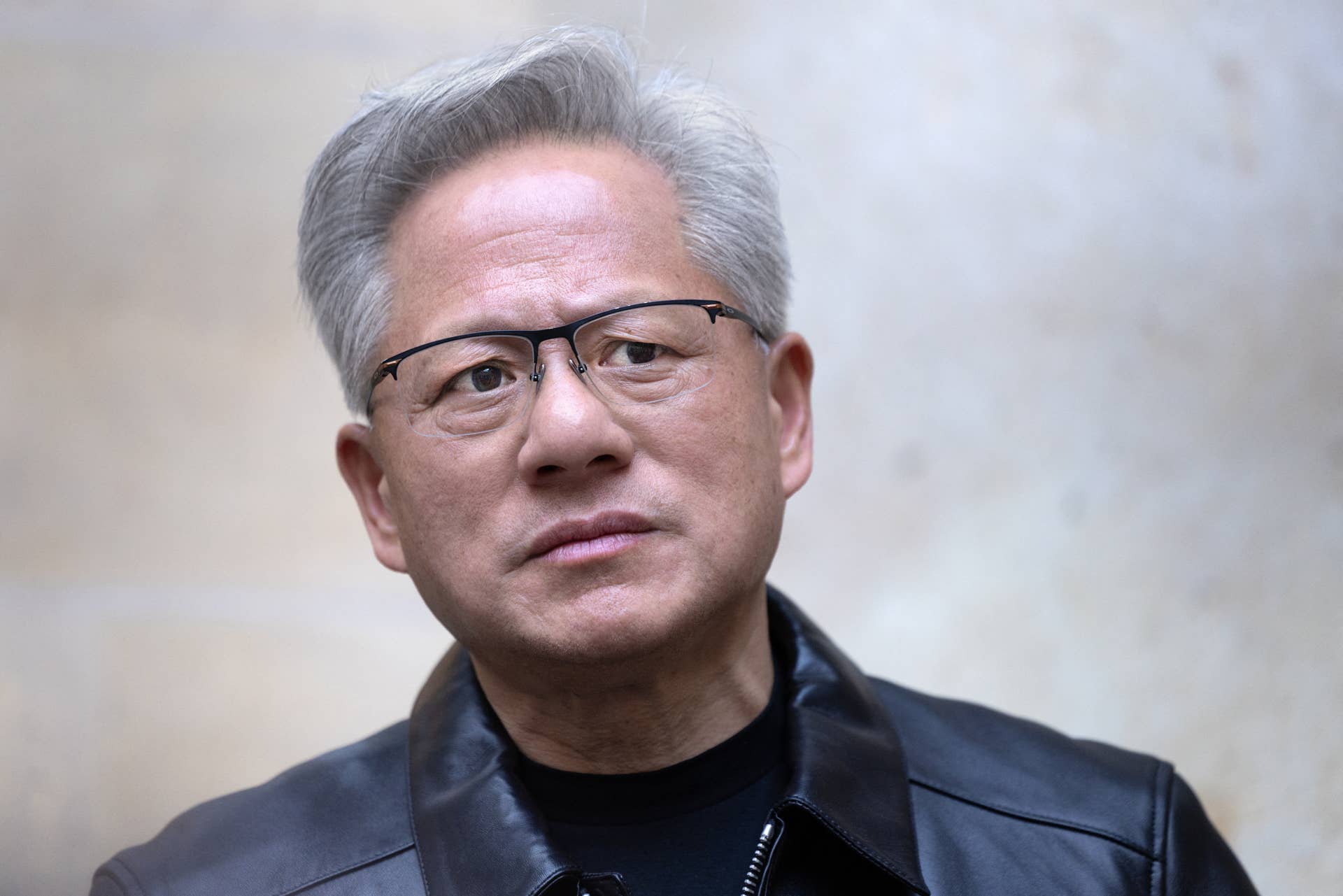
Co-founder, President and CEO of US Technology company Nvidia, Jensen Huang, looks on during a press briefing in Paris on October 13, 2026. Source: Getty Images
Nvidia rebounds, but the bottlenecks remain
Nvidia became the first company to reach a $5 trillion market value on the back of the AI boom. Then the Huang scandal hit. He resigned on Nov. 12 after admitting an affair with a woman alleged to be a Chinese spy, and the stock slid about 40% over the past month, knocking Nvidia from first to fourth among the world's most valuable companies.
On Monday, the board voted unanimously to bring him back. Nvidia said it received input from senior levels of the U.S. government and is confident Huang's return poses no national security risk.
Shares surged about 30% on the news, adding roughly $1 trillion in market value within hours. The stock still trades well below last month's all-time high of $239.24.
Whatever happens in the boardroom, the physical constraints remain. Grayscale notes that securing a grid connection can take more than five years, while lead times for some transformers now exceed three years.
That means AI companies could struggle to expand computing capacity even as chip supply improves. The real bottleneck is delivering fully powered, operational data centers.
More on TheStreet Roundtable:
Why Bitcoin miners could benefit
Bitcoin miners have spent years securing power access and building large facilities to run energy-intensive mining operations. Some of that infrastructure can now host the GPU systems used for AI training and inference.
Grayscale identified 11 U.S.-listed companies positioned at this pinch point.
Nine of them are current or former Bitcoin miners. CoreWeave is a former Ethereum miner, and only Nebius has no crypto mining heritage. Four, including Cipher, Core Scientific, Applied Digital and Galaxy, have already pivoted entirely to AI and high-performance computing (HPC).
The economic incentive is significant. Grayscale estimates that AI and HPC applications earn roughly twice the revenue per megawatt-hour as Bitcoin mining on average. For miners, repurposing power capacity offers an alternative revenue stream just as demand for powered data center space accelerates.
Related: Nvidia’s earnings call names two former crypto miners
Miners lead Monday's rally
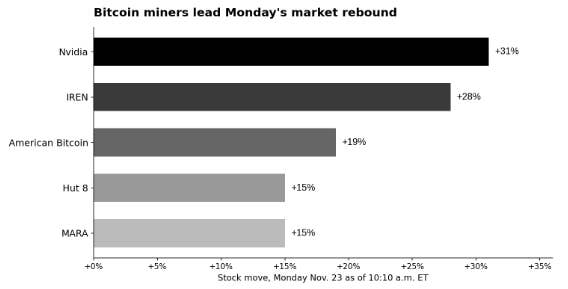
The thesis played out on Monday's tape. Bitcoin miners led the market rebound after the Huang announcement. IREN rose 28% to $15.18, American Bitcoin gained 19% to $4.18, and Hut 8 and MARA each climbed more than 15% as of 10:10 a.m. ET.
Virtually all publicly traded Bitcoin miners have converted or announced plans to convert part of their energy access to AI and HPC use cases, according to Grayscale.
Bitcoin miners led Monday's market rebound after Nvidia reinstated Jensen Huang as CEO. Chart: TheStreet Roundtable
What could go wrong
The transition requires substantial capital. Not every mining facility can accommodate GPU workloads, and companies must secure customers, connectivity and reliable power before generating meaningful returns.
Faster data center construction, gains in AI efficiency and expanding electricity supply could also ease the bottleneck.
Politics adds another risk. Community opposition blocked or delayed an estimated $98 billion of U.S. data center projects during one three-month period, and New York has imposed the nation's first statewide temporary moratorium on new hyperscale data center permits.
Nvidia makes the chips powering the AI revolution. But the companies that supply the electricity and facilities to run those chips could become the trade's important beneficiaries, and crypto miners may already own some of the assets needed to compete.
Readers who follow our market coverage can also track the Roundtable 100, our weekly ranking of the top 100 investable tech stocks, including digital assets. Nvidia fell 49 spots on the list following Huang's exit earlier this month.
Disclaimer: This article is for informational purposes only and does not constitute financial advice. Investments are subject to market risk. Always conduct your own research before making any investment decisions.
Related: Tesla jumps 50 places on the Roundtable 100 amid FSD v15 rollout