Dogecoin started in December 2013 as a joke coin built on top of Litecoin’s code, yet more than a decade later it still ranks among the larger cryptocurrencies and has one of the most loyal c
Dogecoin started in December 2013 as a joke coin built on top of Litecoin’s code, yet more than a decade later it still ranks among the larger cryptocurrencies and has one of the most loyal communities in the market.
Dogecoin block time, which is the average wait between one mined block and the next, is set at roughly one minute, and that single number shapes almost everything about how quickly a DOGE payment goes through.
This gap decides how fast a transfer gets its first confirmation, and it is the reason DOGE is often used for tips and small payments.
What Is Dogecoin Block Time and Why Does It Matter for DOGE Transfers?
Every blockchain puts waiting transactions into groups called blocks, and the block time tells how often a new group is added.
On the Dogecoin network, miners aim to find one block about every 60 seconds, but a single block can come in 10 seconds or take three minutes because mining depends on luck.
A transaction is not final until a miner places it inside a block, so wallets, shops, and exchanges all build their payment rules around this timing. For that reason, Dogecoin block time is one of the first numbers that traders and payment services check before they accept DOGE.
How Do Dogecoin Confirmations Work on the Blockchain?
A confirmation is a count of the blocks that sit on top of the block that holds a transaction. When a transfer is first included, it has one confirmation, and each new block after it adds one more, which makes the transfer harder to undo every time.
Under normal conditions each confirmation takes about as long as the average block gap, so two confirmations need about two minutes, and six confirmations need about six minutes.
Since block discovery is random, these numbers are averages and not promises, and a few slow blocks in a row can make the wait longer.
Dogecoin Block Time vs Bitcoin and Litecoin
The table below compares the usual block gap and the rough wait for six confirmations on several well-known proof-of-work networks.
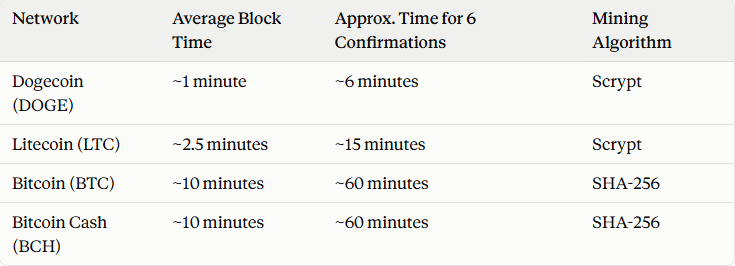
Dogecoin was forked from Litecoin, but its developers chose a shorter gap between blocks. This choice helped DOGE become popular for tips and small payments long before many faster networks gained attention.
How Many Confirmations Do Exchanges Require for Dogecoin Deposits?
Exchanges set their own confirmation limits, and these limits are company rules and not rules of the protocol.
Published guides have listed figures such as 40 confirmations at Kraken and 60 at Binance and Coinbase, which would mean a wait of about 40 to 60 minutes even though Dogecoin block time is only one minute.
Because these rules can change without notice, the deposit page of the platform itself is the safest place to check.
Smaller shops and point-of-sale providers often accept between one and six confirmations for low-value purchases.
Larger payments usually deserve a longer wait, since more confirmations lower the chance that a network split could reverse the payment.
Why Does a Dogecoin Transaction Stay Pending?
When a DOGE transfer stays at zero confirmations for longer than a few minutes, The reason usually comes down to one of the following:
Low fee: Miners tend to pick the transactions that pay the most per byte first, so a payment sent with a very small fee can wait in the mempool much longer than expected while better-paying ones are processed ahead of it.
Busy network: When the market gets excited and many people start moving coins at the same time, blocks fill up quickly and smaller transfers end up stuck behind everyone else, which is a common sight during sharp price rallies.
Many small inputs: A wallet that spends dozens of tiny UTXOs makes a large transaction in bytes, and that raises the fee needed for quick inclusion.
Slow block luck: Mining is random, so two or three blocks can sometimes take several minutes each to show up.
Dogecoin does not support Replace-by-Fee, which makes a stuck transaction harder to fix than on Bitcoin.
In most cases the best choices are to wait until the transaction drops out of the mempool or to use wallet tools that can raise the fee through a child transaction.
How to Check DOGE Transaction Status on a Block Explorer
A block explorer shows whether a transaction is unconfirmed, confirmed in one block, or buried under several more blocks. Explorers such asdogechain.info and blockchair.com are commonly used for this check.
The transaction hash, which the sending wallet or exchange gives after a withdrawal, is pasted into the search bar to show the confirmation count, the fee paid, and the receiving address.
If the explorer shows zero confirmations for a long time, the cause is almost always a low fee or a busy network and not a lost payment. The funds stay on the chain until the transaction is either mined or dropped.
How Merged Mining Supports Dogecoin Block Time and Network Security
Since September 2014, Dogecoin has been merge-mined with Litecoin, which lets Scrypt miners protect both chains with the same computing power.
This setup gives DOGE a level of security that a stand-alone chain of similar size would find hard to reach, and it helps keep Dogecoin block time steady because a large group of miners is always at work.
The block reward has stayed at 10,000 DOGE for many years, so the supply grows at a steady pace and does not follow a halving schedule.
Miners are paid mostly through new coins plus a small share of fees, which is one reason fees on the network stay low.
Quick Glossary for DOGE Confirmation
Block time: The average gap in time between two newly mined blocks on a blockchain.
Confirmation:One block that is added after the block that contains a given transaction.
Mempool: The waiting area for sent transactions that no miner has put into a block yet.
UTXO: An unspent transaction output, which is the basic unit of balance in Bitcoin-style chains.
Merged mining:The practice of mining two matching chains at the same time with the same work.
Reorg: A chain change in which a rival branch of blocks takes the place of the most recent blocks.
Conclusion: What Dogecoin Block Time Means for Real Transfers
Dogecoin block time of around one minute gives DOGE a clear speed edge over Bitcoin for everyday payments, but the real waiting period depends far more on exchange rules and fee levels than on the protocol itself.
Before sending a large amount, it helps to check the confirmation limit of the receiving platform, pay a fair fee, and follow the transfer on a block explorer, since these steps prevent most pending-transaction problems.
Disclaimer: This article is for informational purposes only and does not constitute financial, investment, or trading advice. Readers should do their own research before trading or investing in cryptocurrency.
