Dogecoin costs $0.0942 on Monday afternoon, the equivalent of 0.0842 euros. The number on its own explains nothing. What is interesting is what two moving averages are doing right now: the 50
Dogecoin costs $0.0942 on Monday afternoon, the equivalent of 0.0842 euros. The number on its own explains nothing. What is interesting is what two moving averages are doing right now: the 50-day line stands at $0.0875, the 200-day line at $0.0878. There is 0.37 percent between them. In mid-September it was a good eleven percent. If Dogecoin closes at or above $0.0832 on Tuesday, the shorter line crosses the longer one, and from Friday that cross can no longer be prevented arithmetically at all. What this means for a portfolio in Germany hangs on three things: on the levels of $0.1004 and $0.0801, on a deadline that expires on October 14, and on your own holding period.
Dogecoin price at $0.0942: 0.37 percent separates the two moving averages
A moving average is the mean of the closing prices of the past 50 or 200 days, recalculated daily. It smooths out individual swings and shows where the bulk of the prices of recent weeks or months sat. Dogecoin currently trades 7.3 percent above its 200-day line and 2.2 percent above the 20-day line. The price itself is therefore long since through on the upside. The 50-day line lags behind because it is still dragging the weak August days along with it.
cryptoticker.io compiled this analysis itself on October 5, 2026, on the basis of 365 daily closing prices. The result is unambiguous in one respect: across those twelve months the 50-day line was not above the 200-day line on a single day. The cross now being discussed has no precedent anywhere in the observation period.
How fast the gap was closed
On September 14 the 50-day line was still 11.03 percent below the 200-day line. On September 21 it was 8.49 percent, on September 28 4.33 percent, on October 3 1.51 percent, and on Sunday 0.94 percent. The gap has been shrinking for three weeks by roughly half a percentage point a day, and remarkably evenly at that. This is not coincidence but arithmetic, and it can be quantified precisely for the days ahead.
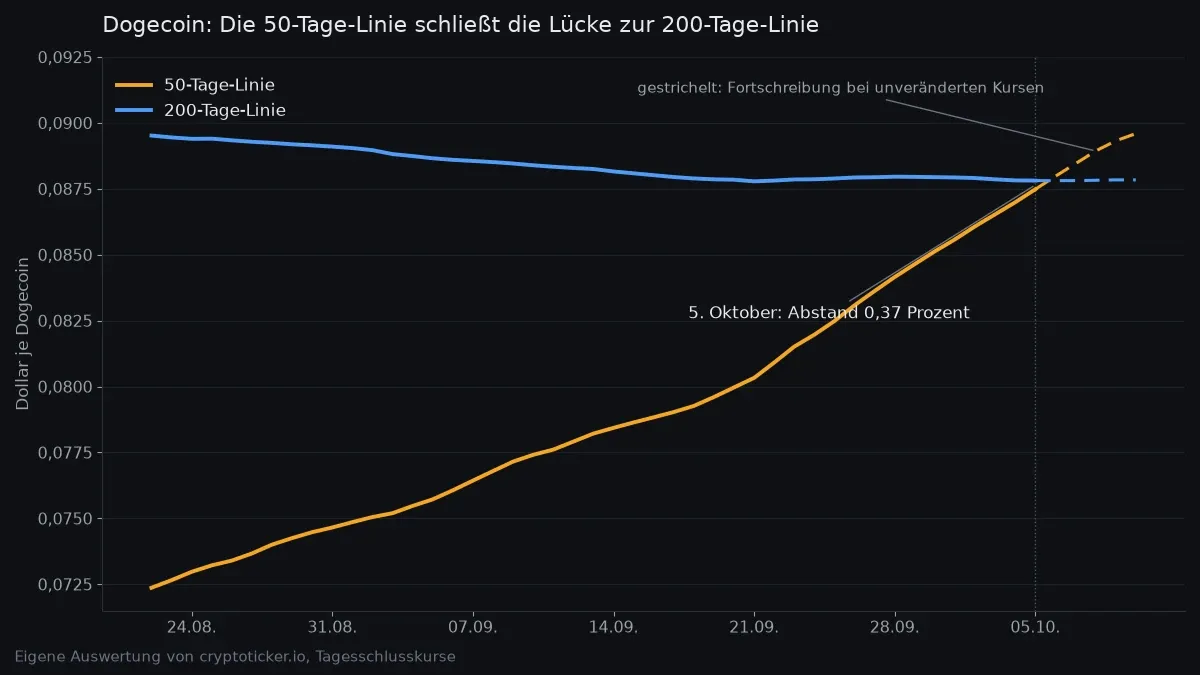
The 200-day line has been running almost horizontally for weeks while the 50-day line comes up steeply from below. The crossing point follows almost of its own accord.
Why the Dogecoin cross is arithmetically settled by Friday at the latest
A moving average changes every day for two reasons: a new closing price joins at the front, and the oldest one drops out of the window at the back. In the case of the 50-day average, the days dropping out this week are precisely those on which Dogecoin was cheapest. That lifts the mean even if the price stands still.
Simply carrying today's price forward produces the following picture: on Tuesday the 50-day line sits at $0.0880 and therefore 0.19 percent above the 200-day line. On Thursday the lead comes to 1.26 percent, and on Sunday 2.00 percent. What counts, though, is the other calculation, the one for the price that would just about still prevent the cross.
The threshold for Tuesday sits at $0.0832
For the 50-day line to stay below the 200-day line on Tuesday, Dogecoin would have to close below $0.0832. That is 11.7 percent under the current price, in a single day. For Wednesday that threshold falls to $0.0514, which would be a 45 percent collapse. For Thursday it sits at $0.0202, so 79 percent lower. From Friday even a price of zero would no longer be enough, because the departing August days carry the mean upwards on their own. In practice, then, the cross is decided on Tuesday and arithmetically certain by Friday.
Four August days dropping out of the 50-day Dogecoin window
The cause sits in the late-summer data. Dropping out of the 50-day window this week are August 17 at $0.0695, August 18 at $0.0704, August 19 at $0.0702 and August 20 at $0.0750. Each of those days sat around 25 percent below today's price. As soon as they disappear from the calculation, the mean jumps upwards.
The one-year low fell in the same phase: on August 7 Dogecoin closed at $0.0690. Anyone who bought then is up 36.5 percent today, without anything fundamental having changed about Dogecoin itself. That is exactly why a moving-average cross is no argument in its own right. It describes the past, not the future.
$0.1004 above and $0.0801 below: the Dogecoin levels for October
For the coming weeks, two values from our own analysis carry more weight than any target from an analyst note. On the upside, the high of the past 30 days sits at $0.1004. That is where Dogecoin last failed, and that is where the sell orders of those who bought at higher prices are waiting. The distance to it is 6.6 percent.
On the downside the 30-day low sits at $0.0801, a good 15 percent below the current price. Beneath that follows the low of August 7 at $0.0690. In between lies the 200-day line at $0.0878, which after a cross from above becomes a catching line. Anyone looking for levels for a stop or a staggered purchase therefore has three traceable values instead of one round number.
What trading volume adds to the picture
Averaged over the past 30 days, around $978 million of Dogecoin changed hands daily. On October 3 it was $1.13 billion, on Sunday $392 million. Market value stands at $14.7 billion, the equivalent of 13.1 billion euros. A breakout above $0.1004 that happens without rising volume is historically the less reliable one. That is a rule of thumb from trading and no law of nature, but it costs nothing to keep an eye on.
Dogecoin versus Bitcoin and Ethereum: the distance to each one-year high
On October 7, 2025, exactly one year ago the day after tomorrow, all three assets marked their twelve-month high on the same day. Dogecoin stood at $0.2668, Bitcoin at $124,740 and Ethereum at $4,691. Today Dogecoin is 64.7 percent short of that level, Ethereum 42.6 percent and Bitcoin 31.6 percent.
That ranking matters more for placing the moving-average cross in context than the cross itself. Dogecoin has lost considerably more over the past year than the two large assets, and since the start of the year it is down 19.8 percent. The 50-day line is therefore rising not because Dogecoin is strong but because the August benchmark was particularly weak. Anyone selecting an exchange for the purchase should know that difference before building a position.
What the Dogecoin moving averages do not say
A cross of the 50-day line above the 200-day line is referred to in trading as a golden cross. That is a descriptive term for exactly this constellation, not a signal with a documented hit rate. Both lines consist solely of past prices; they contain no information about inflows, network usage or regulation.
On top of that comes a tangible objection: because the cross falls as early as Tuesday on any halfway normal price path and is arithmetically settled by Friday at the latest, it is no longer a surprise to the market. Anyone who recalculates the data knows it today. An event whose occurrence is certain is rarely priced in only on the day it happens. As a forecasting instrument the cross is therefore of little use, while as a description of the situation it serves well.
Bitwise is closing its Dogecoin ETF: October 14 is the last trading day
Alongside the price situation, a deadline with a fixed date is running. On September 10 the asset manager Bitwise resolved to wind up its Dogecoin ETF, ticker BWOW. The filing with the US Securities and Exchange Commission names three dates: the last trading day on NYSE Arca is Wednesday, October 14, 2026. Decisive for the settlement is the net asset value of October 21. On Thursday, October 22, remaining shareholders receive that value in cash.
A net asset value is the value of the fund's assets per share, so here the proportionate Dogecoin holding less costs. For holders, the wind-up means this: after October 14 the share can no longer be sold on the exchange, and repayment happens compulsorily at a cut-off price that nobody can steer.

After October 14 the route via the exchange is closed, and from then on the fund is merely settled.
For German portfolios the ETP route counts, not the US fund
A piece of context is needed here that many reports leave out: BWOW is a US product on a US exchange. A retail investor in Germany could as a rule not buy this fund through an ordinary broker in any case, because US funds lack the documents required under the EU regulation on key information documents. The closure therefore mostly does not affect German portfolios directly.
It is relevant all the same, as an indication of the rules of the game for this product type. Anyone wanting exposure to Dogecoin on an exchange rather than through a crypto platform uses an ETP in Germany, that is an exchange-traded debt security on the price, tradable for instance via Xetra. An ETP, too, can be terminated by the issuer, usually with a notice period stated in the prospectus. Before buying it is therefore worth a look at exactly that section of the key information document, specifically at the notice period and at whether the issuer deposits the coins.
Buying route via an exchange with a MiCA licence
The second route is the direct purchase. Since the EU regulation on markets in crypto-assets, MiCA for short, has applied in full in Germany, providers require a licence and are supervised by BaFin. In practice that means: before a first purchase you establish whether the provider operates under that licence, what fee is buried in the price as a spread, and whether payout in euros runs without extra cost. A cheap trading price is of little help if one percent is lost on withdrawal.
Holding period and the 1,000-euro exemption threshold when selling Dogecoin
For most German investors this is the point with the greatest leverage, and it depends not on the price but on the purchase date. The sale of crypto-assets falls under private disposal transactions pursuant to Section 23 of the German Income Tax Act. Subsection 1 no. 2 there covers disposals of assets where the period between acquisition and disposal is no more than one year.
Anyone who has held Dogecoin for longer than a year therefore sells the gain tax-free. Anyone selling earlier pays tax on it at their personal income tax rate. On top of that comes an exemption threshold: under subsection 3 sentence 5, gains remain tax-free if the total gain from private disposal transactions achieved in the calendar year came to less than 1,000 euros. Exemption threshold means literally what it says: at 1,000 euros of gain the entire amount is taxable, not just the euro above it.
The concrete calculation for the August low
An example with our own figures. Anyone who bought at $0.0690 on August 7 is up 36.5 percent today. On a stake of 2,000 euros that would be around 730 euros of gain, so below the exemption threshold, as long as no further private disposal transactions arise in the same year. On a 3,000-euro stake the gain comes to around 1,095 euros, and with that the entire amount is taxable. The difference between the two cases turns on a few hundred euros, and it can be worked out before the sale. A tax tool with a clean acquisition history takes the allocation of individual purchases off your hands, which quickly becomes confusing with several partial purchases.

The purchase date of each individual partial buy governs the one-year period, not the moment the overall holding was assembled.
Leverage and liquidation: $0.0754 on a fivefold Dogecoin position
Anyone trading Dogecoin with leverage should hold the levels from the fourth section against their own liquidation threshold. A rough calculation without fees and without margin calls: at fivefold leverage a long position becomes arithmetically worthless if the price falls by a fifth, so at about $0.0754. At threefold leverage that threshold sits at around $0.0628, and at tenfold leverage already at $0.0848.
The $0.0848 is the critical value, because it lies only 3.4 percent below the current price and therefore within the normal swing of a few days. Over the past 30 days Dogecoin moved between $0.0801 and $0.1004, a range of 25 percent. A tenfold leveraged position would not have survived that range. Anyone using leveraged products will find the differences in financing costs and margin obligations in the broker comparison.
Custody: Dogecoin calls for a wallet decision of its own
Dogecoin runs on a blockchain of its own and not as a token on Ethereum. A wallet that manages ether and ERC-20 tokens therefore cannot automatically take Dogecoin. Before a withdrawal from the exchange, it belongs to the routine to establish whether your own hardware wallet supports the Dogecoin chain at all and whether the receiving address starts with the correct prefix. A transfer to an address on the wrong chain is as a rule not recoverable.
There is no staking with Dogecoin. The network runs on proof of work and is mined jointly with Litecoin, so returns arise only from mining, not from holding. Anyone offered a yield on their holding is dealing with a lending platform, and therefore with a counterparty risk that has nothing to do with the network.
Dogecoin forecast: your next three steps
The moving-average cross falls on Tuesday on any normal path and is settled by Friday at the latest, the ETF deadline expires on October 14, and the holding period depends solely on your own purchase date. From that follow three steps that can be dealt with this evening.
- Gather your purchase dates. List all partial Dogecoin purchases with date and amount and work out which of them already satisfy the one-year period under Section 23. Anyone with several partial purchases transfers that into a portfolio and tax tool rather than reconstructing it afresh every year.
- Write down levels instead of gut feel. $0.1004 as the next target on the upside, $0.0878 as the catching line and $0.0801 as the lower edge of the past 30 days. Anyone trading with leverage enters their liquidation threshold alongside and looks in the broker comparison at what financing costs accrue daily in the process.
- Settle custody before it gets urgent. Establish whether your own wallet carries the Dogecoin chain, and send a small test transfer ahead before the whole holding is moved. Which devices support which chains is set out in the hardware wallet comparison.
(As of October 5, 2026. This article is not investment advice. Prices and fee structures change; check the terms with the provider before you buy.)