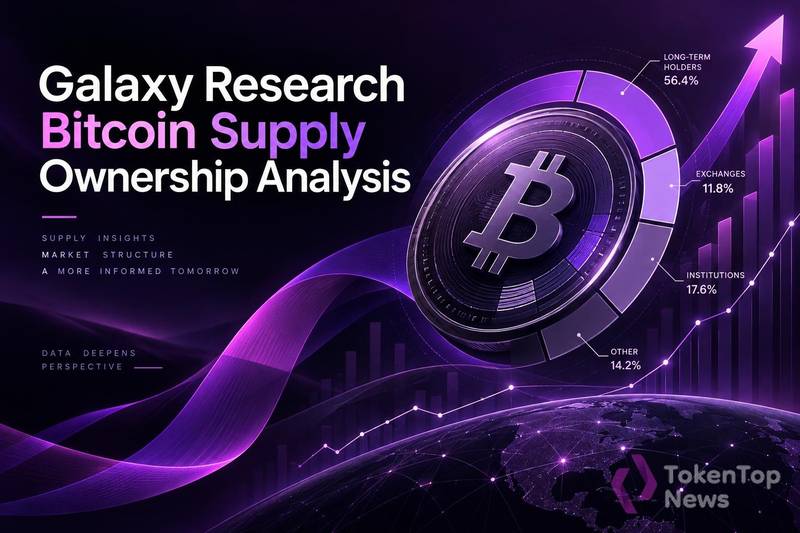
Galaxy Research has published an analysis examining Bitcoin supply ownership, turning analytical attention to one of the more structurally significant questions in the asset class: who actual
Galaxy Research has published an analysis examining Bitcoin supply ownership, turning analytical attention to one of the more structurally significant questions in the asset class: who actually holds Bitcoin, and in what concentrations. The publication adds a research-firm perspective to an ongoing conversation about how supply distribution shapes liquidity, market depth, and long-term price behavior.
What the Analysis Covers
Galaxy Research, the research arm of Galaxy Digital, identified Bitcoin supply ownership as the subject of its latest report. Supply ownership analysis typically attempts to classify how Bitcoin is distributed across different holder categories, ranging from long-term individual holders to institutional custodians, exchanges, and government-seized reserves. The specific methodology, classifications, and findings from Galaxy Research's report were not available at the time of publication; readers should consult the report directly at galaxy.com/insights/research for the underlying data and conclusions. For related coverage, see BTC to $100K? Why Bitcoin Could Drop to $55K First.
The timing connects to a broader pattern of on-chain research gaining traction among institutional analysts. Earlier this year, dormant Bitcoin resurfaced as 4.65 million BTC circulated in 2025, a data point that underscored just how much previously idle supply can shift the ownership picture when market conditions change. For related coverage, see Dormant Bitcoin Resurfaces as 4.65M BTC Circulates in 2025.
Addresses, Entities, and Attribution Limits
Any ownership analysis of Bitcoin supply confronts a fundamental constraint: the blockchain records wallet addresses, not identities. Clustering algorithms can group addresses believed to belong to the same entity, but the attribution is probabilistic rather than definitive. A study may categorize supply by holder type only to the extent its methodology can verify those categories, which is why the specific approach a research firm uses matters as much as the numbers it produces. For related coverage, see Bitcoin ETFs Record $219M Daily Inflow as Weekly Net Flows Surpass $825M.
Galaxy Research has previously covered institutional crypto adoption in depth, including projections on Ethereum and institutional flows, making a supply-side Bitcoin ownership study a natural extension of that analytical frame. The credibility of any ownership breakdown depends on transparency about what on-chain heuristics were applied and what share of supply remains unattributed.
What Supply Distribution Data Can and Cannot Show
Ownership concentration data informs several market considerations simultaneously. A supply heavily concentrated among long-term holders with low exchange balances tends to signal constrained sell-side liquidity, a dynamic that has intersected with sustained ETF inflows to create periodic supply squeezes. Conversely, a rising share of supply on exchanges or in short-term holder wallets can flag elevated distribution risk.
Distribution analysis does not, by itself, indicate market direction. It is one input among many, and ownership snapshots capture a moment in a continuously changing ledger. For context on how ownership shifts interact with price behavior, the intersection of ETF flows and underlying market signals illustrates how structural ownership data and flow data can point in different directions at the same time.
Galaxy Research's decision to publish on this topic reflects growing institutional demand for rigorous supply-side frameworks, particularly as ETF adoption introduces a new category of holder whose custody and holding behavior differs from earlier Bitcoin cohorts. The full methodology and findings are available through Galaxy Research's official publications.
Additional source references: source document 1.
Disclaimer: This article is for informational purposes only and does not constitute financial or investment advice. Cryptocurrency and digital asset markets carry significant risk. Always do your own research before making decisions.
Read original article on tokentopnews.com