Zcash traded at $831.95 at 20:45 UTC on November 14, down 12.94% in 24 hours and 37.1% from the $1,321.77 close it printed on November 7. Seven sessions have now erased roughly $8.33 billion

Zcash traded at $831.95 at 20:45 UTC on November 14, down 12.94% in 24 hours and 37.1% from the $1,321.77 close it printed on November 7. Seven sessions have now erased roughly $8.33 billion of market value from a token that was, until last week, one of the strongest large-cap performers of 2026.
The next scheduled event runs the other way. Coinholders and community panels begin polling on November 16 over Zcash Community Grants’ 8% share of the block reward, according to the coordination timeline published by the five organizations that operate the coinholder voting chain. Polls close on November 30, and a proposal that reaches rough consensus would be written into a follow-up network upgrade the ecosystem calls NU 7.1.
Zcash price today: $832, and a 37% gap from the November 7 high
The snapshot at 20:45 UTC reads: price $831.95, market capitalization $14.18 billion, 24-hour volume $754.7 million, and a 24-hour range of $846.77 to $956.46 that the latest print has already undercut. Over seven days ZEC is down 34.3%, over 30 days down 32.5%, and it remains 73.9% below the $3,191.93 all-time high recorded in October 2016. The token is still 42.4% higher than it was a year ago and 148.6% higher than 200 days ago, which is the part of the picture the weekly chart hides.
The fall is not isolated, but it is larger than the market it trades in. Bitcoin is at $65,414, down 5.04% in 24 hours and 13.63% in a week; ether is at $1,820.56, down 6.47%; Monero, the other large privacy asset, is at $479.77, down 10.15% on the day and 21.45% on the week. ZEC’s weekly decline is 2.51 times Bitcoin’s and 20.6 percentage points deeper. On November 7 the market cap stood at $22.51 billion; at $14.18 billion it has given back 37.0% of that.
The chain has kept producing blocks throughout. Block height reached 3,573,339 at 19:38 UTC, with 3,458 blocks and 17,728 transactions in the previous 24 hours, per Blockchair’s Zcash chain statistics. No halt, exploit, or exchange suspension on Zcash was announced on November 14. The available evidence points to a market-wide de-risking in which the assets that ran hardest gave back the most; that is an observation about correlation, not proof of a single cause.
What NU7 changed on the Zcash chain, measured in block counts
NU7 activated at block height 3,543,405, timestamped 02:34:02 UTC on November 6, per the same chain data. The upgrade cut the block target spacing from 75 seconds to 25 seconds, a change defined in ZIP 259, the deployment proposal for the upgrade. Its own summary of the package is specific: NU7 “reduces the block target spacing from 75 seconds to 25 seconds, introduces per-pool and global shielded action limits, introduces the Network Sustainability Mechanism (NSM), and removes 60% of transaction fees from circulation.”
The effect is visible in daily block counts. In the twelve days before activation the chain produced between 1,139 and 1,155 blocks a day. From November 7 onward it has produced 3,431 to 3,478 a day, and the rolling 24-hour count at 19:38 UTC on November 14 was 3,458. That is a 200% increase in block frequency, and it happened on a single block.
Issuance did not follow. Coin Metrics records 1,790.6 ZEC issued on November 5, the last full pre-upgrade day, and 1,793.2 ZEC on November 13, after eight days of 25-second blocks. The difference is 0.1%. What changed is the amount of ZEC created per block: 1.5625 ZEC before activation, 0.5208 ZEC after it, a two-thirds reduction that keeps the daily flow flat. ZIP 259 defines the “Scheduled Block Subsidy” as the subsidy “determined by the existing halving schedule, after applying the changes in ZIP 218,” which is why tripling the block rate did not triple supply growth.
The same upgrade made version 4 transactions invalid. That has a hard consequence for Zcash’s oldest shielded pool, spelled out in the proposal: “Because Sprout transfers can only be represented by version 4 transactions, funds remaining in the Sprout pool become unspendable.” Sprout was the network’s original shielded pool; whatever balance remains there cannot be moved under the new consensus rules, and the change was flagged in advance as a known cost of shipping NU7 without a second transaction-format migration. ZEC holders who bought the upgrade as a supply story got a schedule change instead, which is why the pre-activation trading case for Zcash does not map cleanly onto the post-activation chain.
Why the 8% grants share is on the ballot
Zcash Community Grants receives 8% of the block reward under the current dev fund. The five organizations that coordinate coinholder voting, Project Tachyon, Shielded Labs, Valar Group, the Zcash Foundation, and ZODL, set an expedited schedule for proposals, public discussion, and polling after disputes over how that share is spent. Their timeline is explicit: “Polls for coinholders and community panels open on November 16 and close on Monday, November 30 at 11:59pm UTC.” The same post states the implementation path: “If there’s rough consensus on a proposal, we’ll support a network upgrade, NU 7.1, to implement it.”
The leading proposal in the forum debate would end the grants committee at the next upgrade and redirect its share to the Network Sustainability Mechanism. Its author, posting as maxdesalle, summarizes the mechanics in one sentence: “Everything left in the ZCG treasury after that goes to the NSM.” The argument behind it is a governance one. ZCG is elected by ZCAP, a panel of roughly 200 people whose membership is decided by the Zcash Foundation; the proposal states that 72 ZCAP members, or 36%, have received ZCG grants, and that ZCAP members sit behind about 75% of the money ZCG has paid out. It also cites a February 2026 coinholder vote in which 98.6% opposed Zcash Shielded Assets, after which ZCG approved another $455,000 for ZSAs in June. Those are the proponent’s claims, and they are contested in the same thread.
The counterargument is not about accountability but about what replaces the funding. Zcash developer str4d replied that ending ZCG “without replacing its 8% with a different development-oriented funding stream… is a decision to explicitly give more money to miners by decreasing the funding available for development and maintenance of the chain,” and noted that the NSM’s reissuance does not begin until 2031. Alternative proposals on the same timeline include a Future Dev and Legal Defense Fund ZIP and the Zcash Adoption Pool. The earlier proposal to withdraw 50,000 ZEC from the grants treasury is one strand of the same argument, not the whole of it.
The dollar math behind Zcash’s 8% block-reward share
At post-NU7 issuance of 1,793.2 ZEC a day, the 8% stream is 143.5 ZEC a day. At $831.95 that is about $119,400 a day, or $43.6 million a year. Against a $14.18 billion market cap, the stream is equivalent to 0.31% of market value annually.
Two things follow. First, the ZEC-denominated flow is fixed by the issuance schedule, so a lower price reduces the dollar value of what the committee distributes without reducing the number of coins holders are diluted by. Second, the stream is paid whether or not the grants produce anything a holder values, which is what makes the governance question a budget question rather than a technical one. Price does not decide the vote, but it changes what the vote is worth: at the November 7 close of $1,321.77 the same 143.5 ZEC a day was worth $189,700 daily, or $69.2 million a year.
Zcash chart: RSI 28 and the $846 break
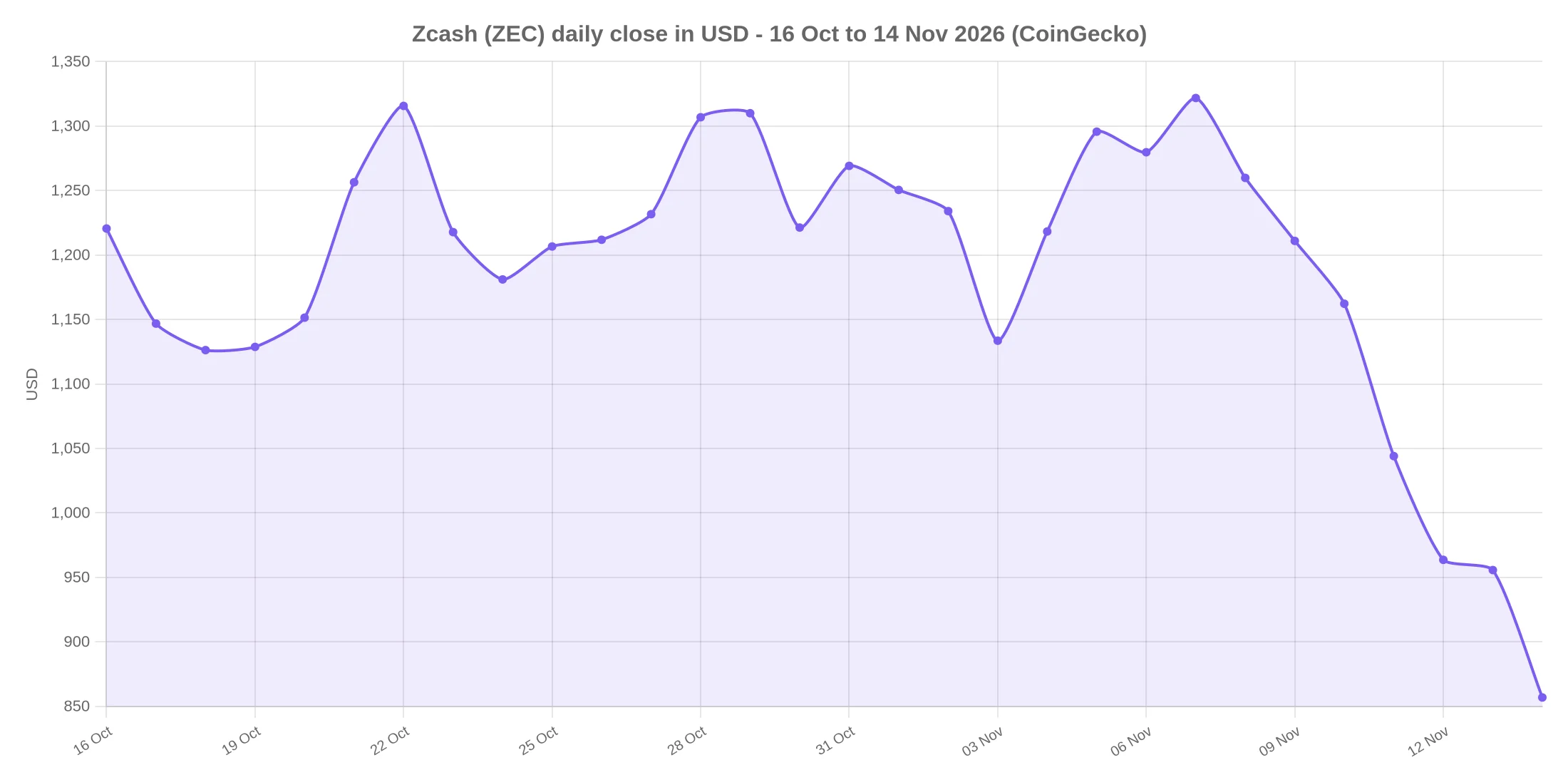
ZEC/USD daily close, 16 October to 14 November 2026. The break begins after the November 7 close at $1,321.77. Data: CoinGecko.
The 14-day RSI calculated from those daily closes is 28.2, below the 30 line that conventionally marks oversold, and it has been under 40 since November 11, when it read 37.5. The method matters here: it is a Wilder-smoothed average-gain/average-loss calculation on daily closes, not an intraday indicator, and an oversold reading describes how far and how fast price has moved. It is not a buy signal. In this same window the reading peaked at 55.5 on November 7, the day ZEC closed at its high.
The levels that matter are drawn from the same data. The 24-hour low to 20:45 UTC was $846.77 and the 24-hour high was $956.46, a range whose $901.62 midpoint is the first level a bounce would have to reclaim. The $1,000 round number was lost on November 12, when the daily close fell to $963.59 from $1,044.03 the day before. The November 7 close of $1,321.77 is the reference high. A daily close back above $901.62 would put the $956 area in play; ZEC is already trading below the $846.77 floor intraday, and a daily close there would leave the $800 round number as the next reference with no trading range between them to slow a move. Reclaiming $1,000 from $831.95 requires a 20.2% advance, and a return to the November 7 close requires 58.9%.
What to watch before the November 30 close
Three dates carry the next information. The poll opens November 16 and runs two weeks; the results are to be published shortly after the November 30 close; and any winning proposal then needs a NU 7.1 target date agreed between engineering teams and miners. ZIP 259 also fixes the NSM reissuance height at block 8,939,664, which is the point at which the mechanism this vote would fund actually starts issuing, and that height is years away at the current block rate.
For holders, the practical question is narrower than the governance debate. ZEC has retraced a third of its value while its supply schedule stayed flat, its block rate tripled, and its oldest shielded pool was frozen by consensus rule. None of those facts change on November 16. What changes is who controls the 8% stream that pays for development, and whether the answer is a committee, a mechanism, or a legal defense fund.
Frequently Asked Questions
What is the Zcash price today?
ZEC traded at $831.95 at 20:45 UTC on November 14, 2026, down 12.94% in 24 hours, with a market cap of $14.18 billion and 24-hour volume of $754.7 million. The 24-hour range was $846.77 to $956.46, and the latest print sits just below that low.
Why is Zcash falling?
ZEC fell 34.3% in seven days against 13.63% for Bitcoin and 21.45% for Monero, during a market-wide selloff that pushed Bitcoin to $65,414. Zcash’s chain kept producing blocks and transactions and no Zcash-specific failure was announced on November 14, so the larger decline reflects the token giving back more of a 149% six-month advance rather than a new problem on the network.
What did the NU7 upgrade change?
NU7 activated at block 3,543,405 on November 6, 2026. It cut block spacing from 75 seconds to 25 seconds, lifted daily block counts from about 1,146 to about 3,443, reduced the per-block subsidy from 1.5625 to 0.5208 ZEC so daily issuance stayed near 1,800 ZEC, removed 60% of transaction fees from circulation, and made version 4 transactions invalid, which left any remaining Sprout pool funds unspendable.
What is the November 16 Zcash vote about?
Coinholders and community panels vote from November 16 to November 30 on what to do with Zcash Community Grants’ 8% share of the block reward. Proposals include ending ZCG and sending its share and remaining treasury to the Network Sustainability Mechanism, a Future Dev and Legal Defense Fund, and the Zcash Adoption Pool. A proposal with rough consensus would be implemented in a network upgrade called NU 7.1.
Is Zcash oversold right now?
The 14-day RSI on daily closes is 28.2, below the 30 threshold usually described as oversold. That measures the speed and size of the decline, not the likelihood of a reversal. The levels to watch are $846.77 on the downside and $901.62, then $956.46, on any rebound.
Data: CoinGecko, Blockchair, Coin Metrics. Price snapshot 20:45 UTC, November 14, 2026.