What Is the Gravity L1 Migration ? Gravity is shutting down its Alpha Mainnet, and the Gravity L1 Migration $G token process is now the single most important thing for anyone holding assets o
What Is the Gravity L1 Migration ?
Gravity is shutting down its Alpha Mainnet, and the Gravity L1 Migration $G token process is now the single most important thing for anyone holding assets on the old network.
The team behind Galxe confirmed that Gravity Alpha Mainnet, the Arbitrum Nitro-based Layer 2 that has powered the ecosystem since August 2024, will stop settling transactions on November 1, 2026. Everything is moving to Gravity's own Layer 1 chain, and users who don't act before the deadline risk losing access to their funds permanently.
This is not a token swap or a rebrand. It is a chain migration, and understanding exactly what changes and what stays the same is central.
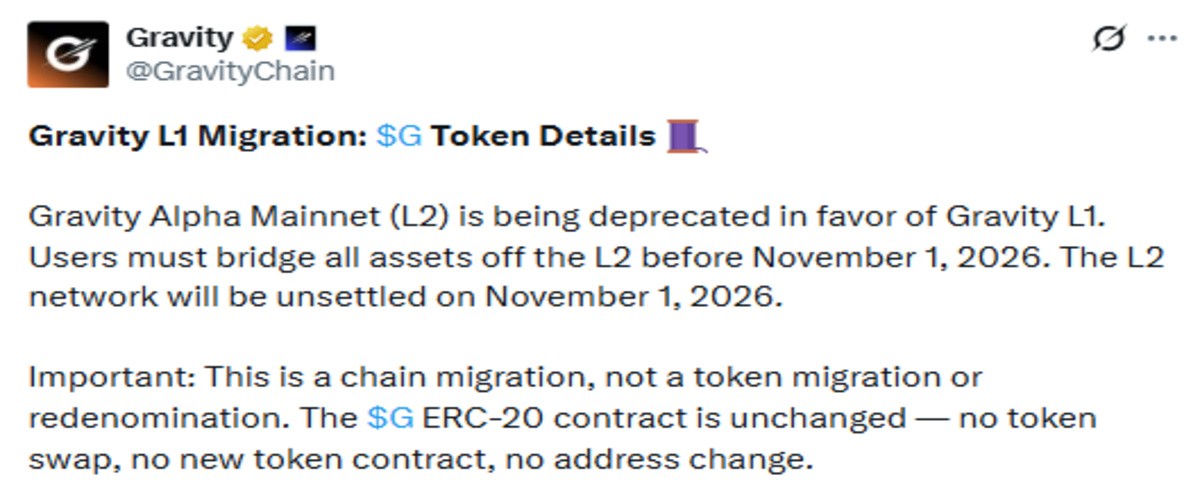
Source: Official X Post
What's Changing
Aspect
Gravity Alpha Mainnet (Legacy)
Gravity Mainnet (New)
Native Token
G (gas token)
G (gas + staking token)
Consensus
Arbitrum Nitro sequencing
Pipelined AptosBFT + Grevm
Explorer
explorer.gravity.xyz
mainnet-explorer.gravity.xyz
Bridge
bridge.gravity.xyz
Same portal, L1-specific flow
Status
Sunset, November 1, 2026
Live, permissioned validator phase
The token went live in early June 2026 as a fully EVM-equivalent chain built on a modified Reth stack, targeting over 12,000 TPS on ERC-20 transfers with roughly 200-millisecond block times.
Galxe's core services, including Quest, Passport, and Score, have already migrated to this new environment, which is exactly why the older L2 is being retired.
Key Deadlines for the L1 Migration
Bridge-out deadline: Move every asset off Alpha Mainnet before November 1, 2026.
Network halt: On November 1, 2026, Alpha Mainnet operations stop, and remaining assets become unsettled and untransferable.
G staking: The Galxe G staking portal goes offline on the same date, so unstake first.
Bridge timing: Native withdrawals of G, DAI, and WBTC through the canonical bridge carry a roughly 7-day challenge period, a standard feature of optimistic rollups, so starting early matters more than anything else in the timeline.
Chain Migration, Not Token Migration
A lot of confusion around any Gravity L1 migration discussion comes from mixing this up with a token migration. The project has been explicit that this is only a chain migration:
No token swap.
No redenomination.
No new token contract or address change for the ERC-20 form.
Native G moves to L1 at a 1:1 ratio.
On both chains, native token behaves like ETH on Ethereum. There is no separate ERC-20 contract for native G on either network, since it is the built-in gas coin.
Token Contracts
ERC-20 G:0x9C7BEBa8F6eF6643aBd725e45a4E8387eF260649, Name: Gravity, 18 decimals. Same address across Ethereum, BNB Chain, and Base.
Wrapped G :0xBB859E225ac8Fb6BE1C7e38D87b767e95Fef0EbD, the same address on both Alpha Mainnet and L1.
Integrators and developers should treat native G deposits and withdrawals the same way they'd treat native ETH.
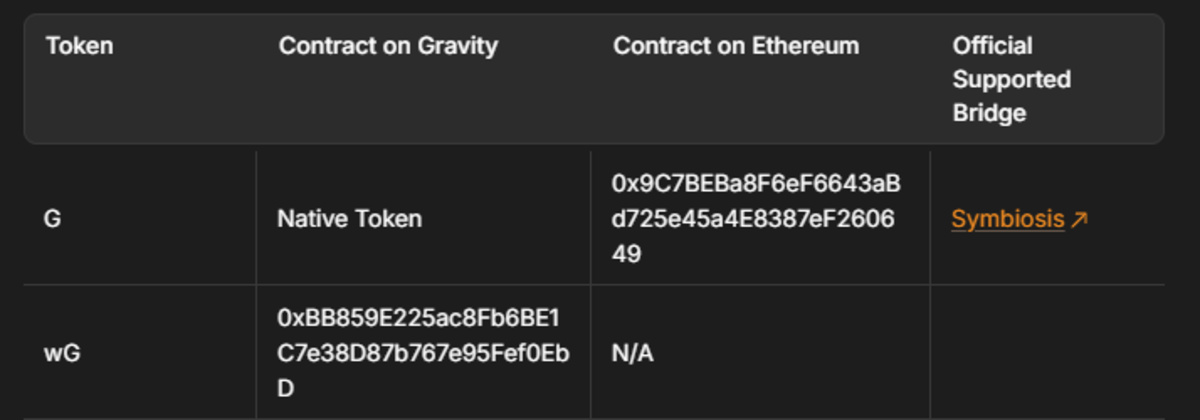
Source:Official Docs
How to Complete the Migration
Different assets use different exit routes, so it helps to separate them clearly.
Asset
Exit Route
Notes
G (native)
Official Gravity Bridge
~7-day delay to claim on Ethereum
DAI, WBTC
Official Gravity Bridge
Same ~7-day delay
USDT, USDC, ETH/WETH
Stargate Finance only
Settles in minutes; canonical bridge not supported
For DAI, or WBTC:
Go to bridge.gravity.xyz and connect your wallet.
Set the source as Alpha Mainnet and the destination as Ethereum.
Select the asset, enter the amount, and submit.
Wait roughly 7 days, then claim on Ethereum.
Optionally, bridge the ERC-20 from Ethereum to L1 through the same portal, which mints native G on L1 at a 1:1 ratio.
For USDT, USDC, or ETH/WETH:
Go to stargate.finance/bridge.
Choose Gravity (Alpha Mainnet) as the source chain and Ethereum, or another supported chain, as the destination.
Select the asset (USDC often shows as USDC.e) and confirm.
Keep a small amount of G on the L2 to cover gas until you're done.
Liquidity routes like Symbiosis can also move faster in some cases, but only official links should be used to avoid phishing risks.
Additional Steps for Users and Developers
Unstake G on Galxe: Visit the Galxe Staking portal and unstake before November 1. Tokens return to their original chain, and if that's Alpha Mainnet, they still need to be bridged out separately.
Smart Balance and other Galxe features: Some balances may migrate automatically or need a manual step, so check Galxe's own announcements.
Developers: Update RPC endpoints and chain IDs to Gravity L1, and migrate any dApps, bots, or scripts still pointed at the legacy chain.
OATs, credentials, and points: These are largely platform-level rather than chain-bound, but checking Galxe for specifics is still worthwhile.
Why Gravity Is Retiring the L2
Gravity Alpha Mainnet did its job. Since launching in August 2024, it processed hundreds of millions of transactions and helped the team identify the bottlenecks that shaped design, including Grevm's parallel EVM execution, sub-second finality, and a validator-attested native oracle.
With L1 now handling production load and offering far higher throughput, running two separate networks would only split liquidity, tooling, and developer attention. Consolidating onto one chain is the more sustainable path for the ecosystem going forward.
Glossary
Layer 2: A network built on top of a base chain like Ethereum to improve speed and reduce costs.
Layer 1: A standalone, sovereign blockchain that settles its own transactions.
Optimistic Rollup: An L2 design that assumes transactions are valid by default, backed by a challenge period for fraud proofs.
Canonical Bridge: The official, protocol-native bridge for moving assets between two chains.
Conclusion
The migration shift marks the end of Alpha Mainnet's role as a proving ground and the start of the project life as an independent, high-throughput layer 1.
The mechanics are straightforward: no token swap, a 1:1 native G migration, and clear bridging routes for every major asset. The only real risk is timing, since the 7-day challenge period means users should start moving funds well before November 1, 2026, rather than waiting until the last moment.
Disclaimer: This article is for informational purposes only and does not constitute financial or investment advice. Always verify migration steps and deadlines directly on official channels before moving funds.
