A two-name entry appeared on the Securities and Futures Commission’s alert list on 18 November 2026: “Hyperliquid / Hyperliquid Hong Kong,” filed under “Suspicious virtual asset trading platf

A two-name entry appeared on the Securities and Futures Commission’s alert list on 18 November 2026: “Hyperliquid / Hyperliquid Hong Kong,” filed under “Suspicious virtual asset trading platforms.” Two days earlier, on 16 November, the chairman of the US Commodity Futures Trading Commission published a statement that pointed the other way, describing approvals granted to a blockchain-based exchange and clearinghouse as proof that “there is a regulated pathway for a new generation of market infrastructure built using blockchain technology.”
That is the whole tension in one week. Hong Kong’s suspicious-platform list now carries the name; Washington spent the same week explaining how a venue of that shape can register. Neither document accuses anyone of a crime, and neither resolves the practical question a trader actually has: can I use this thing from where I live, and what happens if it breaks?
What the Alert List Entry Records, and What It Does Not
The table has three columns. Name, category, date. For Hyperliquid the row reads “Hyperliquid / Hyperliquid Hong Kong,” type “Suspicious virtual asset trading platforms,” date 18 Nov 2026. Nothing else is published in the row.
The SFC’s own definition of the list is narrow and worth quoting, because most coverage of these entries skips it: “The Alert List is a list of entities which have come to the attention of the SFC because they are unlicensed in Hong Kong and are believed to be, or to have been, targeting Hong Kong investors or claim to have an association with Hong Kong.” The regulator adds that “this is not a comprehensive list and new names are coming to our attention all the time.”
Read that as written. The trigger is licensing status plus a belief about marketing direction. An entry is not a finding of fraud, not a court order, and not a freeze. It is a statement that the entity is not on the SFC’s register and that the SFC thinks it has been pointed at Hong Kong users.
The list’s company is worth noting. Fourteen suspicious virtual asset trading platform entries have been added in 2026, from Ju.com on 26 January to Hyperliquid on 18 November, roughly one every 21 days. Some rows are platforms with real trading histories, such as BTCC on 22 October. Others are web-address clusters built to look like established brands; an entry added on 14 August lists domains assembled around the name of a licensed Hong Kong exchange. The list mixes impersonation cases, unlicensed venues and dead ends in one place, and the SFC does not sort them out for you.
Thirteen Licences in Six Years
The SFC’s licensed platform register holds thirteen names. OSL Digital Securities took the first licence on 15 December 2020. HashKey followed on 9 November 2022, then HKVAX, HKbitEX, Accumulus, DFX Labs, EX.IO, PantherTrade, YAX, Bullish, BGE, Victory Fintech’s VDX on 13 February 2026 and NewBX’s Bixin.com on 18 May 2026.
Bixin.com is the most recent. That is 186 days ago. Thirteen licences across 2,166 days works out to one approval every 167 days, and the register has not moved since May.
The applicant list runs separately and carries its own warning: “All VATP applicants on this list are NOT licensed by the SFC, and may NOT be in compliance with the SFC’s requirements.” Hyperliquid does not appear on either list. It is not licensed, and it is not an applicant.
The CFTC’s Version Is a Checklist, Not a List
The American document is a different instrument entirely. Chairman Michael Selig’s 16 November statement did not name the venue. It described the standard instead: “firms employing novel technologies must satisfy the same regulatory standards as those who utilize traditional market infrastructure, including robust anti-money laundering programs, customer protection and segregation requirements, market surveillance programs, financial resources, risk management policies, and system safeguards.”
Those six items are the price of admission. There is no separate crypto rulebook, no suspicion list and no marketing test. A venue files, the staff reviews, and the register either changes or it does not.
It has been changing fast. The CFTC’s clearing register shows Coinbase Clearing and Quanta Clear registered on 28 September 2026, tZERO DCO and Sporttrade DCO on 16 October, XV Clearing on 29 October, and TLD Clearing, the Backpack group’s clearing arm, on 13 November. The contract-market register added tZERO DCM on 10 November and TLD Markets, the Backpack exchange, on 16 November. Seven orders in 49 days, or one every seven days. BlockchainReporter covered the Backpack pair when the second order landed.
Two Regimes Running at Different Speeds
Set the two records side by side and the gap is not philosophical, it is arithmetic.
Measure
Hong Kong (SFC)
United States (CFTC)
Entities admitted
13 licensed platform operators, all time
7 designations or registrations since 28 Sep 2026
Last addition
Bixin.com, 18 May 2026
TLD Markets, 16 Nov 2026
Admission rate
One every 167 days since Dec 2020
One every 7 days since late September
Warning list
14 suspicious-platform entries added in 2026
No equivalent list; pending applications are public
Standard applied
Licensing plus a belief about targeting HK investors
Core principles: AML, segregation, surveillance, capital, risk, systems
The ratio is roughly 24 to one. Hong Kong admits a venue about once every five and a half months. The CFTC admitted seven in under two months, and two of those, TLD Clearing and TLD Markets, are the same corporate group splitting clearing from execution.
That speed difference explains why the alert-list entry and the chairman’s statement can both stand in the same week. Hong Kong’s register is a gate with a slow hinge. The CFTC’s is a queue that has been moving.
What Changed for a Hong Kong Trader on 18 November
Legally, very little, and that is the point. Hyperliquid was not licensed before 18 November and is not licensed now. The entry is a public warning that the SFC does not supervise the venue, which means no investor compensation arrangement, no SFC conduct rules on order handling, and no Hong Kong regulator to complain to if a position is liquidated at a price you dispute.
For anyone who ignored the register and traded anyway, the entry changes the record rather than the access. A dated public notice that the venue sits outside SFC supervision is exactly what a later dispute over disclosure turns on, whether the counterparty is a broker, a payments provider or another exchange deciding who it will face.
The market reaction is the part that needs care. HYPE traded at $61.21 at 19:03 UTC on 20 November, 10.60% lower over 24 hours, with a $14.56 billion market cap and $1.22 billion of turnover, per CoinGecko. Bitcoin was 7.05% lower at $58,324 and Ethereum 8.84% lower at $1,617.15 in the same snapshot. HYPE’s fall outpaced Bitcoin’s by 3.6 percentage points.
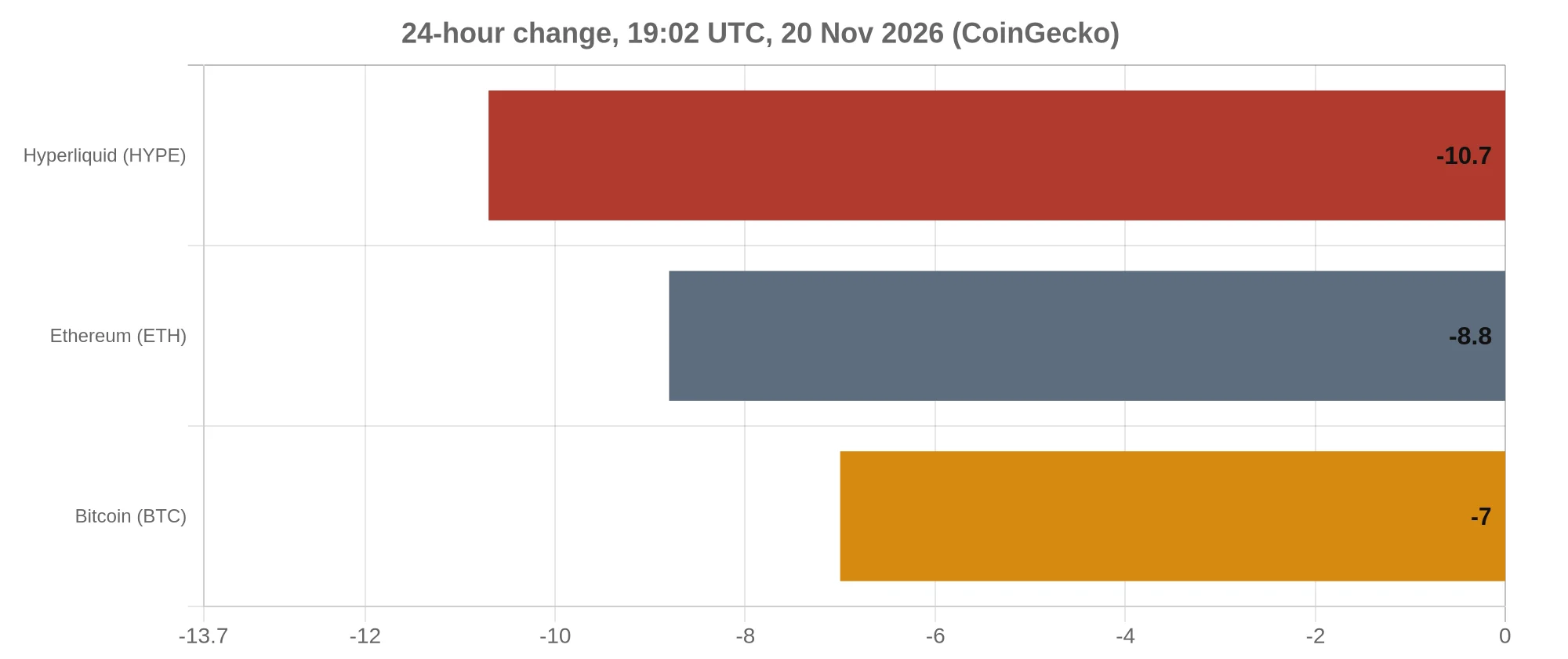
That gap is a coincidence of timing, not evidence that a listing on a Hong Kong warning page moved a $14 billion asset. Hong Kong retail is a small share of Hyperliquid’s order flow, the same session carried a market-wide deleveraging, and the alert list is not a trading halt. Traders who sold into it may have been reacting to the headline, the broader tape, or neither; the data here cannot separate the two, and anyone asserting a single cause is guessing.
What the listing does change is the compliance posture of everyone downstream. A Hong Kong broker that routes client orders to an unlicensed venue now has a document in the public record naming that venue, which is exactly the sort of exhibit a licensing interview asks about. That is the practical bite, and it lands on intermediaries more than on retail. Crypto.com’s decision to close its Hong Kong consumer app in February while its licence bid continued is the same calculation from the other direction: the register, not the product, decides who gets to keep serving the market.
The Question Both Regulators Leave Open
Neither document answers the harder question: what legal person is supposed to hold the licence for a venue that runs on a public chain with no headquarters?
Hong Kong’s regime is built around a licensed operator. The SFC’s register names companies, not protocols. The CFTC’s route is structurally the same: TLD Clearing and TLD Markets are named entities, one clearing the trades and one listing the contracts, and each sits on a public register with an order date. The chairman’s statement treats blockchain architecture as an implementation detail inside that wrapper.
Hyperliquid has neither. It has no SFC applicant entity, no entry on the CFTC’s contract-market or clearing registers, and a token that trades on venues outside Hong Kong’s licensed set. So the entry on 18 November is best read as a statement about the absence of an accountable local entity, not about the code.
Three signals will settle how this develops. The first is whether a new name appears on the SFC’s licensed register after six months of stillness; a licence granted to a decentralised-adjacent venue would say more about Hong Kong’s direction than any alert-list entry. The second is the CFTC’s pending docket, where BAM Derivatives and BAM Clearing, the entities behind Binance.US’s derivatives bid, have sat since 19 November and 21 September respectively. The third is Hyperliquid itself: a filing, a licensed affiliate, or continued silence, each of which tells you whether the protocol intends to be regulated anywhere.
Until one of those moves, the same venue sits on a warning list in one jurisdiction and inside a described pathway in another, and the only thing a user can act on is the difference.
The post Hong Kong Flagged Hyperliquid as Suspicious. The CFTC Spent the Same Week Mapping a Way In. appeared first on BlockchainReporter.