Markets6 min read
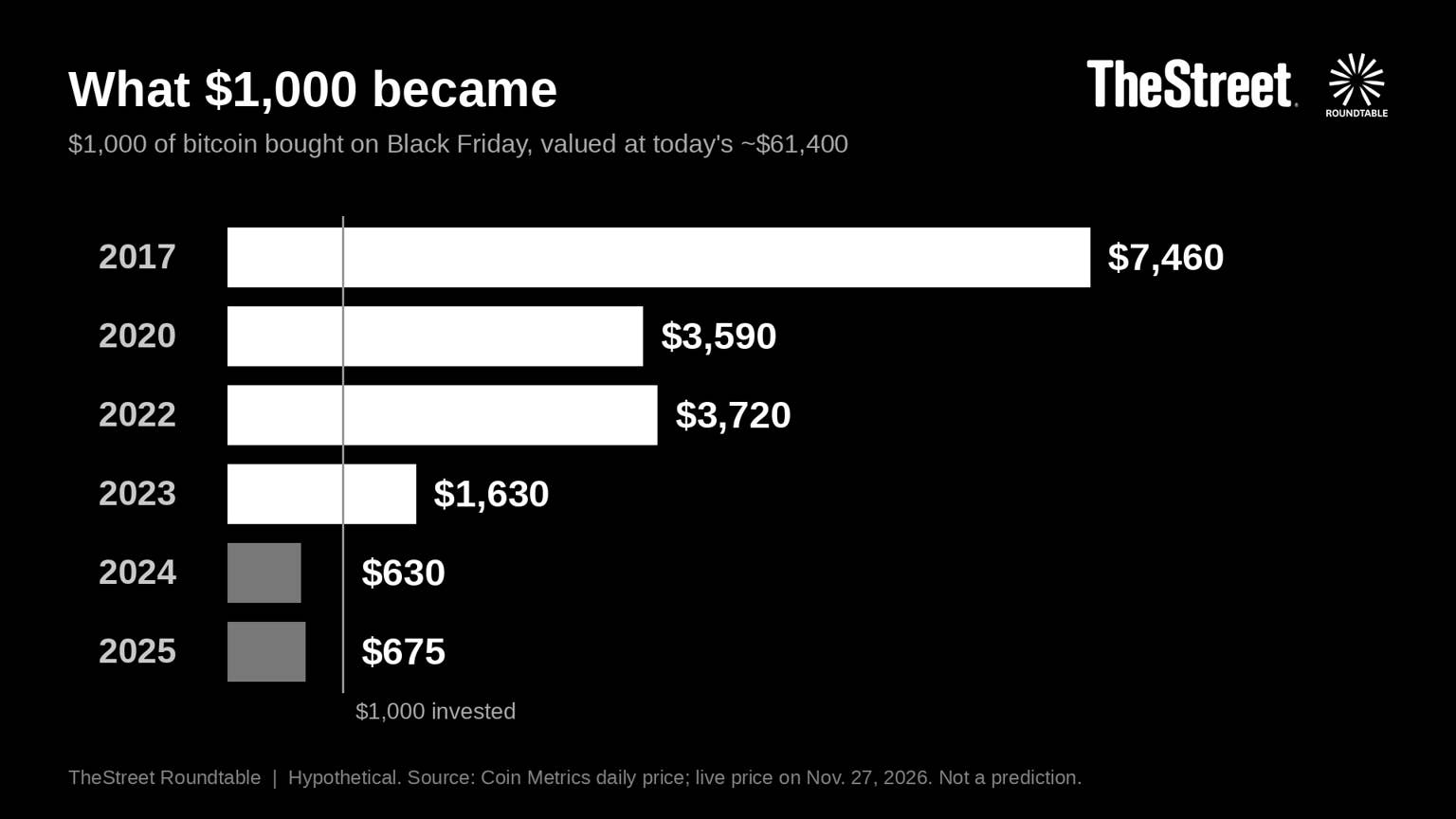
One asset is 51% off this Black Friday
On Black Friday 2017, one bitcoin cost $8,232. Three weeks later it hit $19,641. A year after that it traded at $3,185. Check the price on every Black Friday since and you see a bubble, a bus
Avalanche's Snowman consensus delivers sub-second finality by having validators repeatedly query small, randomly chosen groups of their peers instead of contacting the entire network at once,
Avalanche's Snowman consensus delivers sub-second finality by having validators repeatedly query small, randomly chosen groups of their peers instead of contacting the entire network at once, letting the system converge on an answer in a fraction of a second rather than minutes.
The result is a proof-of-stake protocol that avoids both the energy cost of Bitcoin-style mining and the slower agreement rounds used by many older proof-of-stake chains.
Snowman is part of Avalanche's Snow family of consensus protocols, which also includes earlier building blocks called Slush, Snowflake, and Snowball. Each layer adds more resistance to bad actors while keeping the same core idea: repeated random subsampling.
Instead of every validator talking to every other validator, a node picks a small random sample of peers, by default 20 validators, and asks which transaction they prefer. It repeats this sampling many times. Once the same answer keeps coming back past a set confidence threshold, the node treats that transaction as final.
Because Snowman avoids all-to-all communication, the network doesn't slow down as more validators join. This is different from classical Byzantine Fault Tolerant systems, which scale poorly past roughly 100 nodes because every participant must talk to every other one.
On Avalanche's C-Chain, the EVM-compatible chain that runs smart contracts and DeFi activity, block time runs around two seconds, and transactions typically finalize in roughly 0.8 to 1.5 seconds under normal conditions. This compares with Ethereum's roughly 12-second block time and around 13 minutes for full economic finality.
Avalanche's builder documentation also describes sub-100-millisecond finality as achievable on individual Avalanche L1s, the network's term for its customizable, purpose-built chains, under suitable configurations.
Avalanche runs three coordinated chains under this consensus model:
Snowman's tradeoff is that its safety guarantee is probabilistic rather than absolute from the first round, unlike classical BFT protocols that guarantee finality deterministically but cap out at a much smaller validator set. In exchange, Snowman scales to thousands of validators while keeping communication overhead low, since the number of messages a node handles doesn't grow simply because more validators join the network.
Avalanche launched on mainnet in September 2020. As of September 15, 2026, AVAX traded near $7.52, sitting above its daily 20-day and 50-day exponential moving averages but still below the longer-term 200-day average at $8.19, with the daily MACD histogram slightly negative at -0.06, pointing to cooling short-term momentum even as price recovers.
Market attention around Avalanche picked up earlier in the month after South Korean conglomerate Hanwha announced a tokenization platform built on the network on September 7, a move that coincided with AVAX rising roughly 5.24% to $8.06 with trading volume jumping close to 39% to over $457 million that day.
Snowman consensus replaces all-to-all validator communication with repeated random subsampling, letting Avalanche's C-Chain confirm transactions in under two seconds on average while remaining resistant to Sybil and collusion attacks. The protocol scales to large validator sets without the communication bottlenecks that limit classical BFT systems, giving Avalanche's tri-chain architecture a consistent sub-second to low-single-second finality window across its network.