Monad (MON) is trading at around 0.0104 US dollars on Thursday evening. That leaves the token roughly 78 percent below its 12-month high of 0.0470 US dollars, set on 27 November 2025, three d
Monad (MON) is trading at around 0.0104 US dollars on Thursday evening. That leaves the token roughly 78 percent below its 12-month high of 0.0470 US dollars, set on 27 November 2025, three days after the mainnet launch. Over the past seven days the price has dropped by about 22 percent, over 30 days by about 51 percent. One year after launch, and two days after the first major token unlock, the question is a sober one: is Monad a good buy at current prices, or is this a falling knife best left alone?
cryptoticker.io collected the price data itself on 26 November 2026 and calculated the figures from the daily closing prices on CoinMarketCap: moving averages, relative strength, high, low and volume. All figures in this article refer to that date.
Monad price analysis: where the MON price stands now
The current price of 0.0104 US dollars sits just above the lowest level since trading began. The 12-month low on a closing basis is 0.0095 US dollars, recorded on 25 November 2026, the day after the team unlock. MON has recovered about 10 percent from that close. The 12-month high of 0.0470 US dollars from 27 November 2025 is far away.
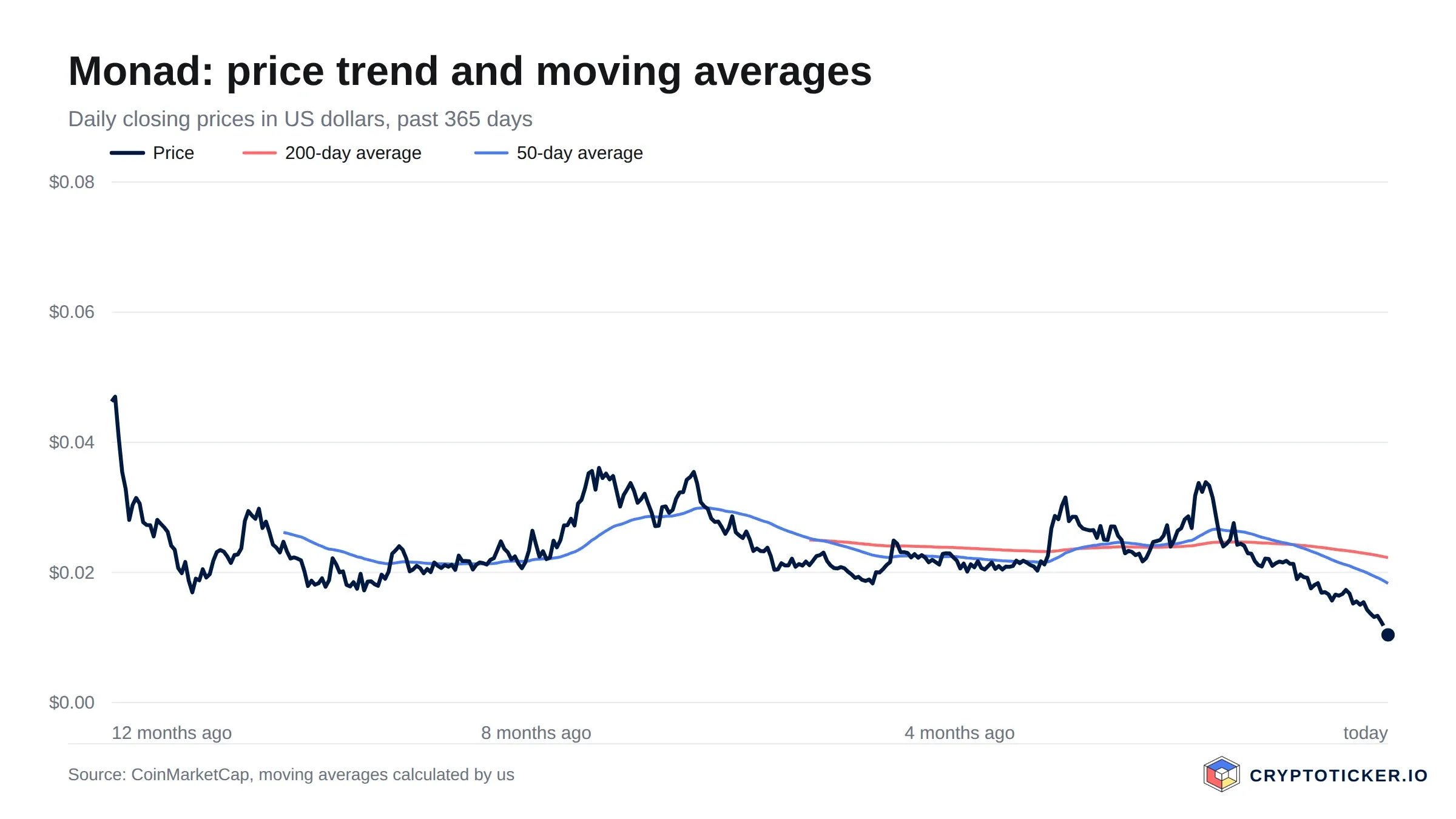
Monad price and moving averages, calculated by us from CoinMarketCap daily closing prices
The most important line on the chart is the 200-day average. The exponential 200-day moving average stands at 0.0223 US dollars, and the price trades about 53 percent below it. The 50-day moving average is at 0.0183 US dollars, roughly 75 percent above the current price. Both lines point down, and the short average sits below the long one. That is what an intact downtrend looks like.
The zone above is the interesting part. Between 0.0169 and 0.0178 US dollars lay the lows of December 2025, January and February 2026. That band carried the price for almost a year. In early November MON fell through it, turning former support into resistance. Below the current price there is no historical reference, simply because the token has no older trading history. The nearest orientation points are the fresh low at 0.0095 US dollars and the round mark of 0.0100 US dollars.
Is the Monad downtrend broken or just interrupted?
Neither. The trend is still running. The price history since launch falls into three phases. Until mid-December 2025 the price dropped from 0.047 to around 0.017 US dollars, a typical sell-off after a token launch. From February to April 2026 a recovery followed, up to 0.0361 US dollars. Since then the highs have kept falling: 0.0354 in May, 0.0315 in August, 0.0339 in October and most recently 0.0193 in November.
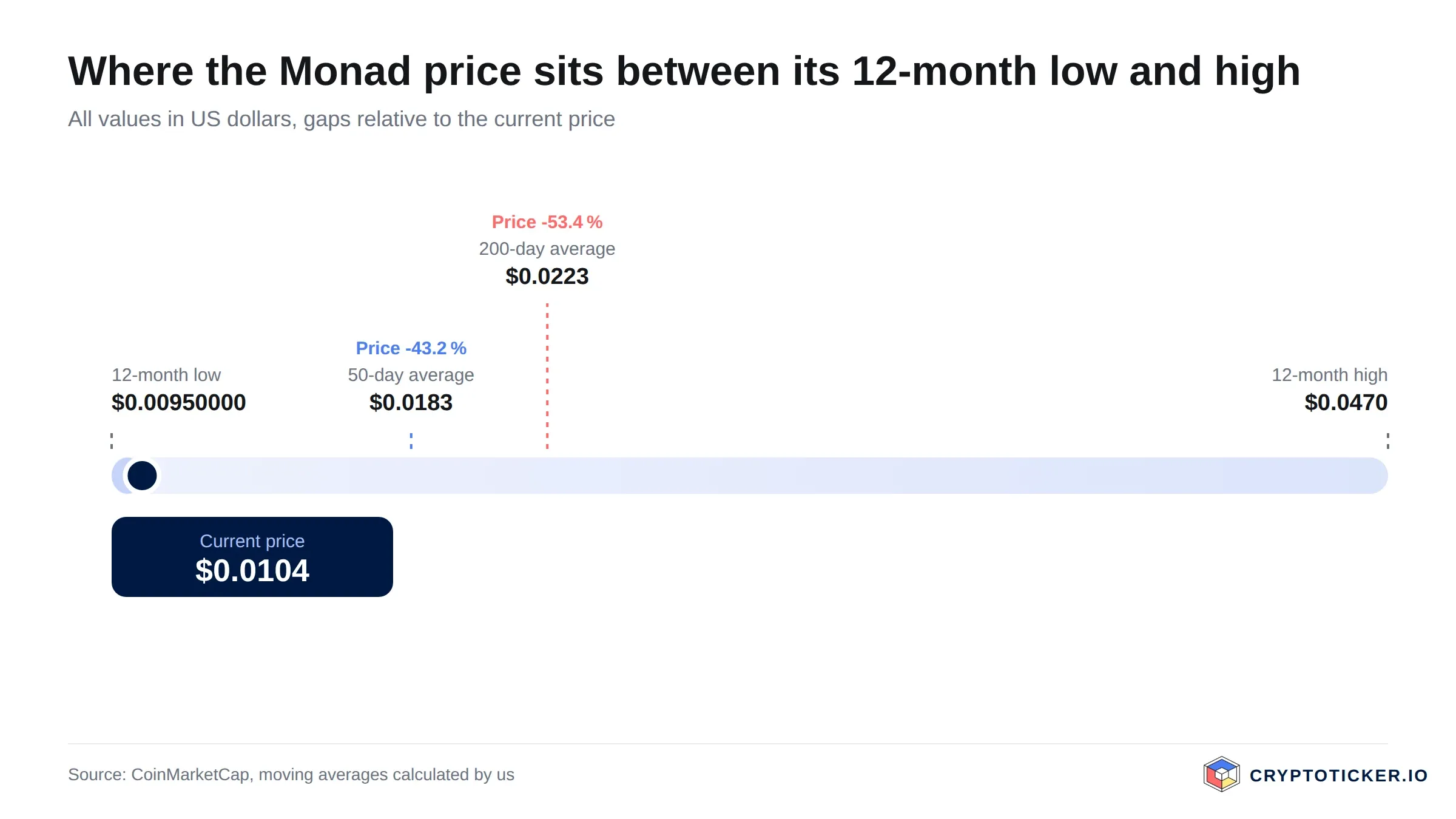
The Monad price relative to its 12-month low, high and both moving averages
Thirty days ago MON closed at 0.0215 US dollars, ninety days ago at 0.0286 US dollars. Measured against the first daily close a year ago, at 0.0463 US dollars, the token has lost about 78 percent. A trend reversal would first require MON to reclaim the 0.017 to 0.019 dollar zone and then close above the 50-day average. The price is a long way from both.
The past week shows how persistent the selling has been. MON closed lower on six of the seven days from 0.0154 US dollars on 18 November to the low of 0.0095 on 25 November. The bounce on Thursday is the first notable gain in that stretch, and one day does not make a turn.
What RSI and moving averages mean for a Monad entry
The 14-day RSI stands at 19.3. Readings below 30 are considered oversold, and values below 20 are rare. They mean the price has fallen unusually hard in a short time, and such phases often end in a technical rebound. On its own, however, that is not a buy signal. In strong downtrends the RSI can stay oversold for weeks while the price keeps sliding.
The moving averages give a clearer picture. As long as MON trades below its 50-day average of 0.0183 US dollars, any recovery remains a recovery within a downtrend. Chart-based traders therefore usually wait for two things: an RSI climbing back above 30, and a first daily close above a meaningful level. The wider market is no help at the moment. The CoinMarketCap Fear and Greed Index reads 10, which is extreme fear.
What Monad trading volume reveals about demand
Over the past 24 hours, MON worth about 27.6 million US dollars changed hands. The 30-day average is around 20.4 million US dollars a day, the seven-day average about 34.3 million. Volume over the past week was therefore well above the monthly norm, with the peak falling right around the anniversary.
A volume spike during a falling price mainly signals supply. The timing matches 24 November, when the one-year lock-up for team tokens ended under the Monad Foundation's tokenomics model. We broke down how large that tranche is, and why it weighs so heavily against the circulating supply, in our article on the Monad unlock and lock-up expiry. As noted there, an unlock only means tokens become available. Whether they are sold appears on no schedule. The heavy volume around the anniversary does suggest that at least part of the new supply found its way to exchanges. That is an assumption, not a proven attribution.
For an entry, volume is a double-edged signal. Capitulation-style days with very high turnover sometimes mark an interim low, because many sellers leave the market at once. Volume has already eased back towards the monthly average on Thursday while the price rose, which fits that reading. If selling pressure returns in the coming days, it would instead show that the unlock has not yet been absorbed.
Which structural factors speak for Monad
Monad is a standalone layer 1 blockchain that is compatible with the Ethereum Virtual Machine. Developers can move smart contracts from the Ethereum ecosystem without rewriting them. According to its developer documentation, the project targets around 10,000 transactions per second, block times below one second and parallel execution of transactions. Monad thus competes in the same market as Solana, Sui or Aptos: fast, cheap applications, but with Ethereum's toolkit.
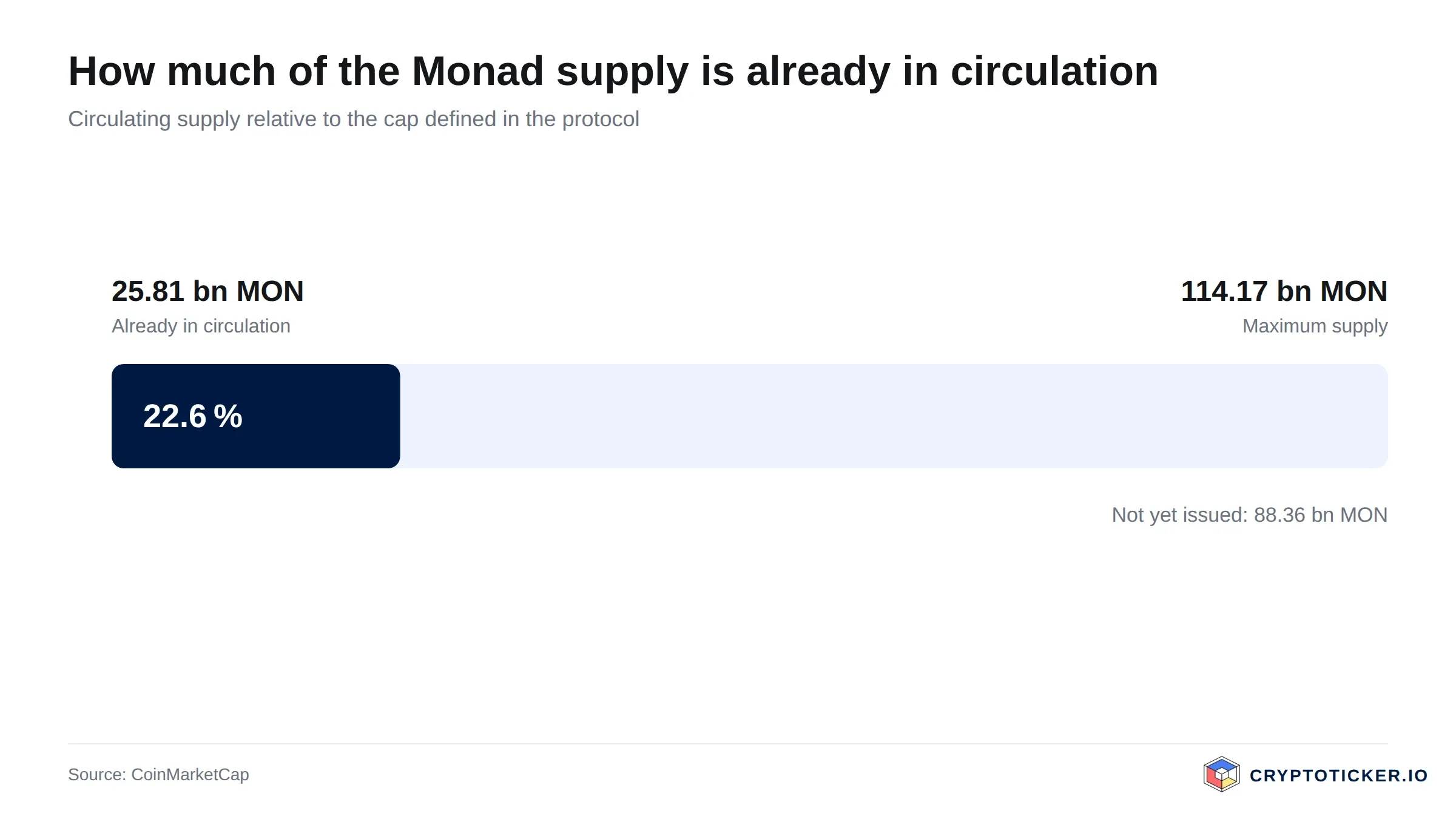
Monad supply structure according to CoinMarketCap data
The MON token has three jobs. It pays network fees, it secures the blockchain through staking with validators, and it serves as the means of payment within its own ecosystem. Holders can delegate MON and earn staking rewards. We compare platforms for that in our staking rewards comparison.
The supply side is less comfortable. CoinMarketCap currently lists around 25.8 billion MON as circulating, against a total supply of 101.9 billion and a maximum supply of 114.2 billion. A large part of the supply is therefore still outside the market. After the anniversary, team and investor tokens are released in monthly instalments over a further three years. With a market capitalisation of about 269 million US dollars and rank 102, Monad is also a comparatively small asset whose price reacts sharply to supply shocks.
In regulatory terms, MON in the EU is treated like other crypto assets without stablecoin character: trading runs through providers that must be authorised under the MiCA regulation. The European Securities and Markets Authority ESMA keeps a register of authorised service providers.
What speaks for buying Monad at current prices
- The discount is large. MON trades about 78 percent below its 12-month high and more than 50 percent below its 200-day average. Anyone who believes in the technology can buy the token today at a fraction of its launch price.
- The first big date has passed. The cliff on 24 November had been known for a year and hung over the price as uncertainty. With the anniversary, at least the largest single tranche is in the market, and the following releases come in smaller monthly instalments.
- The RSI shows an overshoot. At 19.3, MON is deeply oversold, and the volume pattern points to a capitulation phase. Such setups often precede a technical rebound.
What speaks against buying Monad at current prices
- The trend points clearly down. Falling highs since April, a price below both averages and a fresh all-time low argue against an early entry. Below the current price there is no historical support.
- Supply keeps growing. The cliff is followed by three years of monthly releases for team and investors. Each of those dates can bring fresh selling pressure, and a large share of the total supply is not yet in the market.
- Competition is fierce. Monad competes with established fast blockchains such as Solana, Sui and Aptos for developers and users. Whether enough applications emerge to carry lasting demand for MON is still an open question after one year.
How you can buy Monad at current prices
MON is tradable on several large crypto exchanges. Coinbase hosted the public token sale in November 2025 and has listed MON since then. You can read about the exchange in our Coinbase review. Which other providers list MON and what they charge is shown in our exchange comparison. With a token like Monad, three points deserve particular attention.
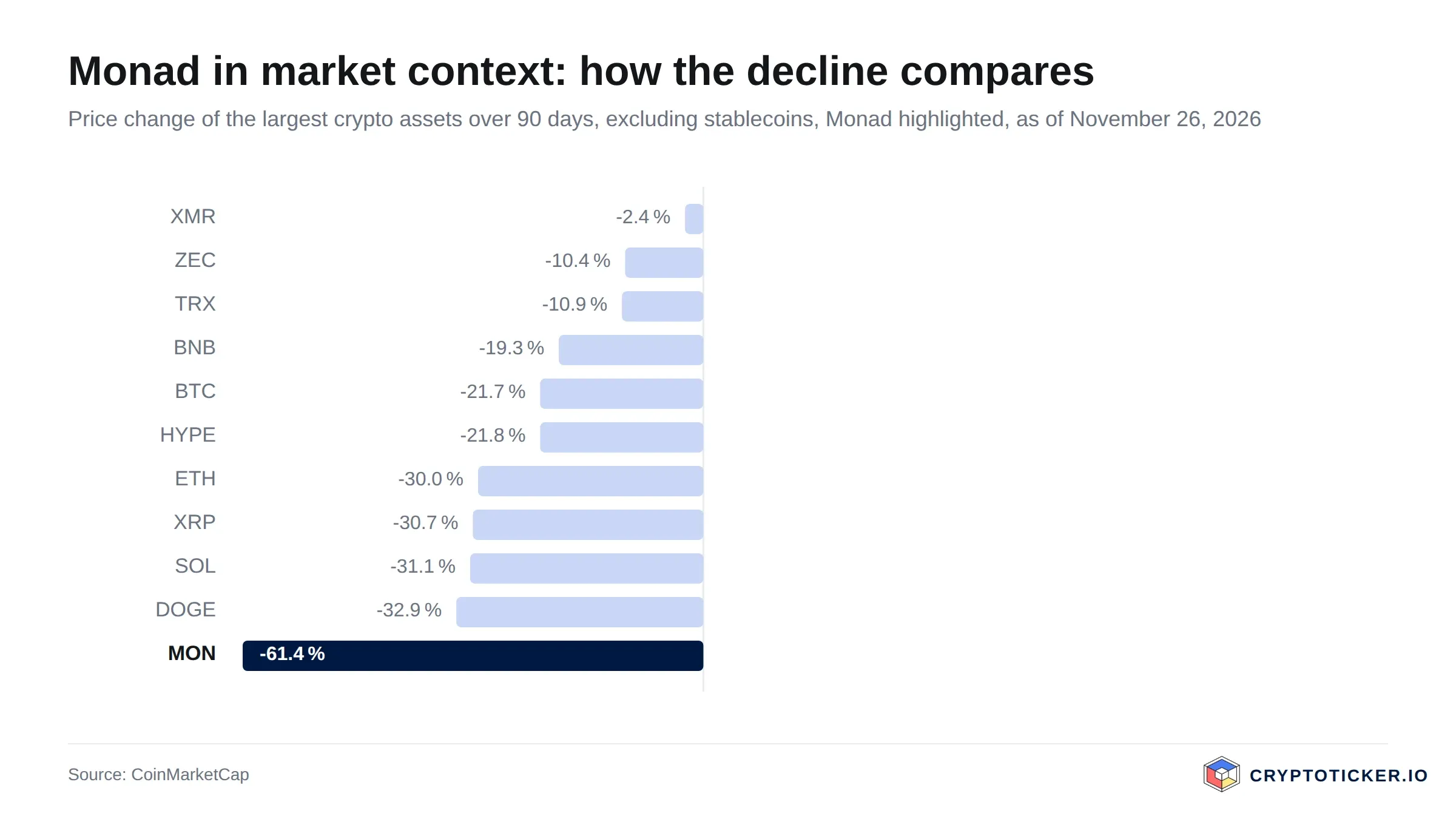
Monad compared with the other large crypto assets over 90 days
First, costs. Smaller assets often come with wider spreads on top of the trading fee. A limit order protects you from buying at a poor price on a hectic day. Second, authorisation. In the EU the provider should hold a MiCA licence, and our comparison of regulated exchanges gives an overview. Third, custody. If you plan to hold or stake MON for longer, you can move it to your own wallet that supports networks based on the Ethereum Virtual Machine. Make sure the withdrawal actually runs over the Monad network and not over a different blockchain.
So is Monad a good buy at current prices?
In the short term, the chart argues against a quick entry. The price has just set a new low, the unlock is fresh, and the market mood sits at extreme fear. A rebound from the oversold condition is possible, and a first target would then be the zone around 0.017 to 0.019 US dollars. A base would only be confirmed, however, once MON closes for several days above the 0.0115 dollar close of 24 November. If the price instead falls sustainably below the new low of 0.0095 US dollars, the scenario of a quick countermove is invalidated.
In the long term, everything depends on whether Monad turns its promise of a fast, Ethereum-compatible blockchain into real usage. If it succeeds, today's price may look low in hindsight. If it fails, the ongoing releases will weigh on the price for years. Long-term buyers tend to spread an entry in tranches over several months and keep the position small, which cushions the risk of further unlock dates. The overall verdict remains a trade-off: at current prices Monad is a speculative bet on the adoption of a young blockchain, not a safe haven. Our view on how the price could develop is laid out in the Monad price prediction. How comparable projects fare is covered in our analyses of Sui and Aptos.
Buying Monad: The key points for your decision
- Review the scenarios and price levels in the Monad price prediction and decide at which price your entry case no longer holds.
- Pick an authorised provider from the comparison of regulated exchanges and buy with a limit order rather than at market price.
- Check the next release dates before buying. The details on the lock-up are in our article on the Monad unlock.
Disclosure: Some of the providers mentioned in this article work with us through affiliate programmes. This has no influence on the price analysis or the assessment of the chart; the price data comes from a public market data source and can be verified there.
(As of: 26 November 2026. This article is not investment advice. Prices, fees and conditions change; check them with the provider before every purchase. Crypto assets are subject to high price fluctuations, and a total loss is possible.)