Key Takeaways Ripple’s RLUSD stablecoin is now legally available in Japan via SBI VC Trade. It’s the first foreign stablecoin cleared under Japan’s new regulatory category. Distribution runs
Key Takeaways
- Ripple’s RLUSD stablecoin is now legally available in Japan via SBI VC Trade.
- It’s the first foreign stablecoin cleared under Japan’s new regulatory category.
- Distribution runs through the licensed VCTRADE platform to retail and institutions.
- RLUSD has reached roughly $1.7 billion in market cap since its 2024 launch.
- The launch builds on a Ripple-SBI relationship dating to 2016.
It marks the first time a foreign-issued stablecoin has entered Japan under a regulatory category built specifically for this kind of asset.
Why Japan Is a Hard Market to Enter
Japan does not let foreign stablecoins in easily, which is what makes this notable. RLUSD cleared the JFSA under a new Electronic Payment Instrument (EPI) classification within Japan’s Payment Services Act (PSA), created specifically for foreign-issued stablecoins that meet the country’s safety and compliance standards. Crucially, that approval rests on a functional equivalence test: Ripple had to demonstrate that the rules governing RLUSD in its home jurisdiction match Japan’s own standards for safety and reserve backing, rather than Japan simply waving the asset through. Clearing that hurdle matters on two levels: it opens one of the world’s largest and most sophisticated digital-asset markets, and it sets a template other foreign stablecoin issuers can follow into Japan.
The significance is less about a single product launch and more about a door opening. Japan’s regulatory rigor has historically kept foreign stablecoins out, so being the first through that specific new category gives RLUSD a first-mover position in a market that’s notoriously difficult to access.
The SBI Partnership Behind It
This was not a cold entry into an unfamiliar market. Ripple and SBI Group have worked together since 2016, a decade-long relationship that built the trust and infrastructure a licensed stablecoin launch requires. SBI VC Trade is a licensed Electronic Payment Instruments Exchange Service Provider, which means RLUSD distribution through VCTRADE carries full regulatory backing from day one rather than operating in a gray zone.
The timeline shows how deliberate the process was. The memorandum of understanding for this specific launch was announced in August 2025, and the actual rollout took roughly ten months from announcement to availability, a pace that reflects the compliance work involved rather than any delay. Jack McDonald, Ripple’s SVP of Stablecoins, framed the purpose directly: “Through our collaboration with SBI Group, RLUSD will serve as a bridge for payments, tokenization and collateral management, connecting Japanese businesses and individuals more efficiently to global liquidity.”
One technical note for those tracking the rollout: the RLUSD made available in Japan runs on the Ethereum network rather than the XRP Ledger, at least for this initial launch.
READ MORE:
 Why $54,000 Could be the Price That Defines Bitcoin’s Cycle
What RLUSD Is Used For
RLUSD’s role in Japan extends well beyond simple payments. The stablecoin is positioned for institutional plumbing where a compliant, dollar-backed token can move value faster and more transparently than legacy rails:
- Programmable trade settlement: automating complex business-to-business payment workflows.
- Collateral management: using the token as a liquid asset for institutional margin and settlement.
- Supply chain finance: creating transparent, near-instant payment rails across trade networks.
Tomohiko Kondo, CEO of SBI VC Trade, called the launch “a major milestone in our ongoing collaboration and our efforts to drive innovation in digital finance.”
That framing matters because it positions RLUSD as financial infrastructure rather than a trading chip. The use cases Ripple and SBI are emphasizing are business-to-business and settlement-oriented, which fits the regulated, institution-friendly way the launch was structured.
The Growth Behind the Token
RLUSD’s trajectory gives the Japan launch its context. Since its launch, the stablecoin has climbed to roughly $1.7 billion in market cap, with a growth curve that has risen in steady step-ups rather than the spike-and-collapse pattern typical of speculative assets. That shape is itself a signal: consistent, staircase-style expansion points to steady institutional minting, money entering for use, rather than retail-driven speculation chasing a price.
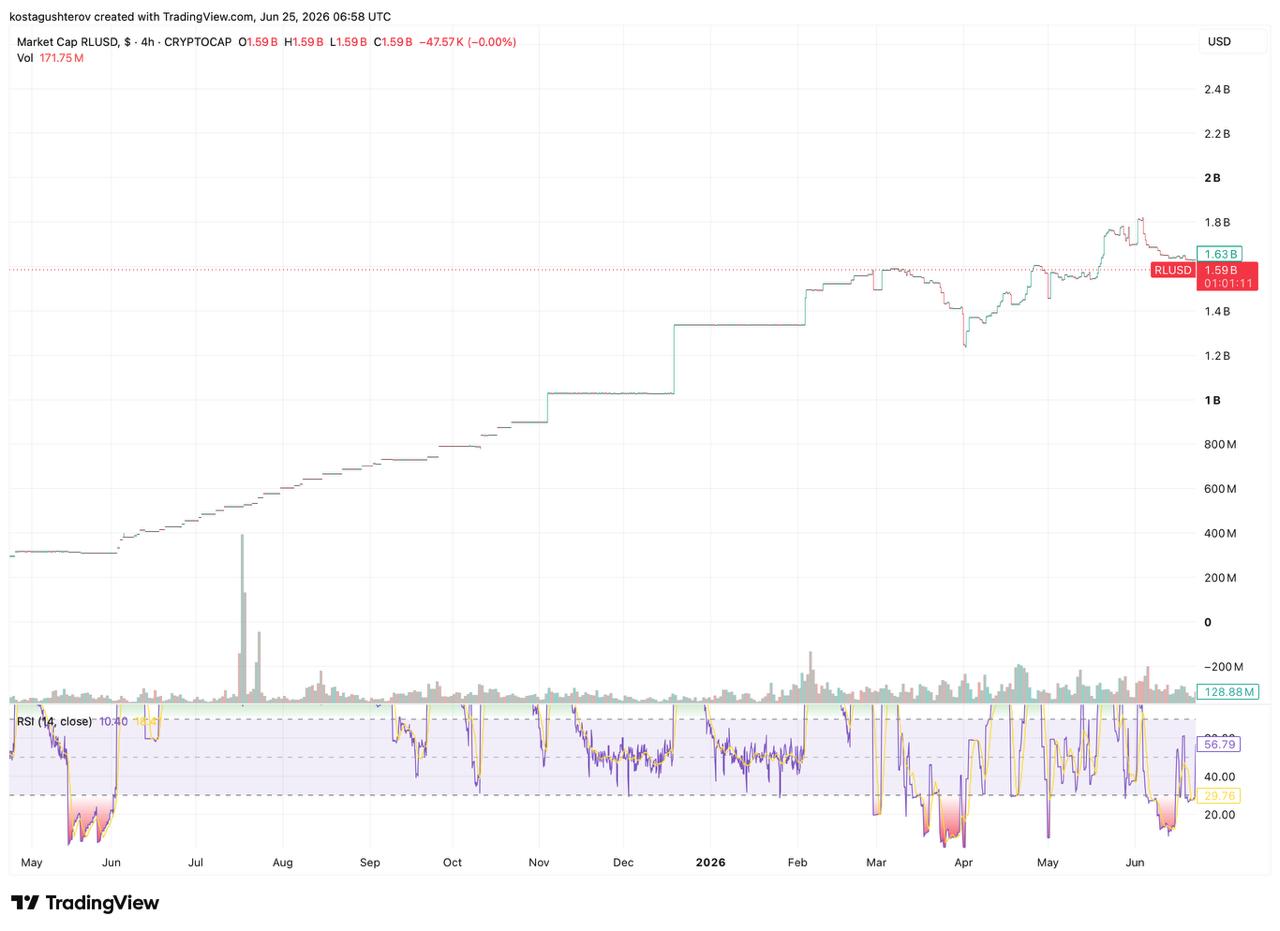
The most recent stretch shows a modest pullback from the peak, with momentum indicators suggesting the recent contraction may be approaching oversold territory. But the broader pattern, a multiple-fold expansion over roughly a year in measured steps, is the more meaningful story, and it’s the kind of adoption curve that makes a regulated expansion market like Japan a logical next step rather than a gamble.
A Template for What Comes Next
The headline is a single product launch, but the substance is a precedent. A foreign stablecoin clearing Japan’s purpose-built regulatory category, distributed through a licensed local partner with a decade of shared history, is the kind of structured market entry that other issuers will study. For Ripple, it extends RLUSD into one of the most demanding markets in the world with full regulatory standing. For Japan, it’s an early test of a new framework designed to admit foreign stablecoins without lowering the bar. How RLUSD performs there will say a lot about whether that framework becomes a model or an exception.
This article is for informational purposes only and does not constitute financial advice. Consult a professional before making investment decisions.The post Japan Approves Ripple’s RLUSD, a First for Foreign Stablecoins appeared first on Coindoo.