Mantle’s MNT traded at $0.385478 at 18:56 UTC on 18 November, up 5.04% in 24 hours while bitcoin fell 1.1%, according to CoinGecko’s MNT market data. The gain landed the same day GMO Financia

Mantle’s MNT traded at $0.385478 at 18:56 UTC on 18 November, up 5.04% in 24 hours while bitcoin fell 1.1%, according to CoinGecko’s MNT market data. The gain landed the same day GMO Financial Holdings published a release at 13:00 JST confirming that its exchange, GMO Coin, began handling the token on 31 October. The release carries no trading volume, no account numbers and no order-book data for MNT on the Japanese venue, so the rally has a date and a headline and no public mechanism behind either.
What is established is narrower than the headline and easier to price: a $1.28 billion token that has fallen 86.5% from its 2025 peak got a regulated Japanese listing on the last Saturday of October, and on 18 November its issuer put out the paperwork. The venue’s rules, the token’s eighteen days of post-listing price action and its distance from its own high are all measurable. The 5% day is not.
MNT Is Up 5% While Bitcoin Is Down 1%
The 24-hour number is the one that travels: +5.04% against bitcoin’s -1.1%. The seven-day number is the one that matters for positioning. Over that window MNT lost 9.98% and bitcoin lost 15.1%, a 5.1 percentage point gap in MNT’s favour. Over thirty days the gap is smaller and runs the other way: MNT is down 27.54%, bitcoin is down 1.1% on the day but 22.9% over the same thirty sessions measured from the 20 October close of $81,875.26.
Market value sits at $1.2765 billion on a circulating supply of 3.312 billion tokens, against a maximum of 6.219 billion. Twenty-four-hour volume of $39.0 million works out to turnover of 3.06% of market value, and that is the first number to keep in mind when judging a 5% move. Thin books produce large percentage changes on modest flow, in both directions.
The one-hour prints tell a less dramatic story than the daily ones. At 18:56 UTC, MNT was up 0.2% over the hour while bitcoin was up 0.7%, which looks less like a token-specific bid and more like a broad tape that stopped falling. Available evidence does not establish the GMO Coin release as the cause of the 24-hour move, and anyone who says otherwise is inferring it.
What GMO Coin Listed on 31 October, in Full
GMO Coin is a consolidated subsidiary of GMO Financial Holdings and sits inside GMO Internet Group. Its 18 November release states the scope of the listing plainly: “2026年10月31日(土)より、国内初(※2)となる暗号資産「マントル(MNT)」、および「ビルドアンドビルド(BNB)」の2銘柄の取り扱いを開始しました。” The translation is that from Saturday 31 October 2026 the exchange began handling MNT, described as a domestic first, alongside BNB.
The “first” claim is the company’s own and it is footnoted precisely: no other Japanese crypto asset exchange operator handled MNT, according to the Japan Virtual and Crypto Assets Exchange Association’s published list of handled assets, as compiled by GMO Coin on 31 October 2026. That is a statement about the JVCEA register on one date, not a permanent property of the asset.
Five services carry the token, which is the detail most English coverage skipped. MNT is available on the sales desk, the exchange’s spot and margin books, the recurring-purchase product and the basic crypto lending product, plus deposits and withdrawals and the venue’s API. The release adds: “これにより、GMOコインでは23種類の暗号資産をお取引いただけます。” That brings the venue to 23 assets in total. Only one of the 23, MNT, is primarily the governance and gas asset of an Ethereum layer-2 network.
The custody rules are where the release gets interesting. In its 29 October trading-rules notice, GMO Coin writes: “マントル(MNT)は、イーサリアム(Ethereum)上のERC-20トークンのみに対応しております。” Only the ERC-20 token issued on Ethereum mainnet is supported. MNT on Mantle Network, the layer-2 the token is named after, cannot be deposited or withdrawn, and bridging between Ethereum and Mantle Network is explicitly outside the service. Deposits opened after the 31 October maintenance window; outbound transfers began at 12:00 JST on 2 November.
Margin terms are set by category rather than by asset. The same notice states: “取引所(レバレッジ取引)の個人のお客さまのレバレッジは2倍です。” Individuals get 2x on the exchange’s margin product; corporate clients are assigned a ratio based on the risk-estimation percentage published by JVCEA. BNB was added on the same date under a matching set of restrictions, with support limited to the BNB Smart Chain.
Eighteen Days Later, the Token Is 18.9% Lower
On 31 October, MNT closed at $0.475107. At 18:56 UTC on 18 November it traded at $0.385478, a decline of 18.86% across the eighteen days since the listing went live. Bitcoin over the same span went from $77,275.05 to $63,137.58, down 18.30%. The listing did not break MNT away from the market it trades in.
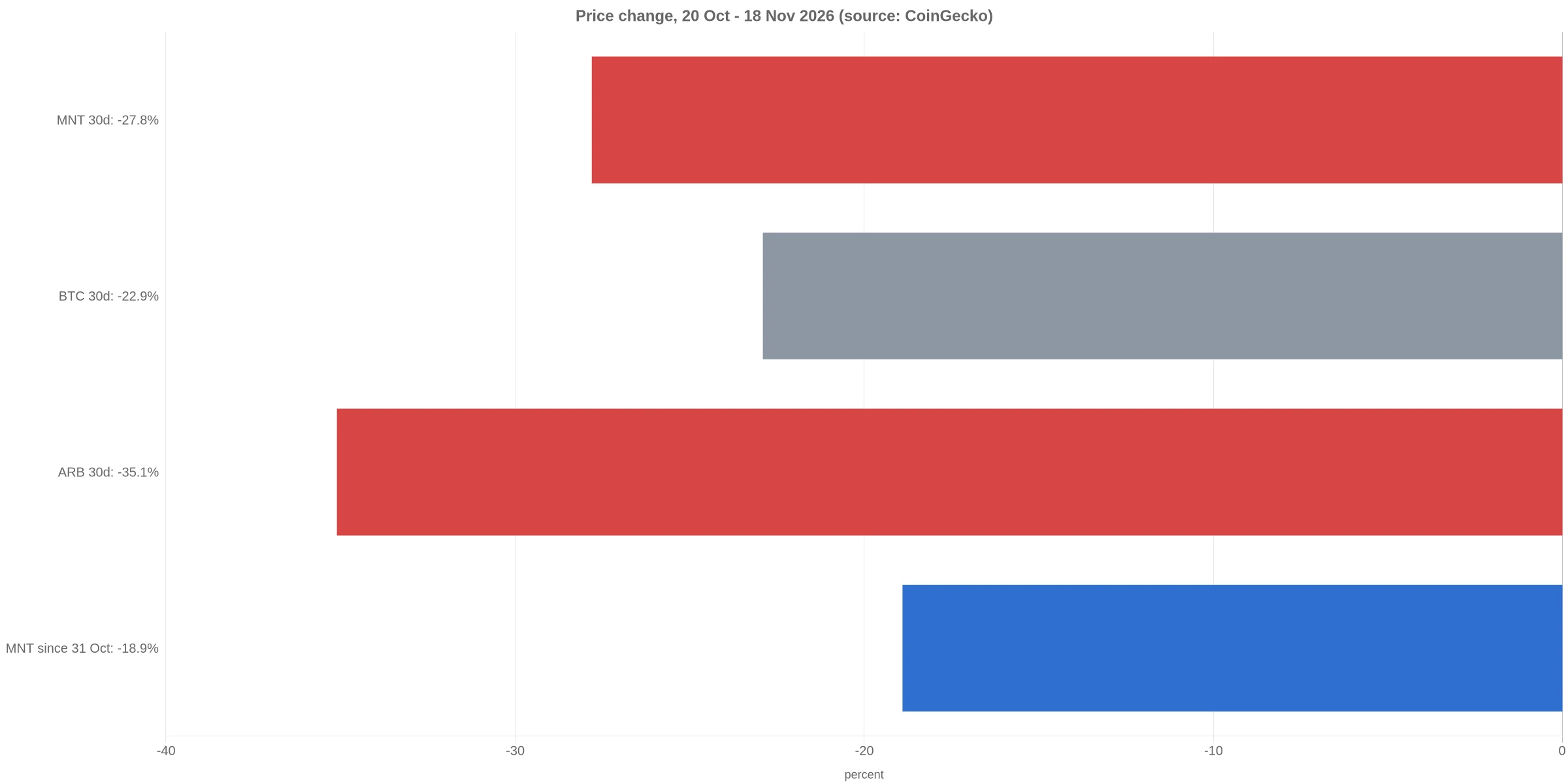
Against its own sector the picture improves. Arbitrum’s ARB is down 35.1% over thirty days and MNT is down 27.8%, so Mantle has held better than the largest competing layer-2 token through the same drawdown. Against bitcoin, MNT lost 4.9 percentage points more over thirty days and 18.9% versus 18.3% since the listing. That is the honest scoreboard: a token that outperformed its peers and still could not outperform the asset that sets the price of the whole market.
MNT’s thirty-day low close came on 17 November at $0.364709. The 18 November price of $0.385478 is 5.7% above it. That is the whole of the bounce in context: a recovery from a thirty-day low inside a thirty-day decline of 27.8%.
The 10x Arithmetic on a $1.28 Billion Market Cap
Anyone buying MNT for a tenfold return is buying a $12.77 billion valuation on today’s circulating supply. At $0.385478, $1,000 buys 2,594 MNT. The same position is worth $10,000 at $3.85478 per token, and at that price the circulating market value would be $12.77 billion. If the full 6.219 billion maximum supply were in circulation at that price, fully diluted value would be $23.97 billion.
For scale, ARB’s entire market value today is $0.895 billion, OP’s is $0.175 billion, Starknet’s is $0.255 billion and Celestia’s is $0.346 billion, all at 18:56 UTC on 18 November per CoinGecko. A $12.77 billion MNT would be 14.3 times ARB’s current capitalisation. Reclaiming the October 2025 all-time high of $2.86 requires a 642% gain from today’s price, and that is before any new supply reaches the market.
Supply is the part of the arithmetic most retail buyers skip. Of the 6.219 billion maximum, 3.312 billion circulate, or 53.3%. The remaining 2.907 billion, 46.7% of the cap, is not in the float. The 18 November release does not publish an unlock schedule, and no part of the GMO Coin documentation addresses dilution. A tenfold price with unchanged float is the assumption behind the $12.77 billion figure, and it is only an assumption.
Where the Japan Story Matters, and Where It Cannot
The listing gives Japanese retail accounts something they did not have: a route to MNT through a licensed domestic operator, in yen, with margin and lending products attached, and no need to move assets across a bridge to a foreign venue. That is a real distribution change for the asset and it belongs in any honest account of the week.
It does not put Japanese flow into the Mantle Network economy. Because GMO Coin supports only the Ethereum ERC-20 token and excludes the layer-2 version, deposits, withdrawals and any lending collateral are denominated in the mainnet asset. Gas demand on Mantle Network, the metric that would make a listing matter to the chain rather than to the ticker, is not addressed anywhere in the release. The venue also publishes no MNT volume figures, so the first hard evidence of Japanese demand will have to come from GMO Coin’s own market data pages rather than from press releases.
Two other constraints sit on the same trade. Turnover of 3.06% of market value means a single mid-sized seller can move the print, and 46.7% of maximum supply has yet to circulate. Neither is a reason to expect a lower price. Both are reasons not to read a 5% day as a change in trend. Mantle’s own pipeline matters more here: the network joined the Global Dollar Network as USDG circulation passed $3 billion in September, and MNT transfers worth $2.5 billion were moved onto Chainlink’s CCIP bridge standard in July, both of which are infrastructure events with measurable on-chain consequences and neither of which requires a Japanese venue to succeed.
The Levels That Matter This Week
Every level below is a daily USD close from CoinGecko, and each is stated with the date that produced it so the basis is checkable. Support sits at $0.364709, the 17 November close and the thirty-day low. Below that, the next reference is the 15 November close of $0.369703, only 1.4% above the low and therefore not much of a cushion. Resistance runs first through $0.402889, the 14 November close, then $0.423440 from 11 November, then $0.475107 from 31 October. A daily close below $0.364709 invalidates the bounce; a daily close above $0.423440 puts the 31 October listing-day price back in play.
For the broader read, the ratio is cleaner than the dollar price. MNT needs to hold above its 17 November close while bitcoin stays above its 18 November level of $63,137.58 for the gain to look like rotation into a specific story rather than a bounce in a falling market. If bitcoin takes out its own recent lows, the Japan narrative will not protect the token, and eighteen days of price action already say so.
Frequently Asked Questions
What is the Mantle (MNT) price today?
MNT traded at $0.385478 at 18:56 UTC on 18 November 2026, up 5.04% in 24 hours, down 9.98% in seven days and down 27.54% in thirty days, according to CoinGecko. Market value is $1.2765 billion on a circulating supply of 3.312 billion tokens.
Is MNT available on a Japanese crypto exchange?
Yes. GMO Coin began handling MNT on 31 October 2026, across its sales desk, spot and margin books, recurring-purchase product, basic crypto lending product, deposits and withdrawals, and API. GMO Financial Holdings, the exchange’s parent, described it as the first domestic handling of the asset, based on the JVCEA list of handled assets as of that date.
Why did MNT rise on 18 November?
The token rose 5.04% in 24 hours on the day GMO Financial Holdings published a release confirming the 31 October listing. The release discloses no MNT volume, user counts or order-book data for the venue, and the move coincided with a broader intraday bounce in crypto prices, with bitcoin up 0.7% over the final hour. No public data establishes the release as the cause.
Does GMO Coin support MNT on Mantle Network?
No. GMO Coin supports only the ERC-20 version of MNT issued on Ethereum mainnet. MNT on Mantle Network cannot be deposited or withdrawn, and bridging between Ethereum and Mantle Network is outside the service, per the exchange’s 29 October trading-rules notice.
What would a 10x from here mean for Mantle’s valuation?
At $3.85478 per token, today’s 3.312 billion circulating supply would be worth about $12.77 billion, against $1.2765 billion now. Fully diluted across the 6.219 billion maximum supply, the same price implies $23.97 billion. Reclaiming the October 2025 all-time high of $2.86 would require a 642% gain and remains 86.5% above the current price.
Data: CoinGecko, GMO Coin, GMO Financial Holdings.
The post Mantle Price Today: MNT Gains 5% on a Red Day as Japan’s First Listing Settles In appeared first on BlockchainReporter.