Billions of dollars are sitting in DeFi liquidity pools right now, doing nothing at all. New research from onchain analytics platform Dune, commissioned by 1inch, has found that 85% of concen
Billions of dollars are sitting in DeFi liquidity pools right now, doing nothing at all.
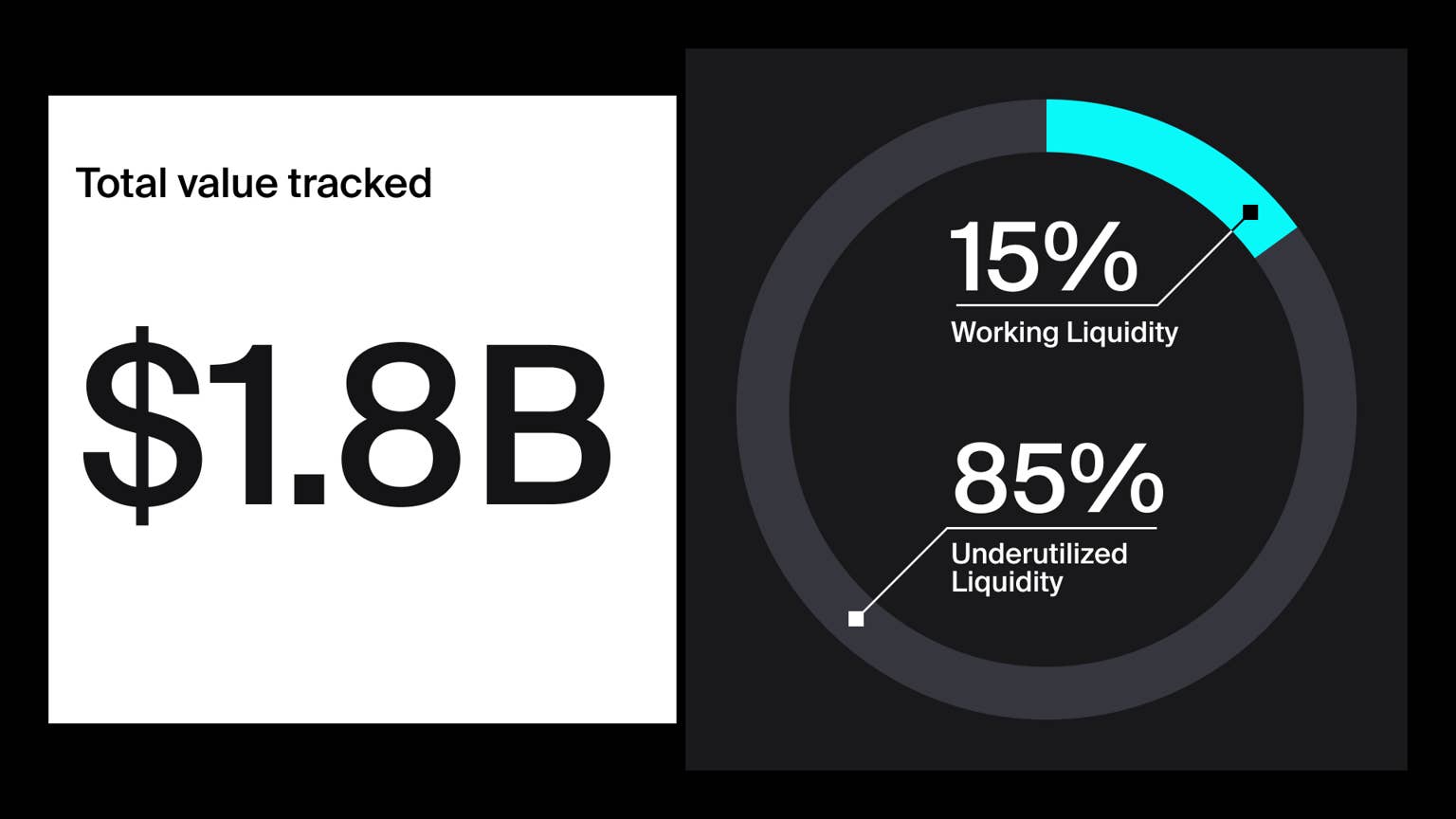
New research from onchain analytics platform Dune, commissioned by 1inch, has found that 85% of concentrated liquidity on decentralized exchanges, roughly $1.6 billion out of $1.84 billion tracked, is underutilized at any given time. Of that, about $542 million sits completely idle in an average week, earning nothing and providing no market depth whatsoever.
1inch is a decentralized trading platform used by 27 million people to swap crypto assets at competitive prices by aggregating liquidity across the market. Its research into liquidity efficiency ties directly into a problem the platform is now trying to solve for its own users.
"Due to structural inefficiencies in DeFi, liquidity providers are leaving billions of dollars in underutilized capital and millions of dollars in fees on the table," said Sergej Kunz, Co-Founder of 1inch.
"If the industry is serious about bringing TradFi's trillions onchain, solving this needs to be priority number one."
Related: Inside Glamsterdam, the upgrade Ethereum's critics have been demanding
How the research was conducted
Dune tracked four major concentrated-liquidity platforms, Uniswap v3 and v4, PancakeSwap v3, and Aerodrome Slipstream, across seven blockchains, taking weekly snapshots between January 6 and June 30, 2026.
The study covered the top 200 pools by trading volume on each platform, holding that group fixed across all 26 weeks to give a consistent panel averaging $1.84 billion in tracked capital. Three simpler liquidity models were also analyzed separately as a baseline for comparison.
- What "idle" actually means here
In DeFi, liquidity providers deposit funds into a price range where they expect trading to happen, earning fees whenever a trade occurs within that range.
When the market price moves outside that range, the deposited funds stop earning anything, they simply sit there, out of use, until the price moves back or the provider adjusts their position.
Across the 26 weeks tracked, an average of 29.5% of liquidity sat in this fully idle state, spiking to around 41% in early February. The financial cost of this is significant, Dune estimates that out-of-range liquidity providers are missing out on roughly $150 million a year in fees they could otherwise be earning.
"Decentralized exchanges have grown into one of the deepest, most liquid markets in crypto, and it is now competing with centralized exchanges and traditional trading venues," said Filippo Armani, Research Lead at Dune.
"What our research shows is that it has reached this scale even though much of its liquidity is not yet fully at work."
Trending on TheStreet Roundtable:
Where the idle capital actually sits
The research uncovered a pattern that runs counter to what many might expect. Smaller positions under $1,000 sit idle about 54% of the time, while positions over $1 million sit idle far less often, around 26%.
But because large positions hold so much more capital overall, they still account for the majority of idle dollars, positions over $1 million represent roughly 47% of all idle capital, and positions over $100,000 account for about 76%.
Distance the price travels over the course of a week turned out to matter more than volatility itself. A week where prices swing wildly but return close to where they started tends to keep liquidity in range. A quiet, steady drift in one direction is more likely to push liquidity out of range entirely.
No single platform design avoided the problem. Comparing the same trading pairs across different venues, idle rates shifted from pair to pair rather than favoring one protocol over another, even Uniswap v4, the newest of the platforms studied, showed idle rates around 30%, similar to its predecessor.
Even stablecoin pools, where prices are expected to stay stable, saw roughly 30% idle rates, since liquidity providers tend to concentrate their funds into extremely narrow ranges.
The research also found that idle capital is overwhelmingly held by individual wallets rather than automated systems.
On Uniswap v3, individual wallets accounted for 82% to 94% of idle dollars across the chains studied, while capital managed by contract-based systems and active market makers stayed in range far more reliably.
What comes next
Armani pointed to the value of real-time visibility into liquidity data going forward.
"It is easy to imagine what these venues will do as efficiency improves and institutional capital keeps arriving," he said.
"Getting there depends on measuring liquidity precisely across every venue and chain, possibly real time, which is exactly the kind of onchain visibility Dune has been building."
Kunz pointed to shared liquidity models and artificial intelligence as potential paths toward a more efficient system, noting that 1inch plans to launch a product called Aqua aimed at helping liquidity providers maximize their capital.
Related: 1inch integrates Robinhood Chain as tokenized stock trading goes onchain