Coinbase has opened its crypto-backed loans to New York residents, completing a rollout that now makes the product available in all 50 states. The exchange said customers in the state can bor
Coinbase has opened its crypto-backed loans to New York residents, completing a rollout that now makes the product available in all 50 states.
The exchange said customers in the state can borrow USDC, a dollar-pegged stablecoin, against their Bitcoin, Ether and Solana holdings without selling them.
The product, called Coinbase Borrow, launched in the U.S. in January 2025. Coinbase updated the announcement on Nov. 16, 2026, to add New York, the last state to get access.
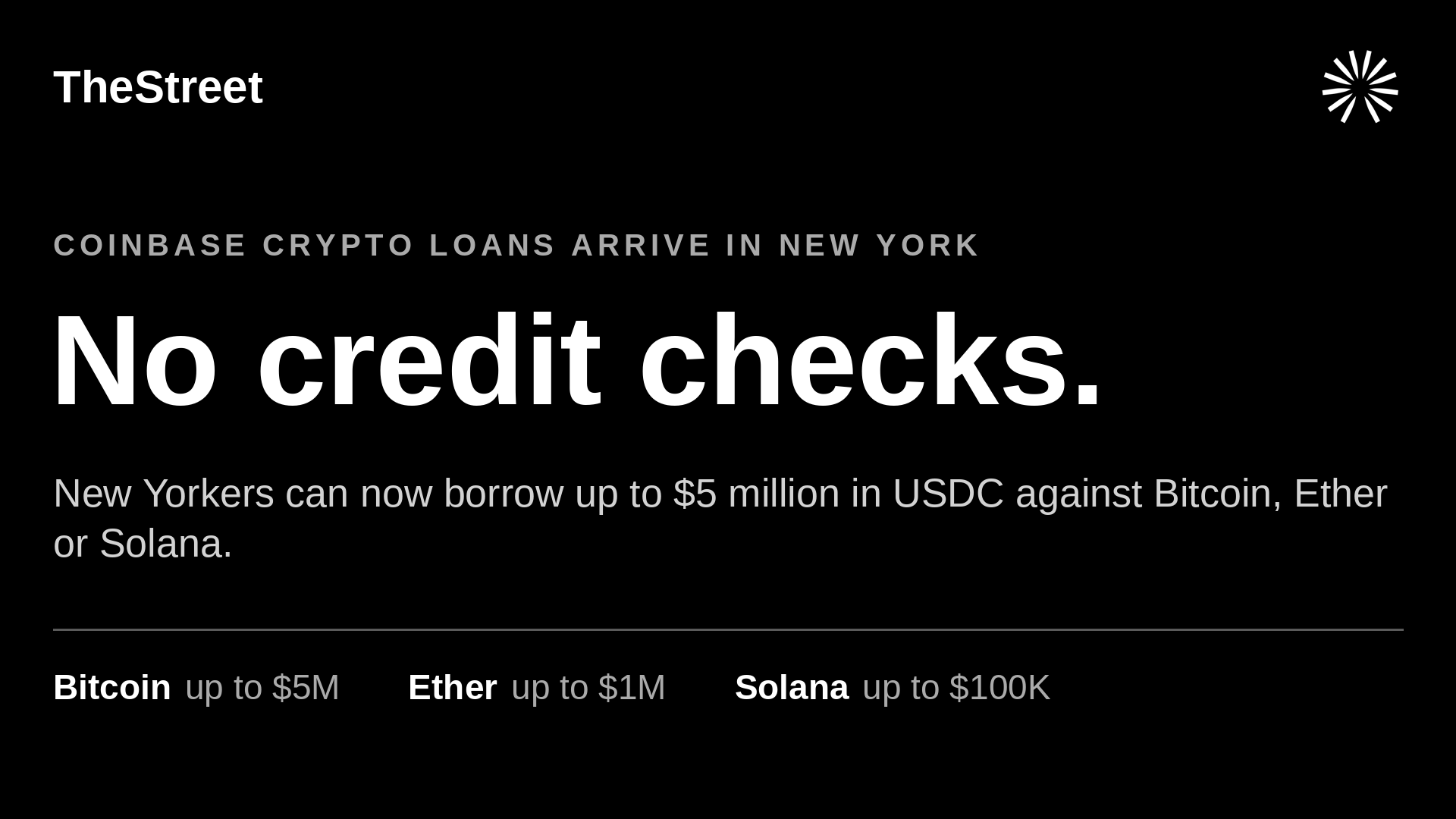
Coinbase opened crypto-backed loans to New York residents on Nov. 16 with no credit checks. Source: Coinbase.
What New Yorkers can now borrow
Eligible customers can borrow up to $5 million in USDC against Bitcoin, up to $1 million against Ether and up to $100,000 against Solana, subject to eligibility and other limits.
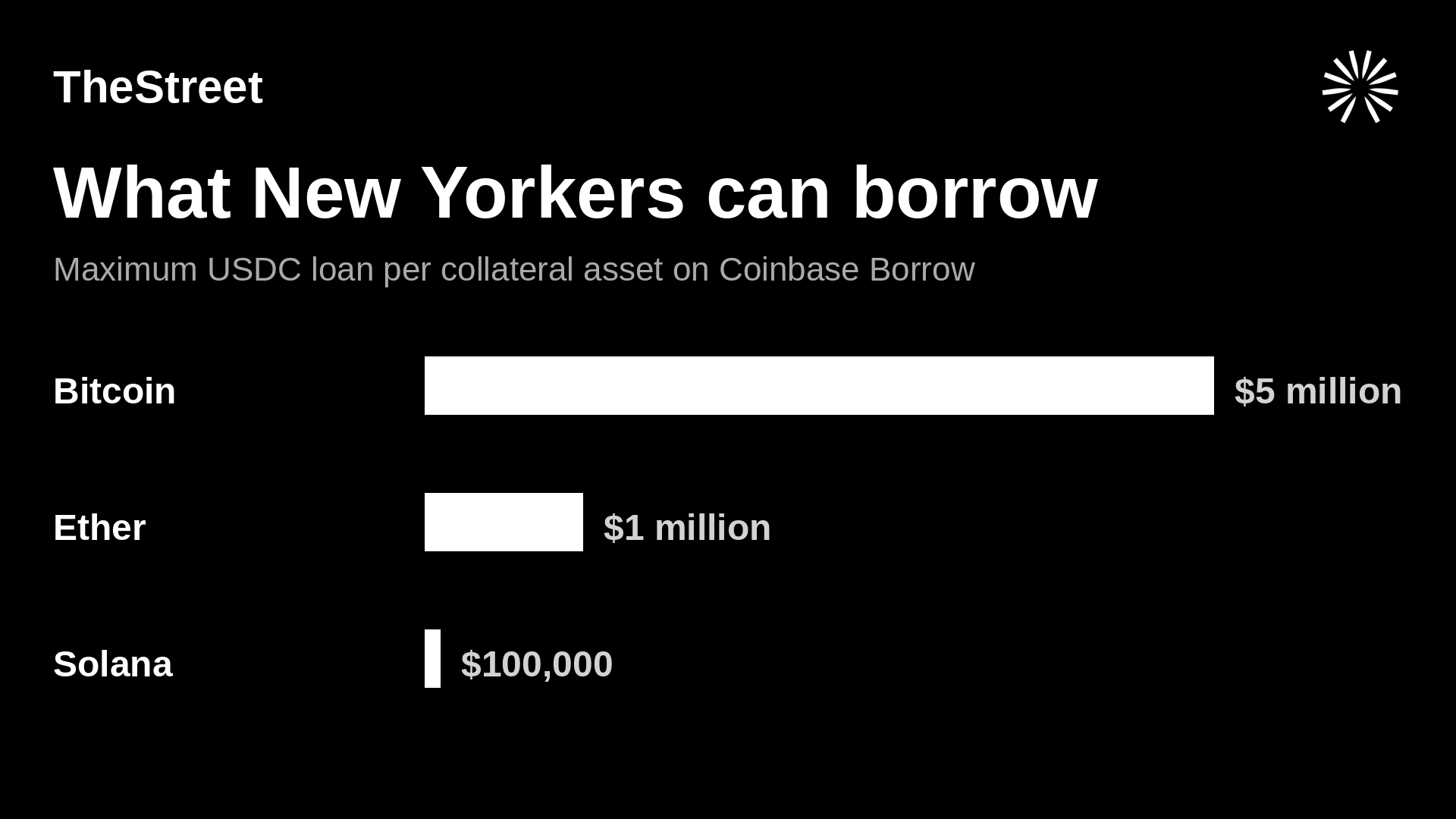
Maximum USDC loan per collateral asset. Source: Coinbase.
There are no credit checks, according to Coinbase's documentation. The loan is secured entirely by the crypto a customer pledges.
New York gets a narrower version of the product than the rest of the country.
Only variable-rate loans are available in the state, and only against those three assets, according to Coinbase's documentation.
Fixed-rate loans, tokenized gold through PAX Gold, XRP, Zcash, Hyperliquid's HYPE and staked assets are all available in other eligible regions but not in New York.
Coinbase's separate USDC lending product, which pays returns on deposits routed into onchain lending markets and holds more than $500 million, is also unavailable in the state.
Who benefits from skipping the credit check
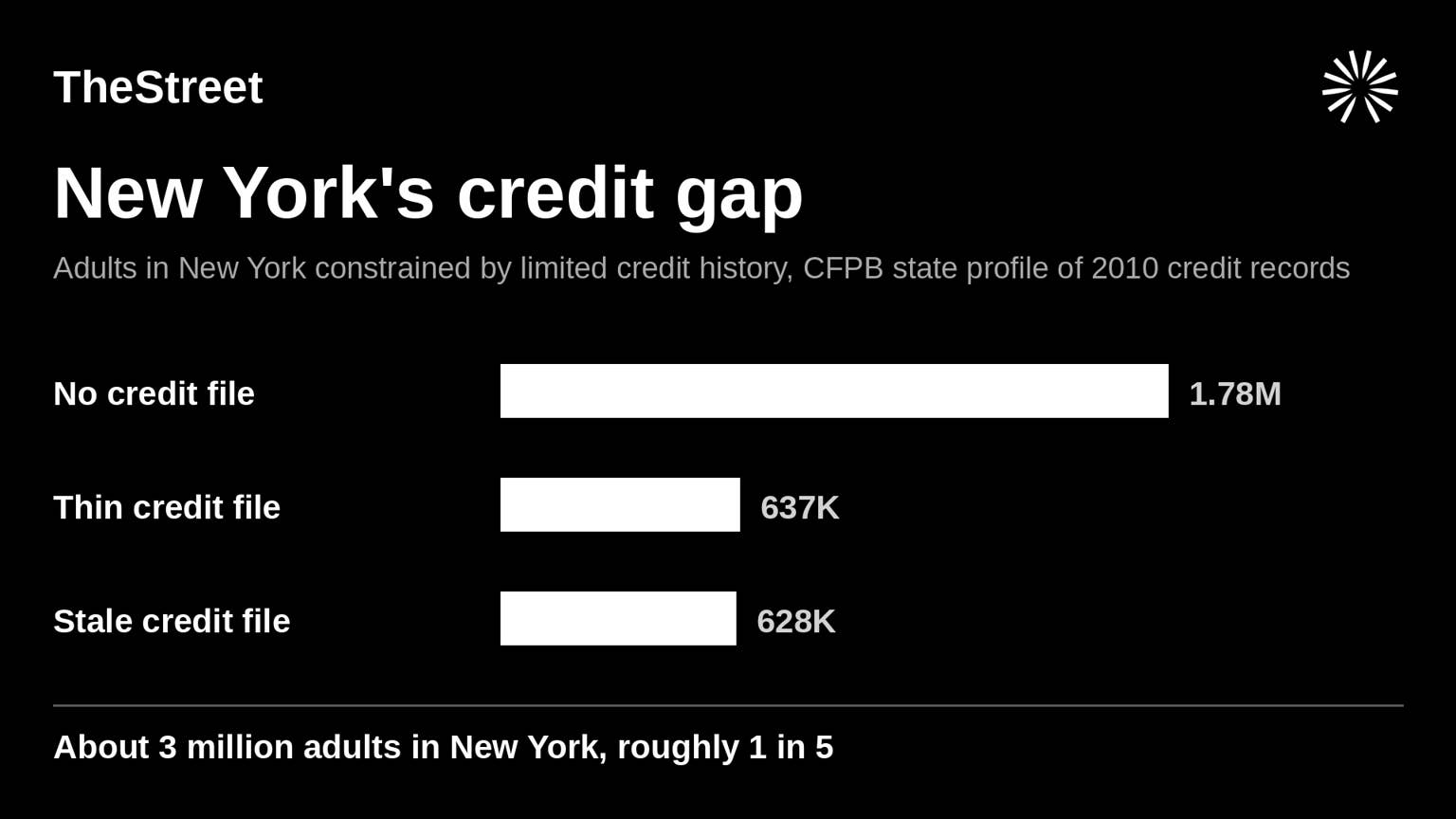
Banks and card issuers screen borrowers by credit score. A Consumer Financial Protection Bureau community credit profile of New York, based on 2010 credit records, estimated that about 3 million adults in the state, roughly one in five, were credit constrained because of a limited credit history, including about 1.8 million with no credit file at all and about 1.3 million more whose files were too thin or too stale to produce a score.
About 3 million New York adults, roughly 1 in 5, were credit constrained, based on 2010 credit records. Source: Consumer Financial Protection Bureau.
Nationwide, the bureau's latest estimate, published in June 2025, found 7 million U.S. adults were credit invisible in December 2020, or 2.7 percent of the adult population, down from 13.5 million a decade earlier.
A collateralized loan sidesteps that screen because the pledge, not the borrower's history, secures the debt. TheStreet has covered founders building credit access for people shut out of that system, including a Harvard dropout serving African immigrants.
Why New York was the last state
New York runs what is widely considered the strictest state-level crypto regime in the country.
Since June 2015, any company conducting virtual currency business with New Yorkers needs approval from the New York State Department of Financial Services under its Part 200 regulation, known widely as the BitLicense.
Coinbase has held that license since January 2017. But holding a BitLicense does not clear new products on its own, and the department reviews new lines of business from licensed firms before they launch in the state.
Coinbase said it had been working with New York regulators since launching Coinbase Borrow last year so that residents could access cash without selling their crypto.
The nearly two-year gap between the national launch and New York access reflects that review. The state has been an aggressive enforcer against crypto lending in the past, a pressure TheStreet covered when California and Manhattan prosecutors moved against crypto lenders in June 2026.
How the loans work
Coinbase does not lend the money itself.
The exchange provides the interface, while the loans run through Morpho, an open-source lending protocol built on Base, Coinbase's own blockchain. Coinbase describes its role as providing an interface to access Morpho's protocol.
When a customer borrows against Bitcoin, the pledged coins are converted one-for-one into Coinbase Wrapped Bitcoin, known as cbBTC, and moved to a Morpho smart contract. Morpho then releases the USDC, which lands in the customer's Coinbase account within seconds.
Interest rates are variable and set by supply and demand in Morpho's onchain lending market. They can shift every few seconds with each new block on Base.
There is no fixed repayment schedule. Borrowers can repay in part or in full at any time, and Coinbase sponsors the network transaction fees.
Each borrow carries a one-time processing fee added to the loan principal, and Coinbase may add a platform fee on top of the market interest rate. Loan proceeds cannot be used for trading on Coinbase under its terms.
The loan is paid out in USDC, not dollars. Once USDC is in the account, it can be sent globally for free or converted to dollars one-for-one. Coinbase charges no commission on the conversion, though its fine print notes the feature is not available in every region and third-party fees can apply. Coinbase also pitches borrowing instead of selling as a way to delay a taxable gain.
What borrowers need to watch
The loan's health rests on one number, the loan-to-value ratio, or LTV. That is the outstanding loan balance measured against the market value of the pledged crypto.
If the collateral falls in value or interest piles up, the LTV climbs. Each Morpho market has a preset liquidation threshold that varies by collateral asset, and Coinbase's examples show thresholds of 86%, 77% and 62.5% depending on the asset.
The exact threshold for a loan appears in its overview page in the app.
Hit that threshold and the collateral is sold automatically to repay the loan, with an additional 4.38% penalty on top. Forced selling wiped out more than $1 billion across the market in a single day this month, as TheStreet reported.
There is also a display quirk borrowers should understand before they rely on the number they see on screen.
Locked collateral still counts toward the total Coinbase balance, while the debt is not subtracted. Coinbase's own example shows a portfolio worth $1.1 million with $100,000 in Bitcoin pledged for a $50,000 loan still displaying a total balance of $1.1 million.
The figure on the screen is therefore not net wealth. The pledged crypto is marked as locked and cannot be traded while it backs a loan.
Coinbase offers an optional loan protection feature that automatically tops up collateral when a loan nears liquidation, though the company says it is not a guarantee. Market volatility and technical issues can still result in liquidation.
The numbers behind the product
Coinbase Borrow has originated more than $3.4 billion in loans since its January 2025 launch, with more than $1.6 billion still outstanding, backed by more than $2.8 billion in collateral, according to Morpho.
The product sits inside a broader Coinbase push to make its app an everything exchange spanning trading, payments, borrowing and tokenized assets. Wall Street analysts have been split on how much that expansion is worth.
The model itself is simple. Holders pledge crypto worth more than the cash they take out, keep their exposure to the asset and get liquidity without a sale. TheStreet has a full explainer on how crypto-backed lending works.
For New Yorkers, the practical change is that the option now exists at all. One of the country's largest crypto exchanges can finally sell the product in the country's financial capital.
This story is for informational purposes only and is not financial or investment advice.
If you follow our market coverage, don't miss the Roundtable 100. Updated every Friday, it's a power ranking of the 100 most investable tech stocks, including digital assets. Check out the latest RTB 100 rankings at roundtable100.com.