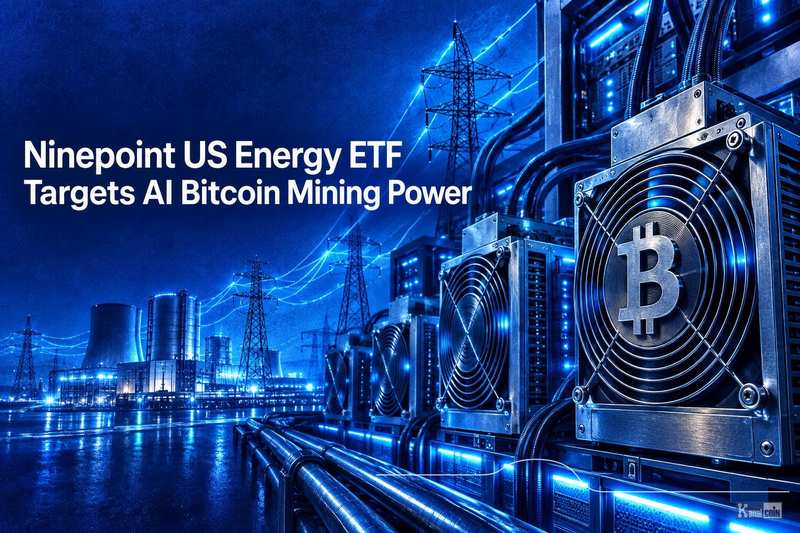
Canadian asset manager Ninepoint Partners has launched a US-focused energy ETF, entering a sector where artificial intelligence data centers and Bitcoin miners are locked in direct competitio
Canadian asset manager Ninepoint Partners has launched a US-focused energy ETF, entering a sector where artificial intelligence data centers and Bitcoin miners are locked in direct competition for the same finite electricity supply. The fund targets the infrastructure underpinning two of the fastest-growing power loads in North America, a dynamic increasingly relevant to Southeast Asian investors tracking global crypto mining and AI infrastructure plays.
A fund built around the power bottleneck
Ninepoint's new ETF centres on US energy producers, utilities, and related infrastructure at a moment when electricity demand is accelerating from two distinct technology sectors. AI data centres and Bitcoin mining operations both require continuous, large-scale power access, and both are expanding capacity at a pace that strains available generation and transmission networks. For related coverage, see Bitcoin Hits $86,000 as Fed Index Shows Elevated Leverage.
The fund's launch positions Ninepoint to capture investor interest in the companies that sit upstream of this competition: the generators, grid operators, and fuel suppliers that profit regardless of whether AI or crypto wins the race for available megawatts. Specific holdings, management fees, and the fund's formal mandate have not been confirmed from official materials and should be verified directly with Ninepoint before treating any third-party summary as authoritative. For related coverage, see White-Hat Hackers Route Bitcoin From Coldcard Exploit to Recovery Trust.
AI and Bitcoin miners compete for the same power
AI workloads, particularly large-model training and inference, require dense clusters of GPUs running continuously, making power availability a primary site-selection constraint for hyperscale operators. Bitcoin mining carries an equally direct relationship with electricity: miners must secure cheap, reliable power to remain profitable, and operations frequently relocate or shut down based on regional energy pricing and grid access. For related coverage, see Bitcoin Breaks Above $85,000 as Crypto Liquidations Hit $747M.
This overlap creates a genuine supply conflict. A new data centre campus and a large Bitcoin mining facility competing for capacity on the same regional grid face the same bottleneck: insufficient generation or transmission headroom. Energy companies that can supply both, or expand capacity to serve the broader demand wave, occupy a strategically advantageous position that Ninepoint appears to be targeting with this product.
For Southeast Asian investors, this tension has regional echoes. Countries including Malaysia, Kazakhstan, and parts of Southeast Asia have attracted Bitcoin mining operations precisely because of lower electricity costs, and AI infrastructure investment is now following similar incentives into the same corridors. How domestic regulators and grid operators respond to competing industrial power demands will shape the investability of local energy assets in the same way Ninepoint is wagering it will in the US.
What investors should verify before acting
The ETF's relevance as an AI or crypto mining proxy depends entirely on its actual holdings and mandate. An energy fund weighted toward natural gas producers carries very different risk from one concentrated in independent power producers or nuclear developers. Investors should confirm the fund's index methodology, expense ratio, and geographic or sub-sector exposures from Ninepoint's official product documents before drawing conclusions about its exposure to either AI or Bitcoin mining tailwinds.
Broader ETF investor activity in crypto-adjacent markets has grown significantly in 2026, with products linking digital assets to traditional finance drawing sustained institutional attention. Ninepoint's energy ETF extends that convergence further into the physical infrastructure layer, at a time when institutional appetite for Bitcoin-linked investment vehicles remains strong. Regional exchanges such as Indodax and Tokocrypto have yet to offer direct exposure to energy infrastructure ETFs of this kind, leaving Southeast Asian retail investors reliant on international brokerage access to participate in the theme.
The fund's timing reflects a structural shift: the energy needs of the digital economy are now large enough to move commodity markets and attract dedicated institutional capital. Whether Bitcoin miners or AI operators ultimately capture the greater share of available US power capacity, the companies supplying that power are positioned to benefit from both, and that is the bet Ninepoint is asking investors to consider.
Additional source references: source document 1, source document 2.
Disclaimer: This article is for informational purposes only and does not constitute financial or investment advice. Cryptocurrency and digital asset markets carry significant risk. Always do your own research before making decisions.
Read original article on kanalcoin.com