The U.S. Securities and Exchange Commission (SEC) and Commodity Futures Trading Commission (CFTC) have filed separate civil lawsuits targeting Goliath Ventures and its founder Christopher Del
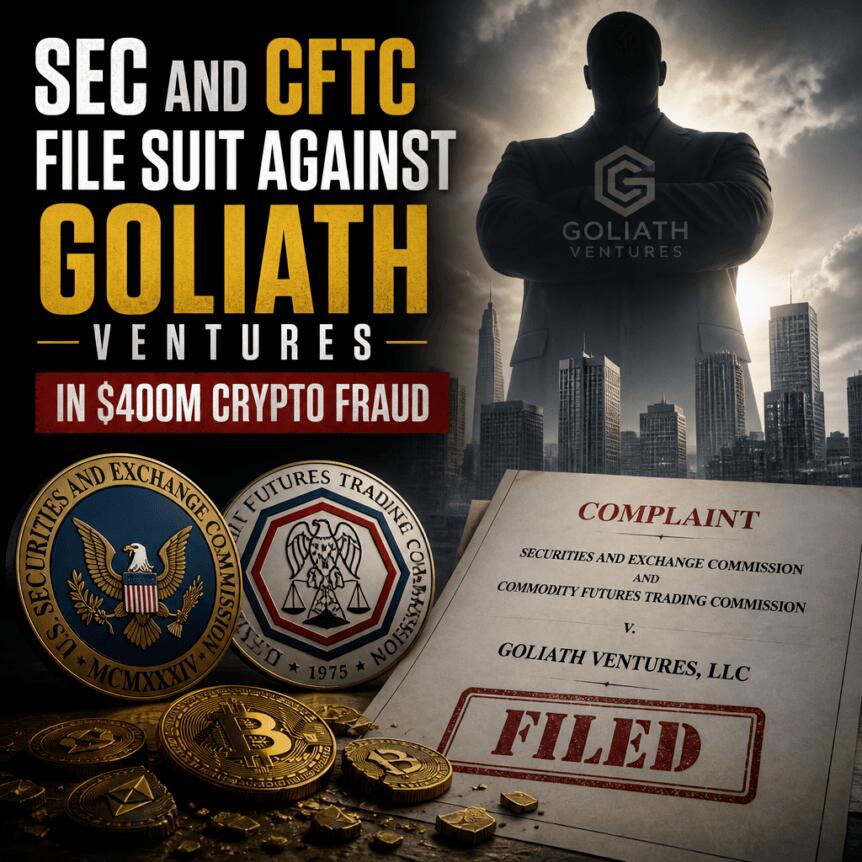
The U.S. Securities and Exchange Commission (SEC) and Commodity Futures Trading Commission (CFTC) have filed separate civil lawsuits targeting Goliath Ventures and its founder Christopher Delgado, alleging conduct consistent with a crypto Ponzi scheme that raised hundreds of millions of dollars from investors.
The SEC’s action focuses on an alleged unregistered securities offering totaling at least $425 million from more than 1,300 investors, while the CFTC says roughly 1,600 customers contributed about $397 million tied to solicitations for crypto trading in Bitcoin and Ether. The agencies are seeking remedies that include restitution, disgorgement, penalties, and permanent bans—expanding potential consequences beyond a parallel criminal case already moving through the courts.
Key takeaways
- The SEC alleges Goliath raised at least $425 million via an unregistered offering and that investor funds were not invested as promised.
- According to the SEC, Delgado allegedly diverted at least $51 million for personal use and allegedly fabricated account balances and performance reporting.
- The CFTC alleges about $397 million came from approximately 1,600 customers after solicitations connected to crypto trading in Bitcoin and Ether.
- Both civil suits add securities and commodities-law enforcement actions, potentially enabling broader investor compensation and market bans than the criminal plea alone.
- Delgado has agreed to a bifurcated settlement in the SEC case that would impose permanent bars, pending court approval and final determinations on financial penalties.
SEC: Alleged unregistered offering and diverted investor funds
In its complaint, the SEC said Goliath collected at least $425 million from more than 1,300 investors through what it characterized as an unregistered securities offering. The agency alleged that investors were told their money would be placed into crypto liquidity pools, but that “none” of the funds or crypto assets were actually invested in the manner represented.
The SEC further alleged that Delgado diverted at least $51 million for personal use. The SEC also said Goliath used funds and crypto assets from new and existing investors to make earlier payments—an arrangement the agency characterized as inconsistent with the investment strategy sold to participants.
According to the SEC, Goliath promised monthly returns ranging from 3% to 10% and guaranteed investor principal, claiming the returns were generated from fees paid by traders using its liquidity pools. The SEC alleges that, in reality, the company made payments by recycling investor money and fabricated account balances and performance metrics to support the scheme.
The SEC also alleged that commissions were paid to sales agents who recruited investors. The agency said the business eventually faltered after it could no longer raise funds quickly enough to meet obligations, stopped making monthly distributions, and collapsed—an outcome the SEC said came after the company’s operations turned unsustainable.
CFTC: Commodities-law claims tied to Bitcoin and Ether trading solicitations
Separately, the CFTC said Goliath solicited funds for crypto trading in Bitcoin and Ether, attracting approximately 1,600 customers and at least $397 million. The agency’s complaint positions the conduct within commodities and trading enforcement frameworks, seeking consequences aimed at restoring losses and preventing continued market participation.
In its civil action, the CFTC is seeking restitution, disgorgement, civil penalties, trading and registration bans, and a permanent injunction. While the SEC case centers on alleged unregistered securities and the handling of investor capital, the CFTC action reflects the regulator’s view that the underlying promotional and trading-related representations also triggered commodities-law concerns.
Delgado’s SEC settlement and what it does—and doesn’t—end
In the SEC matter, Delgado agreed to a bifurcated settlement, subject to court approval. The deal, as described by the SEC, would permanently bar him from violating the securities-law provisions charged in the complaint. It would also restrict him from participating in securities transactions outside personal-account activity and from associating with a broker or dealer.
The settlement leaves key financial components to be determined by the court, including disgorgement, prejudgment interest, and a civil penalty. In practice, this means the case can still produce significant financial exposure, even as certain legal and behavioral restrictions are agreed in principle.
Delgado is also tied to a criminal resolution. The article notes that he previously pleaded guilty to conspiracy to commit wire fraud, wire fraud, and money laundering. The U.S. Department of Justice has said that at least $400 million was paid to Goliath and that Delgado admitted causing at least $250 million in investor losses. The DOJ further stated that forfeiture was part of the agreement, covering properties, vehicles, luxury goods, bank accounts, and crypto wallets traceable to the scheme.
These developments underscore why the SEC and CFTC actions matter: civil proceedings can pursue investor-focused remedies and broader prohibitions that may not be fully addressed through a plea deal alone. Together, the cases give regulators additional tools to seek compensation, impose penalties, and limit future access to regulated markets.
Why the paired SEC and CFTC cases signal a tougher enforcement stance
Running parallel civil actions under two different federal agencies is notable because it reflects a broader pattern in crypto enforcement: regulators are increasingly willing to frame the same promotional conduct through multiple legal lenses—securities and commodities—depending on how the offering and trading-related representations are structured.
Here, the SEC’s allegations emphasize return guarantees, alleged principal protection, and promised placement into liquidity pools—elements the agency says were used to attract capital under an unregistered offering. The CFTC’s allegations, meanwhile, tie customer solicitations to Bitcoin and Ether trading, supporting its request for trading-specific bans and other restrictions.
For investors watching these cases, one practical takeaway is that “getting the money back” often depends on how quickly courts move on disgorgement, restitution, and related orders. Another is that criminal outcomes do not necessarily close the door to civil enforcement: as the regulators seek permanent injunctions and long-term participation restrictions, the civil cases can continue to shape who is barred from markets even after criminal resolution.
Next, investors and observers will likely focus on court approval of the SEC settlement terms and the final rulings on disgorgement, interest, and penalties, along with how the CFTC case progresses toward relief such as restitution and permanent bans.
This article was originally published as SEC and CFTC File Suit Against Goliath Ventures in $400M Crypto Ponzi Case on Crypto Breaking News – your trusted source for crypto news, Bitcoin news, and blockchain updates.