There is a moment in every technological cycle where something gets built that doesn't quite fit the vocabulary of its time. Not a coin. Not a farm. Not a DAO with a Discord full of promises.
There is a moment in every technological cycle where something gets built that doesn't quite fit the vocabulary of its time.Not a coin. Not a farm. Not a DAO with a Discord full of promises.Something quieter. Something that just runs.That moment is happening right now on Ethereum. Most people haven't noticed yet. And by the time they do, the machine will have already been working for months.
What Is a Ghost Protocol?In intelligence, a ghost protocol is a mission that runs without authorization, without a handler, without anyone to call if something goes wrong.No oversight. No recall. No off switch.You build it, you walk away, and it operates in the dark.That's the only honest way to describe what just launched on Ethereum.It's called Vortex. And it may be the most structurally interesting thing to happen in DeFi since Uniswap v3 rewrote the rules of liquidity.
The Problem Nobody Talks AboutEvery liquidity protocol in DeFi has the same dirty secret.When price moves away from a range, the liquidity sitting there goes idle. It stops working. It just waits. Capital with nowhere to go, earning nothing, doing nothing.LPs hate it. Protocols live with it. Everyone accepts it as the cost of doing business.Vortex looked at that idle capital and asked a different question.What if it kept working?
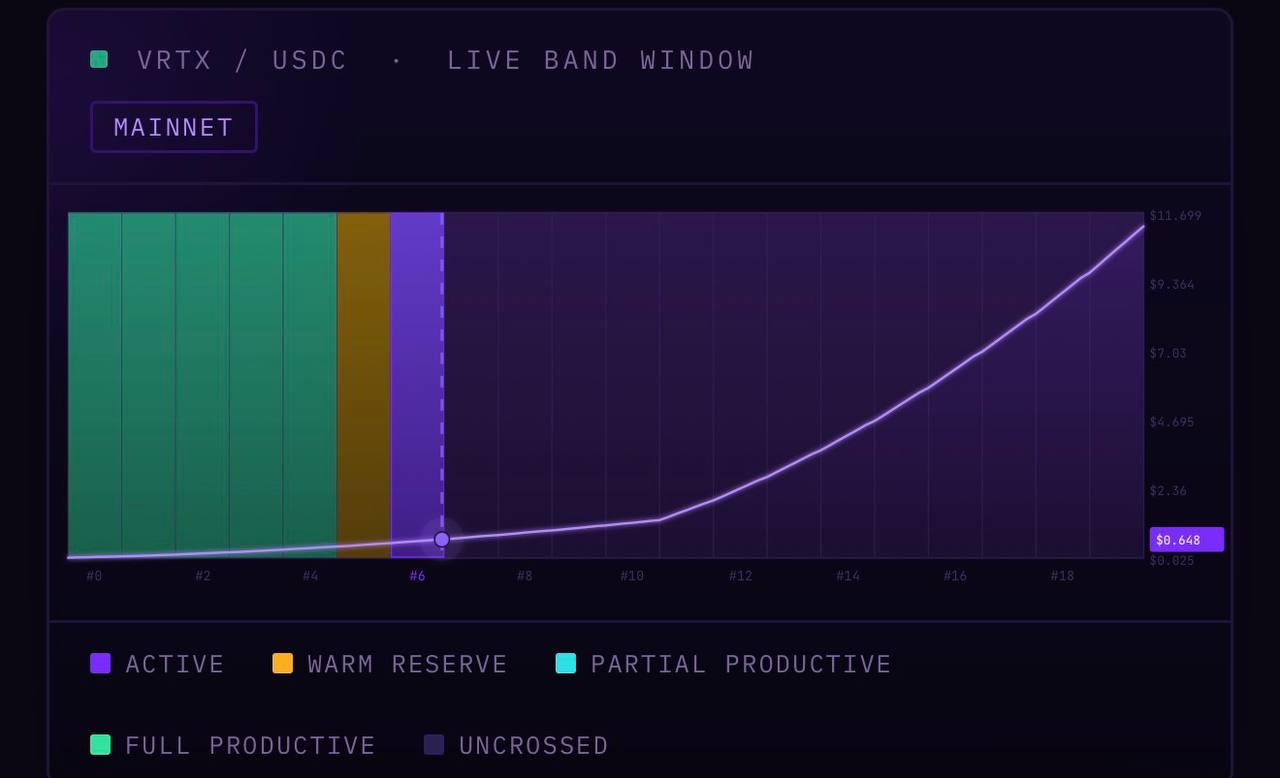
How the Machine Actually WorksVortex distributes its entire fixed supply of 1,000,000 tokens across 100 protocol-owned liquidity bands on a custom Uniswap v4 hook-managed pool.Each band is a programmed zone. Early bands are narrow and token-dense, easy to move through. Later bands widen progressively, requiring deeper demand to cross. The further you go, the harder it gets to move.Here's where it gets interesting.Every time a band gets crossed, every time buyers push price through one of those zones, the USDC on the other side doesn't go to a team wallet. It doesn't go to VCs. It doesn't disappear into a multisig somewhere.It locks. The protocol captures it. And then it puts it to work.That captured USDC gets deployed into Aave lending markets. The yield that comes back from Aave gets used to buy the token on the open market and burn it permanently. Meanwhile a second engine runs in parallel, routing swap fees into Ethena's sUSDe, staking them, harvesting that yield, and feeding it back into the same burn loop.Two independent yield engines. One permanent outcome. Less supply. Always.There is no other destination for that money. The protocol has no owner to redirect it.
The Band That Never SleepsMost protocols have a warm reserve problem. When price retraces, there's nothing left to restore liquidity with because the capital was already spent.Vortex solves this with a warm reserve system.The nearest crossed band always stays liquid. Immediately recallable. If price drops back, that reserve restores the band with zero lag and no governance vote required.Nobody has to approve it. Nobody has to call anyone.The hook manages it. Automatically. Every time.
No Owner. No Governance. No Off Switch.This is the part that separates Vortex from everything else claiming to be decentralized.There are no admin keys. The core parameters, supply, band structure, fee splits, burn thresholds, deployment rules, are fixed. Nobody can change them. Not the team. Not a DAO. Not a governance vote.The protocol is immutable by design. Not by promise. By architecture.This is not a team telling you to trust them.This is code that removed the option entirely.
What 100 Bands Actually MeansThink of it like a staircase built into the price curve.Discovery phase covers the first 11 bands. Narrow. Token-dense. This is where price finds its footing and the market establishes demand. Maximum USDC depth across this phase sits at 165,000 USDC.Expansion phase is the next 30 bands. Wider steps. Each zone requires more buying pressure to cross, while continuing to convert that pressure into productive reserves.
Acceleration phase is the final 59 bands. These are the widest steps of all, with USDC intervals scaling from 150,000 all the way to 300,000 per band. Supply gets genuinely scarce here. Crossing these bands requires serious, sustained demand.Total maximum USDC depth across all 100 bands: 14.365 million dollars.The machine gets harder to run the higher it goes. But it never stops running.
The Part That Should Shock YouHere is the thing most people in DeFi aren't ready to hear.Every protocol-owned liquidity system built before this one treated reserves as defensive capital. Something to protect price. Something to use if things go wrong.Vortex treats reserves as offensive capital.It takes the USDC that accumulates as buyers move through bands and turns it into a permanent yield-generating balance sheet. That balance sheet funds a buyback and burn loop that operates indefinitely, regardless of whether anyone is buying at any given moment.Even in a sideways market, the machine is still burning.Even in a bear market, if there's any yield coming from Aave or Ethena, the engine is still reducing supply.It doesn't need momentum to function. It just needs time.
The Ghost RunsTwo days after launch, the protocol had already deployed tens of thousands of USDC into Aave. The burn queue was building. The Ethena treasury engine had activated.No announcement. No hype campaign. No influencer calls.The dashboard just showed the numbers moving.That's the thing about a ghost protocol. You don't hear it coming. You just check the chain one day and realize something has been working in the dark this entire time.Ethereum has seen a lot of experiments. Most of them needed someone to keep the lights on.This one doesn't.
What To WatchThe structural checkpoint at the end of the Discovery phase sits at a $1.298 USDC price per token and roughly $1.3 million FDV. That's not a price prediction. It's just where the curve's first phase ends and the architecture shifts.Watch the Aave deployment numbers on the live dashboard. Watch when the first burn executes. Watch how the warm reserve behaves during the first major retrace.The mechanics are transparent. Everything is on-chain. The dashboard shows you exactly where the capital is, what it's earning, and how close the protocol is to its next burn.You don't have to trust anyone.You just have to read the chain.vrtx.network
Vortex is live on Ethereum. The contract is verified on Etherscan. DYOR. This is not financial advice. Crypto is volatile and positions can go to zero.
Ca: 0xB4589127a468f9fea9da3c8C9e39c48Fdfd982fa