Crypto often markets itself as an open ledger where everything can be checked—yet the industry’s history is also packed with missing identities, unresolved thefts, and disappearing funds. Fro
Crypto often markets itself as an open ledger where everything can be checked—yet the industry’s history is also packed with missing identities, unresolved thefts, and disappearing funds. From Bitcoin’s origin myth to high-profile exchange collapses and personal stories tied to key loss, the biggest mysteries endure not because they’re unobservable, but because the answers remain incomplete.
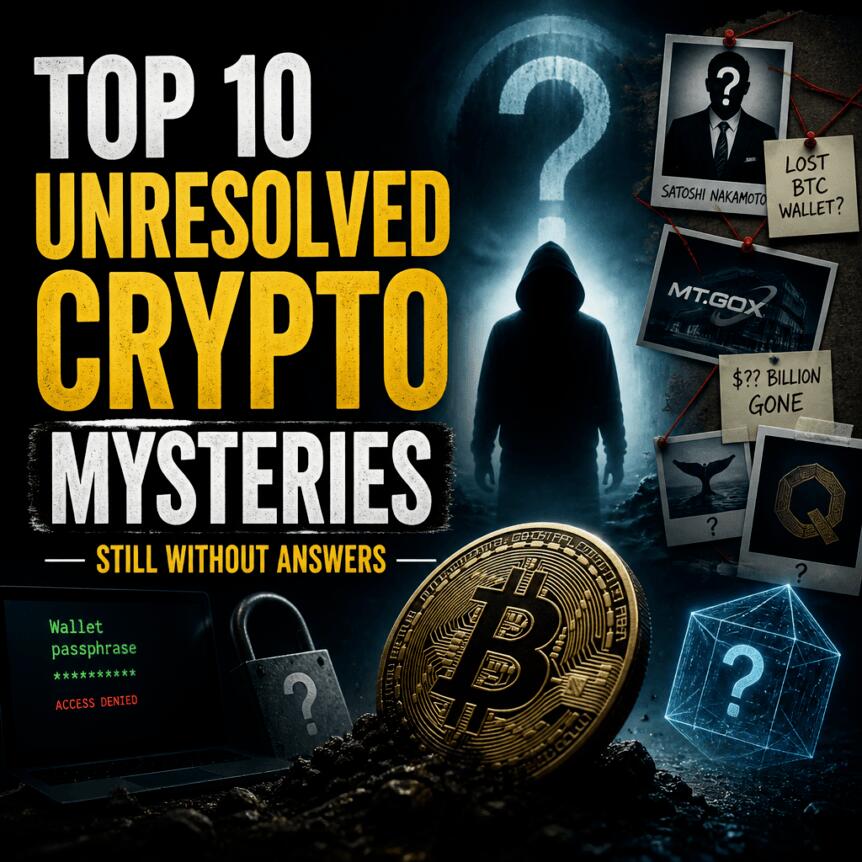
A recent roundup highlights ten lingering questions that still lack definitive resolution—from “who” authored Bitcoin’s earliest work to “where” certain assets ultimately went. Even when investigators trace portions of movements, the full picture is often still out of reach.
Key takeaways
- Satoshi Nakamoto remains unidentified despite major investigative claims, including a prominent 2026 New York Times report naming Adam Back as a leading candidate.
- Early Bitcoin holdings are still partly unexplained, including the “Patoshi” miner theory and the unknown remainder of funds tied to Mt. Gox.
- FTX’s alleged post-bankruptcy theft was reported at roughly $415 million, yet the perpetrator’s identity is still not established in the public record.
- Several mysteries involve key access rather than lost chains: cases like James Howells show that Bitcoin can remain on-chain even when keys are unrecoverable.
- Some stories intertwine with criminal allegations, such as QuadrigaCX, OneCoin’s Ruja Ignatova, and the unresolved circumstances around Nikolai Mushegian’s death.
Bitcoin’s origin stories still don’t add up
The most famous mystery—who created Bitcoin—dates back more than 17 years. The Bitcoin white paper was published in 2008, the genesis block was mined in January 2009, and the figure associated with the “Satoshi Nakamoto” name appeared active in early development before vanishing from public view around 2010.
Over the years, investigators and writers have circulated numerous candidates, ranging from cryptographers to early developers. In April 2026, The New York Times published an investigation that put British cryptographer Adam Back forward as its leading candidate, citing similarities in writing, shared cryptographic interests, Back’s work on Hashcash (which is referenced in the Bitcoin white paper), and other circumstantial connections. Back has denied the allegation.
Other notable claims have included Peter Todd and Hal Finney among historical suspects, and Craig Wright as a self-proclaimed creator who was reportedly ruled by a UK court not to be Satoshi. There are also fringe theories, including online speculation tied to newly released Epstein files; however, the article notes there is no credible evidence supporting the claim that Jeffrey Epstein was Satoshi.
From “Patoshi” to Mt. Gox: missing coins and partial answers
Another early-epoch Bitcoin mystery focuses on who mined a large stash attributed to a single operator. In 2013, blockchain researcher Sergio Lerner reportedly discovered a pattern in how the earliest blocks were mined and linked it to a miner he later dubbed “Patoshi.” Lerner estimated the holder controlled about 1.1 million BTC across roughly 22,000 blocks, making the entity—if the theory is correct—one of the largest Bitcoin holders. The account remains unproven, but it is presented as one of the strongest analytical links connecting early mining behavior to the era’s most influential identity, whether or not that identity is actually Satoshi.
Mt. Gox’s collapse remains another unresolved case with real-world consequences. When the exchange failed in February 2014, it initially claimed around 850,000 BTC had disappeared. Later, Mt. Gox reportedly found about 200,000 BTC in wallets it previously believed were empty. What happened to the rest is still unclear.
Even after more than a decade, creditors have begun receiving some returns, but the “missing” portion hasn’t been completely accounted for. The article references investigative claims and allegations tied to hacking and laundering, including US prosecutors’ assertions that Russian nationals stole and laundered about 647,000 BTC. Yet the broader question—who took the coins, how and when it occurred end-to-end, and where all remaining funds ended up—remains unanswered in full.
Exchange collapses and “missing keys” shape modern crypto mysteries
Some mysteries are about crime; others are about custody and control. The QuadrigaCX story, for example, turned on the claim that founder Gerald Cotten died in December 2018 and left the exchange unable to access customer crypto because private keys were allegedly unrecoverable. A later investigation by the Ontario Securities Commission reportedly concluded that Cotten transferred millions of client funds to personal accounts and used client assets to cover trading losses and expenses.
That finding reframed the mystery from “lost keys at the bottom of a grave” to an account of internal misuse—though it still leaves room for questions about the exact mechanics of the transfers and what, if anything, could have been recovered earlier.
Similarly, the disappearance of large sums after the FTX bankruptcy filing continues to be discussed as an open question of responsibility. After FTX filed for bankruptcy, digital assets began leaving the company’s wallets. According to reporting cited in the piece, about $415 million in crypto was reported stolen. US authorities later seized hundreds of millions in assets linked to the case, and investigators have traced parts of the movements. However, the article emphasizes that the attacker’s identity has not been publicly resolved.
Personal disappearances and “forever on-chain” losses
Not every mystery involves purely technical puzzles. The FBI still lists Ruja Ignatova, founder of OneCoin, as a top fugitive. According to the article, the FBI says the scheme defrauded victims worldwide of more than $4 billion and offers a reward of up to $5 million for information leading to arrest and conviction. Ignatova disappeared after traveling in October 2017, was added to the FBI’s Ten Most Wanted list in 2022, and the FBI maintains she remains at large, describing her as “well-funded” and “well-connected” in a later update.
Other cases show how crypto can make mistakes permanent in a different way. Welsh IT worker James Howells is tied to a long-running attempt to recover a hard drive containing Bitcoin keys. The article says Howells insists the drive ended up in a landfill and that he pursued excavation plans for years, though a High Court judge ruled in January 2025 that he had no realistic prospect of succeeding. The Bitcoin itself, importantly, is still present on the blockchain—accessible only if the keys can be found—illustrating a central tension in self-custody: the ledger may be transparent, but the ability to spend depends on the private keys.
In the DeFi era, the DAO hack from 2016 also remains unresolved. The article describes how an attacker exploited a vulnerability in The DAO’s smart contract to siphon more than 3.6 million ETH into a child DAO before the attack stopped. The attacker was never identified. A later claim by Laura Shin connected the attacker to Austrian programmer Toby Hoenisch, but he denied it and reportedly was never charged. The event reshaped Ethereum’s development and helped set the stage for Ethereum Classic, underscoring how disputes about immutability and governance remain practical—not just philosophical.
Finally, the piece includes a mystery tied to the death of early MakerDAO developer and Balancer co-founder Nikolai Mushegian. He was found dead off Condado Beach in Puerto Rico in October 2022, and local police said strong currents were responsible. But the article highlights that Mushegian had posted alarming messages on Twitter shortly before his death, warning of a possible assassination and alleging involvement by intelligence agencies and others. The Puerto Rico Justice Department reportedly investigated for almost a year and determined no criminal involvement. Still, his online warnings leave unanswered questions about what happened in his final hours.
When funds move to “burn” addresses, the trail can still go cold
Some mysteries are deliberately designed to end the path to recovery. In May 2026, the article says someone sent 107 BTC (reported as worth about $8.5 million at the time referenced) to a Bitcoin address from which the coins were rendered unspendable—effectively destroying them. It also notes that the coins had been acquired around 2014 when Bitcoin traded below $600, making the timing especially unusual given later price appreciation.
The article adds a further complication: one of five wallets reportedly sent about 20 BTC—around $1 million—to what appeared to be a large crypto custodian in March, with roughly the same amount returning three weeks later before the 107 BTC were ultimately burned. The sequence suggests interaction between multiple entities, but without a verified explanation, the motive remains speculative.
For readers, the common thread is that crypto’s transparency doesn’t automatically produce certainty: transactions are visible, but identities, intent, and final custody often remain obscure. The next developments to watch are the cases where authorities, auditors, or on-chain investigators can connect partial traces into complete narratives—especially for large losses where public reporting ends before accountability does.
This article was originally published as Top 10 Unresolved Crypto Mysteries Still Without Answers on Crypto Breaking News – your trusted source for crypto news, Bitcoin news, and blockchain updates.